Lots of cultural heritage institutions have these kind of services for historical pictures, often with very liberal Creative Commons licensing (or Public Domain). Your own Library of Congress[1] is a fantastic example. In Europe you can get a hint of what's out there via Europeana[2]. Flickr Commons[3] is also a good resource. If you are looking for contemporary pictures, Wikimedia Commons[4] and Flickr[5] is great.
When it comes to Unsplash I feel a bit skeptical[6]. I don't share every sentiment expressed in that post, but essentially I think they've stripped away many of the pros that made it a win/win for both photographers and users. I would much recommend trying to establish Wikimedia Commons as a platform. At least it offers a license with attribution as an option for their contributors.
It's really a shame that it simply gives you the original files, not allowing very high res images (ie greater than 10.000 x 10.000). We built a tool for this that's being used by for instance Rijksmuseum and Van Gogh Museum http://www.vangoghmuseum.nl/ , which allows for ultra-res images. The Met should also consider using http://micr.io/ or any similar technology.
Ofcourse the huge volume is great, it's awesome! But by only offering single high-res .jpg files instead of image tilesets just makes the viewing experience less than pleasant.. Downloads are slow, the pages are unresponsive, and I can imagine it's going to cost them tons of unneeded bandwidth.
I agree that "deep zooming" is desirable. Looks like Micrio doesn't support the International Image Interoperability Framework [0], something I think a museum would be interested in. Oh, and I hate that http://micr.io uses a fullscreen background image that highjacks the scroll wheel.
Thanks for your reply, you're right about that. Currently we've only been developing micr.io based on wishes we received, that includes features such as hotspots, tours, etc. See https://tuinderlusten-jheronimusbosch.ntr.nl/en for its first release. We simply haven't had the time yet!
Unless you have a really big monitor, like 40" or so, nothing compares to the real thing. I once saw a Rothko and my jaw dropped to the floor. The thing was so imposing, not only the theme was captivating but the sheer size of the picture made it look grandiose in every sense. The same goes for Pollock's artworks, some Picassos and so on.
I have a friend that works at the Met, and (with management's permission of course) was able to get me into the modern wing during a time it was being renovated. It was just incredible, being able to sit in front of such giant paintings in peace.
If you stand as close as you can to a Rothko (with your knees practically touching the velvet rope barrier), and stare for a while it just completely envelopes your eyes. The colors take over your entire field of vision and you can really get lost in them, and just "feel" the painting. You can't really do that otherwise without someone asking you to please move. The Pollocks were my favorite, but it's all incredible. It definitely became my favorite type of visual art after that and I will always visit the Met and MoMa when in town.
Edit: Unfortunately, seems like none of those are public domain, so only low resolution images are available.
It's more noteworthy that very small works can be easier to study on screen, and then there's obviously the advantage of a total absence of contention for the physical space directly in front of the print/painting.
Rothko's works are often installed in "environments" like at Tate Modern or in Houston. Many people can experience them at the same time and there's not much to be gained from closing in to six inch viewing distance. They're works of the movie age.
On the other hand, the situation with a Durer print or some other delicate miniature image is really helped by digital distribution. For 3D artifacts, being able to orbit them in a viewer is another good thing that we'll probably see more of. Lightfields, even.
Rothko is an interesting case for digital reproduction because his work is all about aura and atmosphere but, technically, his work is not exactly impossible to fake. Is his work really spiritual or maybe a bit bogus, for that reason of being grandiose and imposing yet also "easy"?
Best argument, I think, in favour of Rothko and the like is the idea that "what's difficult is not to make something, but to put oneself in a state conducive to making." (Brancusi)
How different complex, technical software engineering is to the simplicity of even the most elaborate painting/sculpture...
> Unless you have a really big monitor, like 40" or so, nothing compares to the real thing
I disagree; simply, "nothing compares to the real thing". But I can't have the real thing right here, so a large hi-def monitor is better than nothing.
EDIT: If I sell a 40" monitor displaying a high-res Van Gogh - will the price compare to the real thing? (Sorry, couldn't resist.)
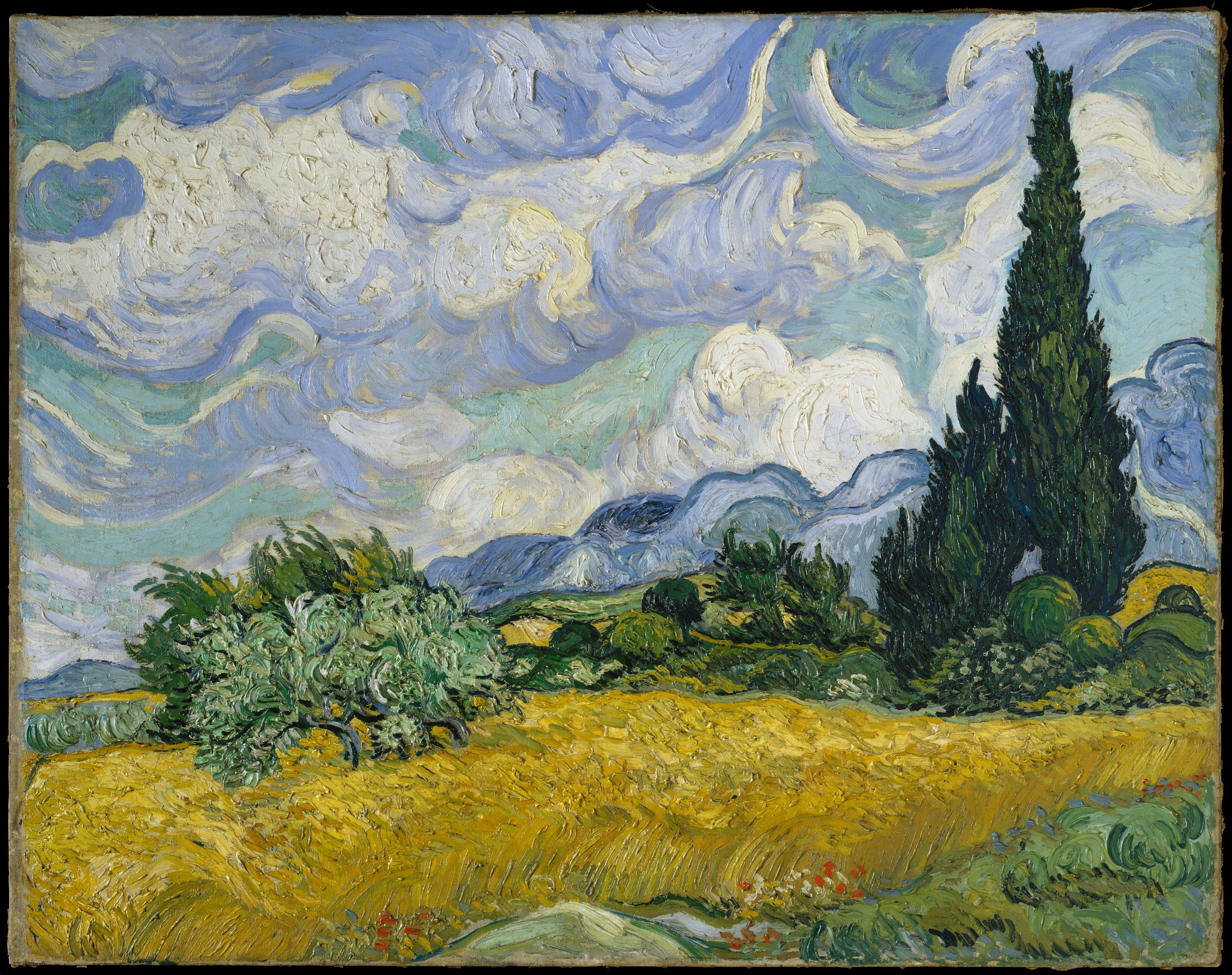
This. No 2D image of most of van Gogh's paintings can match the real thing because the 3D texture of the paint is such an integral part of the experience. I discovered this when I visited the van Gogh museum in Amsterdam. The 2D representations look lifeless to me now that I know how much more visceral the paintings are when viewed in real life.
Am not someone who can claim to "get" art. Is there some description someplace that will help interpret the work of art - for the one you've linked to, for example?. A background of the context perhaps?
A simple starting point for contemplating any art is to ask yourself the questions:
What is the artist trying to say?
Have they said it well?
Was it worth saying?
These are of course highly subjective. Your answers may be very different from those of others and even from the artist themselves. And that's fine.
These questions can also springboard your curiosity if you allow it. What was the artist trying to say? How can I tell? What can I read to help understand the context within which the artist was working? This can be a lovely, deep, rich contemplation if you choose. You can set your own pace, and decide when you have had your fill.
An economist once argued that it would be worthwhile for museums to sell the bottom 1% of their collections (stuff that's destined to moulder in the archives and would never be displayed anyway) and set up trusts that would fund free admission. Then, people would feel freer to visit for just an hour and enjoy small tastes of art more frequently.
(Unfortunately, selling anything is taboo in the world of art museums. This plan "can't" happen.)
Most museums offer annual memberships that are only 2-3x the cost of a single day ticket. I used to live within walking distance of MoMA and it changed my experience of art to be able to wander up and linger on a single piece or exhibit for long periods without worrying about "doing it all" in one day.
Strongly recommend getting memberships to your local museums!
(All IMHO, and sorry if it states things you already know:) I 'get' art, and I'll say that 'getting' art is a misunderstood, over-emphasized concept. Find works that move you, that challenge your perspective. Who cares what everyone else thinks or likes? Find your art. Art is in the eye of the beholder; don't worry too much about the artist's intentions - they lost that control once they put it on paper - what does it mean to you, as it is right there at that moment? Art isn't some secret code that needs decoding; it is what it is, to you. Just to get your mind working on it; here are some questions to ask yourself and tips:
* How does it make you feel? To really grasp art, bring the emotional part of you to bear - it's more far effective than the rational side in this regard. Then try to articulate it (which ties in the rational side). If I can't seem to get traction then I just think 'how do I feel?' - not even how does the object in front of me make me feel, but just 'how am I feeling?' - and often, presto, everything comes into focus.
* Unlike real life, nothing in a work of art is accidental or gratuitous (unless it's intentionally that way!). Why is that red line there? What would a different red look like? A much thicker line? A less opaque one? Rotated 90 degrees? Or, why is it set on a sunny afternoon? What if it was cloudy? Nighttime? Moonlight and stars?
* Often the most powerful question: What are the assumptions behind image in front of you? What didn't they paint (or sculpt, etc.)? If it's a Renior of nudes by a stream, the painting assumes there is beauty in pink flesh, in nature, a relationship between those two things, and it assumes there is no shame in it, no danger, but something positive.
If a work of art makes me uncomfortable, that's a great starting point - what is making me uncomfortable? It's just an object; it can't do me any harm or do anything at all. Often the works that make me most uncomfortable at first - the ones I hate - are the ones that I love the most in the long run. The ones that bore me are the worst.
Reading a book on art history can help you understand a lot of the context behind and specific images in the art (X was a big issue at the time, or image Y represented something in that culture), but IMHO it is much more valuable to read later, to learn something that enhances your burgeoning art appreciation rather than to learn about something you aren't familiar with in the first place. Just find what you love.
Perhaps this has already been done, but I'd be fascinated to see randomised controlled trials to test peoples enjoyment of art under different priming conditions, e.g. true/fictitious/absent information around description/background/value, social proof like crowds around particular pieces, etc.
It may seem obvious, but for those who haven't tried it: The effect of high-res great art on a high-res luminescent screen can be magical. It puts all those other desktop backgrounds to shame - instantly revealing how incredible some of these images are. Make one your desktop background.
I displayed the Hermitage painting collection on a secondary 30'' monitor, set to rotate at 5 minutes. A key factor was that I had the titles watermarked on the images otherwise I would have been frustrated to see something beautiful that I don't know the name of.
Had this setup for a couple of years, and watched lots of beautiful paintings. My purpose was to submerge my visual perception into art for a long time and just let my artistic perception develop organically.
There's many ways to skin that cat - assuming Unix, immediate options include:
the images are stored locally, you have some mapping from filename to title, and you create new images with watermarks using ImageMagick in a bash script
or the images are hosted online, and you write a small C/Python/whatever code that gets the URLs and associated titles from the host, and then uses Imlib2 (maybe with some wrapper) to display the images with titles rendered as text composited on top
Yea I was trying to find a way to do it with code that's by default shipped on the mac. Unfortunately imagemagick is not. And the php functions to actually add text to an image are not loaded by default. Maybe I can do something by converting the images to pdfs. The speed of the program isn't an issue it just has to be completely automated.
and increase 'offset' by 100. The JSON output contains image URLs. The total number of results is 441048, so finding another endpoint that doesn't enforce a limit of 100 on the 'perPage' argument would be great.
---
EDIT: thanks to spitfare, I updated the perPage argument to 100. The site doesn't allow larger values, but that's definitely a great start! (about 4k requests to get everything)
edit: it doesn't download the highest available resolution...
This Perl script should get most of the images (but it would probably be better to save them in the original sub-directories):
    use strict;
    use warnings;
    use LWP::Simple;
    use JSON qw(from_json);

    my $url    = "http://metmuseum.org/api/collection/collectionlisting?offset=";
    my $args   = "&pageSize=0&perPage=100&sortBy=Relevance&sortOrder=asc";
    my $offset = 0;

    while ($offset < 5000) {
      my $decoded = from_json(get($url.$offset.$args));
      $offset = $offset + 100;
      my @results = @{ $decoded->{'results'} };
      foreach my $i ( @results ) {
        my $filename = $i->{"largeImage"};
        my $title = $i->{"title"};
        print "Status: ".getstore("http://images.metmuseum.org/CRDImages/".$filename,$title.".jpg")." ".$filename. "\n";
      }
    }
Can't agree more, this should be shared on torrent, it would make it more accessible.
The torrent would need to include the information on the art piece.
I just finished downloading this this morning. I've been able to look through some of it so far and there's some really fascinating stuff.
I'm particularly interested in the paintings for use as wallpapers, but there are lots of printed materials dating back to the 17th century (and probably earlier).
I'm working on pulling the images now, like I did for the Rijksmuseum CC0 dump. FWIW a good place to host that torrent is the Internet Archive - it's great for discoverability.
These images were already in the public domain surely? In the United States you don't get a copyright over a public domain work just be copying it, even if digitally. It was established by Bridgeman Art Library v. Corel Corp. in 1999.
Yes, these images were already in the public domain. It was, however, not easy to find high resolution digital images of them online. This move is about making those images easily available on their website.
They were also already available on the website in high resolution, many of them since 2011. The difference this time is the CC0 licensing, I'm pretty sure.
A lot of people are confused about the licensing of museum images and why it's news that a major museum is releasing them CC0 when they're already public domain. I see some good thoughts here--e.g., absolutely there is a difference between 2D and 3D images (an image of a 3D work might have sufficient additional creativity involved to support a separate copyright), and yes, the Bridgeman decision is a thing. But Museums have a lot more to worry about than that. E.g., there are a lot of orphan works. More importantly, there are important people they want to be careful not to offend, whether living artists, their estates, their representatives, or potential donors. In my experience, all of those groups except artists tend to be more conservative about sharing than the staff at most museums.
This is not to say that any of that trumps the law. But Bridgeman was one weird case in one weird situation and it hasn't been tested in a museum setting. What we're talking about is not whether you can legally use the image as you like, but whether the museum will willingly show you the image. By 2011, the tide had turned and it was not going to be long before most/all major collections saw sharing as more valuable than hoarding. But in 2009 that wasn't the case.
The CC0 licensing assertion is simple ass-covering by the museum's lawyers. Images that are exact replicas of works of artists who have been dead for 70 years or more are in fact public domain under US copyright law no matter what license they assert, per Bridgeman.
Originality is a critical element of being able to assert copyright in a derivative work. To the extent that these are exact reproductions, they have no element of originality and the museum's assertions of license are invalid.
The story here is that you get an "official" public domain image from the museum itself, which will presumably be of technically high quality - appropriate lighting, correct focus, high res, camera plane exactly parallel to the work, camera on a tripod, etc. as opposed to the widely varying quality of the images you find on the web now - while some are technically fine, others are shot by a museum visitor with shaky hands, scanned from a photo book, etc.
You can now also find these images from a reputable, central source rather than scattered across a slew of ad farms.
Paul, you're actually going a little too far. No court case has ever shown that a "museum's assertions of license are invalid," and these are case-by-case issues. So Bridgeman may or may not apply in any given case. It could be cited as precedent for sure. But e.g. I'm pretty sure it specifically limited itself to 2D representations of 2D works.
When, in the past, good-hearted souls have scraped museum websites to construct larger images (e.g., from the old-fashioned zooming tools that only showed part of the image at a time), the museums in question stopped short of pursuing it in court for fear of just what you say. So it has not been tested (even though most thoughtful people agree with you about what would likely happen).
The Met has had (most of; maybe almost all) these images online since 2011. The licensing was unclear then--there was a hard to read, existing T&C that was more or less NC-BY-SA. Or maybe it was "no derivatives," I'm not sure. But getting the images out (hard but straightforward) without dealing with changing the license (hard and complicated) served basically 100% of the people without putting the Met at any risk.
This is now the third time in six years the Met has gotten a lot of news out of the "release" of these images. One could argue that this is not a big step, but if, in going CC0 it means they can release more images, that's a good thing. I haven't seen any report that the number of images has changed, actually. However, it does sound like they're not claiming copyright on 2D representations of 3D works in the public domain, which they certainly could do.
That only applies to 2D works if I remember right. A lot of the MET's collection is 3D. Also many countries don't recognize releasing copyright and actually do acknowledge the sweat of brow doctrine, so this would still be a big win for them. (CC0 defaults to maximum permissiveness if it isn't legally possible to relinquish one's copyright)
I'm curious about their reasoning for choosing Creative Commons Zero over the public domain. I'm fond of the public domain; I've released some of my software[0] into the public domain. Cynically, I think it's more fashionable and branded to license something CC0 than declare it public domain. Despite my cynicism, I like that they're doing this.
The article says:
> Enabled by the Museum's move to open access, we also announced today a series of major new partnerships—with Creative Commons, the Wikimedia community, Artstor . . . We'll be blogging about these partnerships in the coming weeks . . .
I suppose releasing pictures into the public domain doesn't lend itself to "major new partnerships." ;).
In some jurisdictions, you aren't actually allowed to release things to the "public domain". In many where you are allowed, there is specific language that must be used to make it binding. In some others, you can allow copying ... but you still are liable for uses of the work. So in that case you want to create something that waives the liability at matches the impact of US public domain declaration.
CC0 is just to tool to allow you to declare something in the public domain on world-wide basis that meets the standards of as many jurisdictions as possible and matches the expectations of most in the western world of what public domain entails.
If you just add a header to your software saying "I release this work to the public domain." You probably actually didn't.
I've read that on CC's website. Can you point me to some examples where US'ians (of which I am one) declared something public domain, and some country acted against someone who used the US'ians work?
even GPL has not really been tested in court (VMware case doesn't count yet), so the odds of CC0 being tested is low. however, there are (at least) two good reasons for using CC0 anyways:
1. there is arguably a chilling effect if you make up your own license. I don't know how much that applies in this case, but look at how json is being removed from Debian and has been banned from Fedora for the undefinable phrasing in its license. this leads me to
2. just because it has not been tested doesn't mean it isn't a good idea; I am not aware of anyone who has been killed by a PC falling on their head, but if I were to attempt mounting a PC on my ceiling, I would seek help rather than cobbling something I just made up. even better, if there are plans on the internet that tens of engineers have verified to be reasonable, I should use those instead of complaining that they are too "fashionable".
I think it's more that it's poorly legally defined (I'm not a lawyer).
By default copyright grants you five rights which I think last until 75 years after you die (90 for contract work if I remember correctly) [1].
- The right to reproduce the copyrighted work
- The right to prepare derivative works based upon the work
- The right to distribute copies of the work to the public
- The right to perform the copyrighted work publicly
- The right to display the copyrighted work publicly
I think the creative commons license exists to give explicit perpetual and irrevocable access to these five rights - public domain is work where the copyright has expired or was done by a public organization like the government. It's my understanding loosely saying 'I release this as public domain' doesn't give as much of a guarantee since it's not possible to give up your copyright that way - you could later argue you thought public domain meant something different.
It didn't used to be this way in the US. Copyright was retroactively extended and made default (you used to have to register to get its protection). It was originally intended to 'promote the progress of science and useful arts' with limited time monopolies as the means to do so for the public benefit. It was meant as a incentive to create - the retroactive extension doesn't follow in this context since work that already exists didn't need incentive to be created. You could also argue that it's unlikely you'd need the rights after you're dead. Today it hurts the public more than it helps.
It is possible that the Met has licensed some|many|all of the images from their authors. If so, then I would not be surprised if the terms of such licenses are grounded in copyright and while the licenses may grant very permissive usage and relicensing rights, the licensing rights are unlikely to have provisions allowing the Met to terminate the author's rights on behalf of the author as would be required to place a work in the public domain.
Creative Commons exists to avoid some complexities that come with placing work in the public domain when copyright would otherwise obtain.
CC0 is a legally formalised version of public domain, and this can be useful.
The partnerships are to get the word out and make the images readily available for use, so they do the job of spreading the works and publicising the works and the museum. Wikimedia blog post: https://blog.wikimedia.org/2017/02/07/the-met-public-art-cre... tl;dr this is actually pretty awesome, and we have a Wikimedian In Residence there to help.
I didn't know that abou the Rijksmuseum, that's very cool. Had a lot of fun spending a day there last year on vacation. Do you know if the ship models are included?
Sigh, now if only the museums would each stop reinventing the wheel regarding online virtual museum software, internal asset management, etc and work on an open source version of said apps. It's so tiresome that there isn't a decent OS app out there to handle curation, inter museum loans, virtual display of scanned assets to the public etc. everyone goes off and writes the same apps over and over and over again and never shares it. They need to get together and write one OS suite to be shared to all museums.


Some other CC0 art/photo websites I've used a lot lately:
https://pixabay.com/
https://unsplash.com/