Get a good, name brand soldering station. Yes it will cost a few hundred dollars, but it will make a huge difference in your work. The cheap-o $15 soldering irons all produce horrible results and will shatter your confidence...
Get good, very thin solder. It will be expensive ($40) but will last forever and if paired with a legit soldering iron, will make a huge impact in your abilities.
I've looked around for a good soldering station and the best thing that I could find for the price/performance is the TS100. All the other budget (sub $100) didn't have a direct heating element. In total, I probably spent about $100 to get a stand and other things needed for soldering.
I'd second the TS100. It's ~$40 (given you can find a power supply for free, laptop bricks work fine. I'm using mini photo printer power supply which I found on the street + $1 plug + $3 worth of heat resistant silicone cable).
Warms up in seconds, open source and customizable firmware, takes very little space (kind of important to me since I don't have a dedicated shed/garage for the hobby). What's not to love about it for a beginner?
Apart from reading the buttons that control the device and writing the display, a digital iron needs firmware to control the feedback loop that maintains the temperature. Digital irons generally have PID based temperature regulation, unlike the crappy analog ones that have open loop systems (some analog irons have temperature regulation, e.g. Weller's old magnetic tips, but the crappy $5 irons do not). This requires a controller to supervise, but also means the iron heats up much faster and maintains that temperature while soldering.
Other features like a temperature graph or adjusting calibration and control parameters are handy additions when you have a nice display like in the TS100. Realistically though, people aren't really writing their own TS100 firmware with the exception of a few tinkerers. What it comes with is good enough.
Can you say where you can find a TS100 for ~$40? The cheapest I'm seeing is $50-55.
Also, are there different versions you need to worry about or are they all the same? I assume you only want a "MINI TS100" vs. some of the other knock off brands.
I use a Weller W61C (80-90€), which is a soldering iron (not station) that regulates its temparature using magnetic tips. Bit of an oddball, but it works fine even for soldering most SMD stuff, and it's just delightfully simple. Just plug it in and start soldering. Takes up basically no space too, since it's just a soldering iron with no station.
For really fiddly SMD items I have a cheap hot air rework station, but I don't need it very often - mostly when I have to desolder something SMD or solder on an IC with a thermal pad on the bottom.
I could not recommend the DSO203 in good conscience, it has almost no isolation of the input channels which makes it downright dangerous.
It's nice if you only do audio or low voltage stuff but the first time you're going to point your probe at something a bit more beefy and you will let the magic smoke out (good case) or worse.
I have a $99 100w Duratech one and it's perfectly adequate, no different from the $400+ Weller ones I've used in the past.
If you're just doing a bit of soldering as a hobby, though, get leaded solder. It works so much better than the modern unleaded stuff. Just don't breathe the smoke.
>If you're just doing a bit of soldering as a hobby, though, get leaded solder. It works so much better than the modern unleaded stuff. Just don't breathe the smoke.
That is personally not the tradeoff I'd make.
Lead is a special kind of poison in that it makes you stupid before it kills you: This is especially true of children, but I don't want any of it on my adult self, either.
Note, you can also buy lead-free 'low temperature' solder, which has a lot of the same properties of lead solder, though it's more expensive.
As far as I know, many lead free solders produce more toxic smoke than leaded solder because they contain different types of flux. When soldering the leaded stuff, the lead in it doesn't get evaporated anyways. The smoke produced during soldering is mostly evaporated flux.
"don't breathe the smoke" is just generally good advice, and it definitely doesn't become less applicable if you use lead free solder.
I mean, I ain't saying you should lick either one... and yeah, I don't know how much if any lead is released into the air during normal operation, but lead is pretty seriously toxic to humans, and avoiding touching the lead as I'm using it sounds kinda difficult. The flux? yeah, that isn't any good for you either, but I don't think it's in the same category as lead when it comes to toxicity.
Agreed on not licking either! I haven't been able to find anything conclusive saying how much lead you would get in the air when soldering, but the MSDS you linked says:
> Soft soldering temperatures (<450 °C) are generally too low to generate significant amounts of metal vapors, however, metal oxide fumes/dust or flux decomposition fumes can occur.
> RECOMMENDATION:
> For frequent or prolonged soldering processes, use of a local exhaust system to avoid exposure to thermal decomposition products. For example, use fume cabinet, a hood on a flexible arm, or tip-mounted fume extraction system on the soldering iron.
So if you're only occasionally soldering up a circuit board, you stay well ventilated, and you keep the solder temperature below 450°C (my soldering iron is usually set around 280°C - 300°C) then the risk seems pretty negligible. If you take up circuit board fabrication as a career then obviously you'd take it much more seriously. I should still give unleaded solder another shot, though - maybe it's improved since last time I tried it.
>So if you're only occasionally soldering up a circuit board, you stay well ventilated, and you keep the solder temperature below 450°C (my soldering iron is usually set around 280°C - 300°C) then the risk seems pretty negligible.
I think the danger is in touching the lead directly; it's a soft metal and comes off on your hands to a certain extent, and my understanding is that some of the dross can end up as lead dust.
According to the NIOSH, just washing with soap is often not effective for removing lead from your hands,
>I should still give unleaded solder another shot, though - maybe it's improved since last time I tried it.
I'm starting to look into different formulations; I'd start with the SAC305 formulation. It's like 3.5% silver and slightly more expensive, but still cheap. and widely available.
Get either a Hakko FX888D or a Weller WES51. I personally prefer the Hakko, but both are excellent stations that cost under $150 which will serve you for years if you take care of them.
A note - soldering stations usually come with a cheap conical tip as a starter tip. Pay an extra $20 or so to buy two chisel tips: a tiny one for fine work, and a big one for larger work. The flat surface allows you to apply more heat to the joint. Take care of your tips (ie: keep them tinned, don't leave the iron on too hot, and don't scrub too hard with the brass sponge) and the tips should last a few years without trouble.
A thing to say in Weller's favour: They stock parts forever. My Weller station is somthing like 35 years old, now, still works perfectly. But someone damaged the sleeve that holds the tips in place. No problem, for a modest cost I could still buy a replacement, even though that particular part no longer fits any contemporary model of iron Weller sells. Kudos to them!
The WES51 as a solid soldering iron. You can get ones with a display readout but it's less useful than you might think. Most of the time you just set the temp and then switch tips if you need more or less heat transfer. Need to solder something large or stubborn? Using a phat chisel tip is better than upping the temp. Too hot and the rosin quickly oxidizes and turns to varnish, which prevents the solder from wetting.
Also tips, get a hooked tip, about 80% of the time it'll do the job.
YiHUA (or other genetic Chinese brand) 936B clones are plenty cheap (less than $30 shipped IIRC) and are actually quite good.
Yes, the Hakko's are really nice and quality, but the Chinese clones are honestly 'good enough' for many people. They're workhorse machines that see tons of use in their native market.
I recommend the TS100 (<$100 budget) and JBC ($300-$500 budget). After getting a decent soldering iron I never looked back. Yes its expensive, but so are the parts you destroy with the crappy $30 irons, or the frustration of soldering big copper pads and the tip cooling down in the middle of the process.
Regarding the JBC, after the initial investment, various the tips (chinese clones ~$5 or even originals ~$25) add so much incremental value to the soldering iron base for such a little extra cost.
Hakko and Weller are a solid choice, but I purchased a programmable TS100 last year and haven't looked back since. I solder a lot on drones and it's just delightful to work with: so light, quick to heat, it has an OLED screen built in, changeable tips and it's programmable. All that for under $50 there's nothing that I would recommend more.
If you're soldering for a living there are probably better suited soldering stations, but if you're just starting out: get this one.
Also: don't skimp on tin. Good quality soldering tin makes a huge difference!
buy a weller and use appropriately sized solder for the application (very thin solder sucks really bad if you are doing something like throughhole or larger parts...you will have to apply the heat longer to apply enough solder)
> The cheap-o $15 soldering irons all produce horrible results and will shatter your confidence...
I would make the opposite argument that if you can get great results from a cheap-o soldering iron, your confidence and ability will soar thereafter.
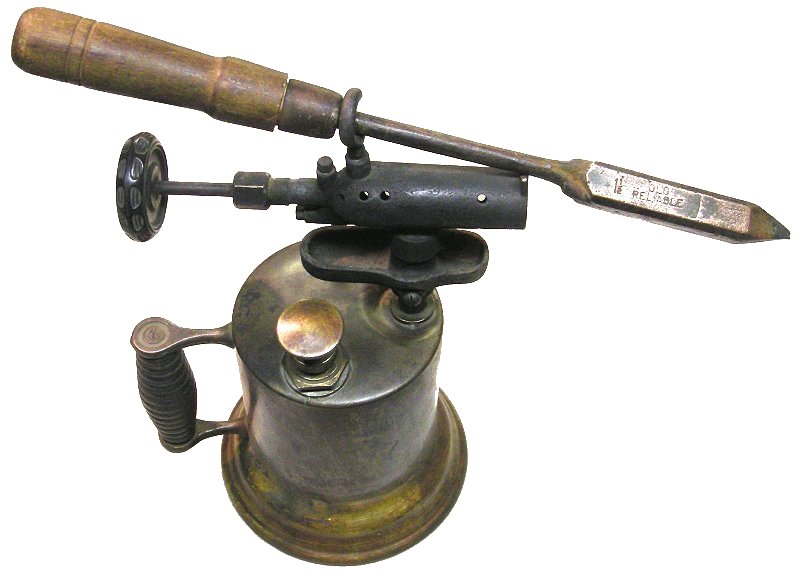
Recall that, back in the really early days, soldering irons were large affairs, consisting of a large block of copper heated via a gasoline or kerosene torch, with a large wood handle and a steel shaft:
Now granted, connections were mostly "free-air" and not PCB based or similar. Also, some of those irons were meant for soldering sheet metal, not really electronics or electrical work - but that's what people had at the time...
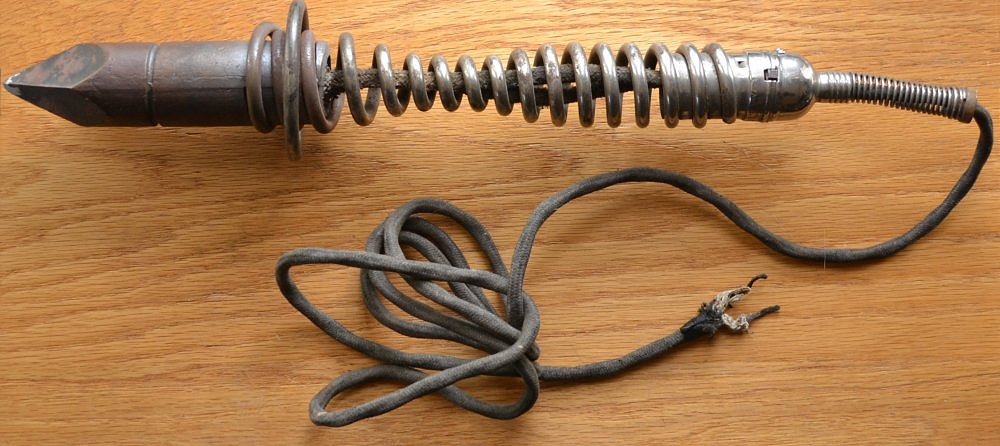
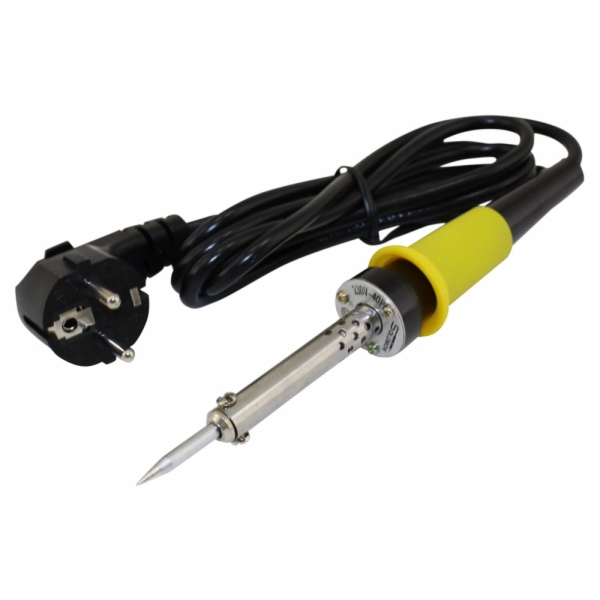
When I learned to solder thru-hole electronics, I learned with what could be called a "cheap-o" soldering iron; something like this (maybe not as nice looking):
I still have it, and still use it occasionally. It takes "forever" to heat up (about 10-15 minutes), and the tip looks like hell. But for thru-hole construction, it works great. Once you know how to use it, you can solder like a champ.
Would I use it for SMT rework? No. Basically it's virtually worthless for anything with less than 0.1" pitch, unless you're removing parts and just need to dump a lot of heat in a small area.
The key to successful soldering is knowing how to control and place the heat where you need it, and flowing the solder into the joint properly. Most make the mistake of not tinning their iron or the part leads, then trying to flow the solder using the tip of the iron, where all it does is stick the iron tip. Instead, you have to heat the component's lead(s), and flow the solder using the heat on the lead(s). Tinning both the iron and the leads helps with this as well. Flux can also help, but if you use a decent flux-core solder (preferably 63/37 ratio tin-lead), flux should rarely be needed. A paste flux is useful though for cleaning the tip of the iron, especially when shutting down for the day.
It's kinda like arc welding. Sure, MIG can be easy to learn. But if you really want to understand, start with rod (stick) first. Yeah, you'll stick the rod continuously, cussing a storm up at first. But after a while, you'll develop the knack of keeping that weld pool just right and moving the rod while feeding it in, without sticking. Once you've done that, MIG is nothing...
> I would make the opposite argument that if you can get great results from a cheap-o soldering iron, your confidence and ability will soar thereafter.
I tend to disagree, when you're learning is not the time to be fighting your tools.


> A real soldering station > Solder
Get a good, name brand soldering station. Yes it will cost a few hundred dollars, but it will make a huge difference in your work. The cheap-o $15 soldering irons all produce horrible results and will shatter your confidence...
Get good, very thin solder. It will be expensive ($40) but will last forever and if paired with a legit soldering iron, will make a huge impact in your abilities.