"[...] casino security, who were constantly on the lookout for card counting". Why this is something "forbidden", this isn't cheating, am I missing something? Anyway, how security can detect that someone counts cards? I assume gamblers are not doing that aloud.
Casinos are private properties, they can kick you out for any reason without having to justify themselves. Playing too well is one of these reasons.
Of course, kicking you out is the only thing they can do. They can't take your earnings, prosecute you, detain you, or use force unless you resist. Usually the player will be kindly asked to cash-in and leave.
Security can track your play patterns, your gains and losses. Card counting result in very characteristic patterns, and if your gains are too consistent to be explained by chance alone, they are going to watch closely. If you are just lucky, they will offer you free drinks, if you are an advantage player, you will be asked to leave, if you are a cheater, you are going to have problems.
Edit: I think there are some places where casinos can't just kick people out for no reasons. But anyways, there are ways of making card counting impractical. The use of continuous shuffling machines is one of them.
> Casinos are private properties, they can kick you out for any reason without having to justify themselves.
I find this surprising. Aren't there any rules about having to serve everyone equally? Like non-discriminatory rules? A Casino could unilaterally bar entry to all people from a certain ethnicity and they wouldn't have to justify themselves? Is this true for all businesses?
It's really fishy that Casinos can say you can come play here unless you win.
Counting cards isn't considered cheating because you're manipulating numbers in your head and in NJ, where the case happened, you can't be asked to leave a casino just for counting cards. Edge sorting is considered cheating as it's basically a form of marking cards. (This is an oversimplification of the rulings in the US
If you can count perfectly, you can beat the odds. An obvious solution would be for casino to reshuffle cards at ever game but I suspect they don't do it because they bank on a lot of people who underestimate how hard it is to count cards or overestimate their mental skills.
Blackjack is an incredibly boring game, remove the ability to count and beat the odds and no one would play it.
You don't really need to count absolutely perfectly. The more you count the better, of course, but it's a probabilistic system with a thin edge to begin with.
They don't reshuffle every time because your last statement is very wrong. The money card counters can take before being caught is a rounding error in the face of the masses of people who are happy to play with no edge.
I haven't personally done the math but one of the articles I read (Scientific American?) mentioned that 1 error an hour makes you basically at the break even level. Higher error rates brought the house advantage _higher_ than non-counting methods. Is this incorrect?
It probably depends on the technique. Some counts are pretty easy to manage, like simply keeping a tally of the number of 10+ cards vs. total cards. It does take practice, but it's way easier than trying to keep a tally of every card you've seen in your head.
But yeah, it's really easy for casinos to keep a track of your betting pattern and kick you out if you're playing the game too well. That's why the really successful card counters play as groups with personas. They'll station a bunch of low key guys around the casino and have them maintain a steady stream of cheap wagers while they count. When a table gets hot they'll signal a flamboyant high stakes looking guy to sit down and play a few rounds.
The Casinos will eventually catch those guys too, simply by correlating who is sitting at what tables when the high stakes guy comes to play, but it takes a lot more work and they make out with a bunch more cash. Worse, because what they're doing isn't illegal the casio can't even deny them the winnings, only kick them out and plaster their faces all over the blacklists the casinos use.
Your middle paragraph was true, but is now outdated as of the last 15 years or so. This is indeed how the MIT Blackjack Team worked, as documented in books like Bringing Down The House.
However, casinos now know of and how to foil this strategy. The countermove is to prohibit entering a table while a shoe is in progress. Either the new player must wait until the deck reaches its established end point at the cut card, or the deck gets reshuffled immmediately upon the new player entering. Either way, an incoming player can't take advantage of any count.
Well there are casinos that use shuffling machines to shuffle every blackjack hand. People still play it though, just like they play slot machines and the dozens of other boring things to do in Casinos.
If you want to know how boring casinos are, but don't live near one, go to any game arcade where the games give out tickets that can be traded in for prizes. Compare with home video game consoles.
They sucked most of the fun out of video games to turn them into gambling machines for kids. Now imagine if they sucked the remainder of the fun out, and the only thing left was the gambling. Now you can only have fun if you think playing a game where you are statistically guaranteed to lose everything in the long run is fun.
They may have more glamour in the gambling-centric cities, but the few casinos I have been in have all been sad, dingy, smoky places filled mainly with old women staring at their slot machine with dead eyes and cups full of their pension funds.
Even if you temporarily win at gambling, you're still part of a machine that sucks life out of people and leaves them drained husks.
If you don't have an expert system mathematically guaranteed to give you an advantage over the house, you're better off gambling on the stock markets, because at least if you lose there, it might have at least paid for someone else to have a decent non-bullshit job for a little while, and there's also a possibility that everybody wins, even those who didn't play.
> you're better off gambling on the stock markets, because at least if you lose there, it might have at least paid for someone else to have a decent non-bullshit job for a little while, and there's also a possibility that everybody wins, even those who didn't play.
In Quebec all the lottery games and the casinos are owned by the government, thus every gain there goes to the public sector. Everyone win (except the one with gambling addiction, which are sadly the vast majority of the customers).
Yeah, actually I forgot how boring you can make the experience once you have people addicted to it. I should know, there are tons of pachinkos where I live. The dullest experience of all...
The purpose of a casino isn't to provide a venue for betting on cards. The purpose of a casino is to take your money. Cards are just the mechanism. Some wins are allowed to maintain the fiction and keep gamblers coming in, but they won't allow anything that jeopardizes the overall direction of flow from gamblers' pockets to the casino's. They don't differentiate between being "too good" at the game and simply cheating.
There's an interesting article on how security detect card counting[0]. My take is that it's not a science, instead the security/ pit boss' who spend significant time watching players would develop a 'feeling'.
It is actually quite easy to spot counters depending on how greedy they are. In order to successfully count you have to bet proportional to how positive or negative the count is in your favor. It is not uncommon for someone that knows nothing about counting to vary their bet a bit based on how much they are winning or how "lucky" they feel, but if you see someone varying their bet widely (Say min bet -> 32x min bet) then all one has to do is keep a count as well and that person is easily detected. Many dealers and security personnel keep counts anyway.
Casinos will use continuous shufflers which kill counting 100% or will cut off multiple decks at the end of the shoe so one cannot get a very positive count and more certainty that the deck is in their favor. In addition, as stated earlier, the type of counting these people did in the early days which was most lucrative is easily spotted. So now modern counters have to apply "camouflage" which includes placing higher bets when the deck is not in their favor to make it appear they are betting randomly, and also reducing their bet spreads. All of these eat into the theoretical return, and make it much less lucrative if not entirely not worth it. So modern advantage players look for casinos that don't watch as carefully or dealers that are not cutting off enough cards.
They likely do some kind of cop tricks to get the player to admit to counting cards. I wonder how many people have been banned from casinos for bragging on social media about their skills.
They don't need to get the player to admit it. It isn't illegal, and is easily spotted in many cases. Casinos are private establishments and can either toss the player out, or if they are nice, allow them to only make the same bet every time (flat betting) which makes it impossible to make money counting. Egregious counting which makes decent returns will be spotted almost immediately anywhere that isn't asleep. More subtle camouflaged counting is harder to spot, but the return is also much less. So whenever that player starts varying their bet more, or moving to high roller tables they will get more scrutiny.
I think you misunderstand me. If they get the player to admit he can count cards they can just ban them and justify why they did it. The casinos even share info with each other. There are talented people who probably brag after winning a lot and get banned forever.
To make it even weirder you can self-ban yourself statewide from casinos in most states that allow gambling. It is actually a crime for you to go back in[1]. Not sure what the punishment is.
Oh, you want to know the punishments for willingly breaking responsible gambling rules?
Huge fines, potentially followed by loss of license.
You do not want to go there. With the elevated scrutiny on gambling operators (triggered in part by the US opening up, in part by the increased competition, and in part by the receding margins) all the regulators are itching to make examples out of suitable villains.
Disclosure: I work for a [UK] gambling company and deal with compliance matters on an almost daily basis.
An interesting question to be honest. I'd somehow expect any prosecution to be far too complex for the parties to enjoy court.
Sure, you excluded yourself but then went to the casino after all. Did you do that because addiction caused you to misjudge the risks? Did you go there with the intention of defrauding the casino when you lost money? (Gambling establishments that fail to prevent self-excluded customers will have to refund their losses. And if they do that only after regulators get involved, there will be fines on top.)
Proving the nature of intent for that kind of violation could be very messy indeed.
Worse; they're subject to the public's opinion. A player says "They're throwing me out because I won too much! Go someplace else! These guys are bad sports!" and they may lose business. They have to have something obvious and convincing on a person, especially if that person is well-known.
Casinos have way better information on large players' win/loss figures from in-casino surveillance (eye in the sky and pit bosses) than they could ever get from social media.
I count cards and it is not hard at all to spot the patterns that counters use. The most common counting system follows a very specific pattern that, if used, would leave anyone following along with an identical count. In response to that count people will change their betting patterns and this is what is generally being watched for (and guarded against, to your earnings detriment, by people that don't want to get caught). More serious counters will work in teams and the casinos can try to look for the signaling that such teams traditionally employ (in addition to betting patterns).
Even with counting (at the individual level) you are really only giving yourself a very slight edge and this assumes that all other advantages are being taken (playing a perfect game, playing favorable rules... unfavorable rules are everywhere these days... managing your bets to take advantage of the count without getting caught, having a properly sized bank roll, etc.). Sadly, after all of that you can still get your butt handed to you on a bad night. On the aggregate you can beat the house with counting and all of the above but only just.
Anyway, how security can detect that someone counts cards?
It’s pretty simple. Surveillance and the pit bosses also know how to count cards. All mathematically correct counting systems will tell you to raise or lower your bet at almost exactly the same, because a counting system is simply a way of quantifying your positive or negative edge at a given time. So if you modify your bet in correlation with the count even 4 or 5 times, the odds that you did that on a hunch become very small. Do it 10 times in a row, and the odds are nearly 100% that you are counting.
It isn’t counting that casinos hate, per se. They hate anyone that can consistently beat their games - “advantage players”. Counting just happens to be the most easily detectable form of advantage play, so the people that still do it are cannon fodder for surveillance. Most professional advantage players today don’t count cards. They use a variety of other techniques, such as hole carding and taking advantage of promotions created by mathematically challenged casino marketing departments, that are both more profitable and far harder to detect than counting.
It is forbidden by casinos because it is in their best interest to keep winning players away. Even if the house still gets their cut, it can create a bad image for players that are losing.
If we are talking about live dealer, they use bigger shoes (6+ decks) and they switch decks randomly around midway, making the counting techniques almost useless.
Online casinos can shuffle cards without having to use automated shuffling machines and set the cut card earlier[0], which makes it less profitable/ harder/ worthwhile to Card Count.
IIRC card counting relies on tracking which cards have been drawn and thus inferring which cards are remaining in the deck. Shuffling by hand is a tedious process, hence it is done only so often and this makes counting possible. With electric shuffling machines, shuffling becomes easier and is done more often. This, in turn, makes counting cards harder because the remaining deck never gets small enough for you to draw any useful conclusions about the remaining number of cards. In an online casino, you would have the same problem I guess ...
I often think, why don't online games deal from an 'infinite deck'? That is, every card is simply random from among 52 choices, regardless of the previous cards dealt. Then card-counting would be pointless.
I know - it would change the games entirely. So? The games are arbitrary. They would be new games, and it would defeat many modes of cheating.
I think the idea of games like Blackjack/Poker is that intuitively it feels like it's a skill game, rather than just a game of chance. It feels like if you played enough you'd get better - after all, with only 52 cards, how hard can it be to get an edge on the house?
This is different to a slot machine, where clearly it's just a game of chance.
In reality casino card games are 99.9% chance, but I think the infinite deck idea would remove the skill feeling and hence the attraction for many players.
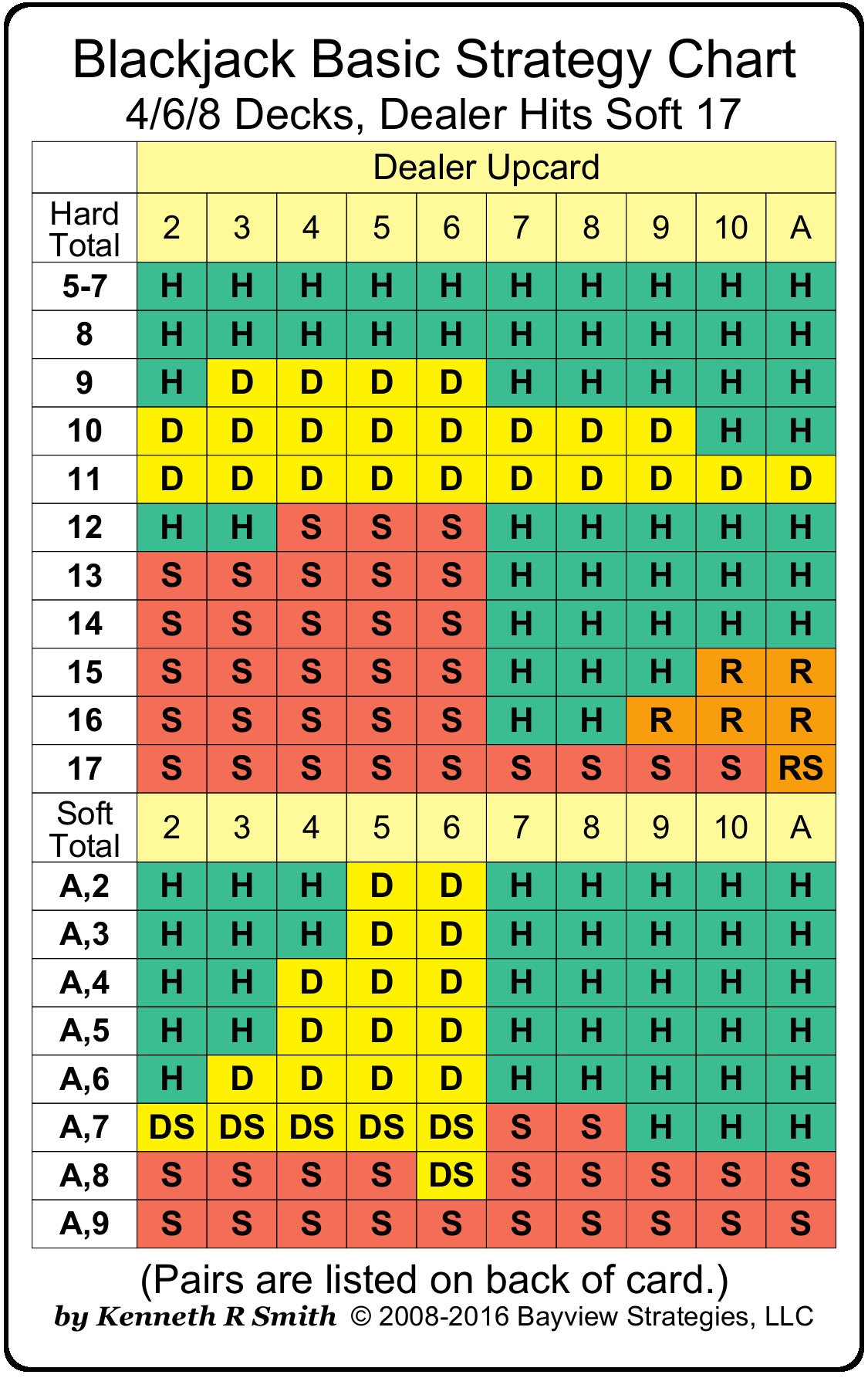
Small nitpick: I'd argue that Blackjack is closer to 80% skill, and 20% chance, just based on the fact that if you don't play every Blackjack hand with the same statistically "correct" strategy [1], you will end up bleeding money well in excess of the house advantage.
I'd venture a guess that casinos make 80%+ of their profits from players that aren't playing with perfect Blackjack strategy (for example, not double down on an 11, or not splitting aces, or not remembering whether to hit or stand a 16, etc). When players aren't playing with perfect Blackjack strategy, the house edge isn't all that relevant.
The amount of money a player loses can be attributed to the "mistakes" an average player will make (that can be avoided by memorizing perfect blackjack strategy), rather than being attributed as much to chance. Someone playing perfect blackjack strategy will on average break pretty close to even, since the house edge for Blackjack is incredibly small.
> It feels like if you played enough you'd get better
From the perspective of a player learning perfect blackjack strategy, the truth is you do get better with practice :)
Poker is somewhat a game of probabilities related to the 52-card deck. But any professional poker player would tell you, the big pots come from reading the other players. That wouldn't change.
It's so much harder to read a hand (and player) value when there are an infinite number of possible outcomes. If I have AA in a game of hold 'em with an A on the flop, I know there's no possibly way anyone else has AAA.
If there's an infinite deck, there's now no way of knowing if I'm tied for the best hand or not. How the hell can you read a player if you have no way to possibly peg him to a hand? The game would be unplayable with an infinite deck
That's also the reason that you can't play poker with multiple decks shuffled together, despite this being common in blackjack. The rules of hold 'em don't allow for the possibility of two players both having the nut flush, nor is there any concept of "five of a kind," which would of course at some point happen with multiple decks in play concurrently.
Two players having the same hand is no issue - just split the pot. This already happens when neither player can improve on the five community cards.
Adding five of a kind also seems like a pretty easy adjustment.
The most obvious difference is the possibility of cards matching both suit and rank. So if you have HA HK and the flop is HA HJ S2 you have both top pair and also a very strong flush draw (although HA HA would be better), a combo which is impossible on that board with a single deck.
Yes, the game can deal with these things. There's been wild card games forever and people like them just fine.
The issue is that this is a completely different game. It might be a fine game. People might like it (maybe even more than Texas Hold 'em). But this isn't the same game anymore. They're both played with the same 52 data points, but the frequency of those 52 data points makes these games and the skills needed to be good at them very different.
My previous comment of the game being "unplayable" might have been hyperbolic. The point I was trying to make is that it's not the same game when you change one of the rules so dramatically.
They shuffle a lot. I've seen some online blackjack where it is possible to count cards, but they know this and the stakes are low enough and game speed slow enough it's just not worth the effort.
A casino makes its money on the house edge which is for example for European Roulette 1/37. If you win on a single bet you get 36 times in winning. But you do have the number 0..36 on the wheel so 37 numbers. If you are good at counting cards the casino will have a negative edge and if all customers would be doing that it would lose money over time.
Interesting story about a group of UC Santa Cruz students using slight tilts in roulette wheels which increased the probability of the ball falling in specific sectors the wheel.
The most obvious way they are caught is changing their bets.
If you bet 10$ every hand, then suddenly 100$ when you think the count is good, and are winning, then back to 10$, you're done.
Good card counter will level their perceived variance by dumping money back, just like a poker player will sometimes call with a wider hand range than they consider their play style to be profitable in.
One of the ways casinos combat card counters is to lock their betting. So, they'll see someone with variant betting, between 1 and 100, and tell them they can keep playing, but only if they bet 20$ per hand.
That's an easier thing to kill card counting than outright banning players, as they still may be losing players at slots or some other table game.
That's not enough variance to win in the long term. Counters actually work in teams and will bet closer to the table maximum when the count favors them. They also stop playing as soon as the count is not in their favor. Someone sitting down to play 5 hands at the table maximum is a pretty big red flag.
This is explicitly legal in Atlantic city as a result of a lawsuit, Uston v. Resorts International Hotel. In all other areas the casinos can kick you out except for a few legally prohibited reasons like race.