This seems like good marketing but reading this press release and looking at the courses in their degree program I feel like I'm missing what's different here (other than some reference to supply chain management).
Most of the coursework here seems to be very similar to what was available over a decade ago at the state university I attended for graduate school (my concentration was semiconductor device theory related). While I think this material is very interesting I don't know that the demand is going to be there for this type of field. Companies like Intel have dedicated smaller departments for process development which do the more academic work (for example the D1X facility).
My experience with fabrication organization is the need is much more process engineer and technician focused rather than semiconductor engineers. The high volume hires are in improving reliability, reducing cost etc. I don't think you really need the EE degree for this, more likely industrial engineering, chemical engineering or statistics.
This said, Purdue has always had a very strong program in the more device oriented semiconductor courses (Until his passing Robert Pierret the fellow who wrote some of the best and most used grad textbooks on devices called it home).
You are correct. This is clearly not the first…check out Rochester institute of technology…it’s just a branding exercise which is very in keeping with the current Purdue leadership.
> LeetCode is the beginning of the process of standardized testing for engineers at Big Tech companies, better testing tools will probably soon supplant LeetCode
LeetCode has been the de-facto screening standard for at least the past 15 years. As a hiring manager, I keep closely up to date with the screening field. I see nothing else coming to replace LeetCode any time soon. There isn't even a general consensus about what such a replacement would look like.
LeetCode also isn't just used as an initial screen: in many processes it is effectively the only technical screen. You can pass many big tech screens if you just know LeetCode + System Design, and the latter is only required if you're a senior.
Help me understand, are you saying this is purely smoke and mirrors or just nothing fundamentally new?
As a semiconductor lay-person, my expectation is that this course would really just be an organized curriculum around semiconductors, and if you completed it you'd be hopefully competitive getting a job at Intel/Qualcom/etc. I am not expecting them to be providing any fundamentally novel approaches to semiconductor theory or design. To me it makes sense that the same type of knowledge may have been at the graduate (or more advanced) level before.
So to my (ignorant, layperson) perspective, I see the value of this making semiconductor study more accessible. It's no longer something you have to do for a (for example) PhD, but rather a structured program that should lead to an increase in semiconductor experts.
Am I off base? When you say you feel like you are "missing what's different here", what would you expect? Is it typical for new academic physics programs to provide truly novel techniques?
Definitely not saying that its all smoke and mirrors. Purdue is a great school for a lot of semiconductor related topics and there are a number of scholars I respect who work there (I did not attend that university).
What I mean is just that the announcement seems to be more of a branding exercise than a fundamental shift in what's included in a degree program. If you look at what they describe as the curriculum for example: undergrad: https://engineering.purdue.edu/semiconductors/degrees
grad: https://engineering.purdue.edu/online/programs/masters-degre...
These types of courses are very common among most curriculum I've seen as are many of the things they're offering (e.g. have a design fabricated something universities have done through MOSIS for quite some time or time in a university research fab which many schools have also had.
The positioning in the article seems to be highlighting the growing need for fab-type engineers though and I think that's not quite a match for what's on offer here. If you want to do very fundamental semiconductor device work like designing new device types or fabrication techniques there are some jobs in this but they do typically require a graduate education likely a PhD and are much more limited. If the construction of new fabs is what they are saying drives the need for a bigger wider program what is actually needed isn't device designers and engineers its tool owners, process managers, technicians/operators etc.
In semiconductors I'd say things are divided kind of between
1. Front End Design (Digital+Architecture and Analog) where the better and more plentiful jobs are (with more in the digital side)
2. Backend (timing closure, placement and routing, final simulations etc)
3. Process Design <-- this is where you're doing everything from figuring out how to manufacture a device you designed, implementing new and novel structures, doing a lot more 'chemical' type work potentially for things like interconnects etc. There are far fewer of these jobs
4. Manufacturing <-- running the process of operating a fab, making sure things are fast, repeatable and smooth, testing the output products from process stages to chip sort and test etc. This is much more full of technicians and some supervising engineers.
If I was trying to make an analogy to more software like roles, the manufacturing + backend folks are people running the build process, the process designers are a small library designing team and the frontend design teams are the bulk of the folks using all of the above to implement chip designs. You can get into the analog and digital design side with an EE masters in VLSI from most programs.
The programs Purdue offers can definitely get you into any of these types of role depending on what you do or are interested in, but what they're talking about in this writeup doesn't seem like a fundamental shift. If the goal was something more industry focused I could see perhaps creating a bunch of new courses or co-ops focusing on more industrial concerns (DFT/DFM, process management, simulating for non-idealities etc). I don't see the curriculum being wildly different in a way that things wouldn't slot into the more traditional roles at all. I don't think this is a bad thing, I just think this announcement is a bit more on the marketing side letting people know this is available.
As far as the provide truly novel techniques, I think there are plenty of those being designed for various special purposes in universities. Sometimes these designs lead to interesting industrial applications but the thing that's usually an issue is that industry focus is on predictable, low cost and high yield. The type of research industry will do typically enables generational jumps in density or power improvements etc but until its really necessary they'll wait to adopt highly novel academic research and then spend time figuring out how to make things manufacturable.
The reality of getting a job in semicondutors though is most likely you're going to do something design/verification related, process work will come to you from your fabricator in the form of a PDK (process development kit) which will have all the parameters of the process and rules for manufacturing (and perhaps a good set of standard cells you can use for digital implementations with the initial parasitic extraction work done etc). Like any job its a little more standard in practice and bit less focused on the exotic stuff ;)
Ha, I'm interning with their chip design team right now. They've done 7 tapeouts but there's a lot of mistakes and other issues down in the plumbing.
I wouldn't say their program is significantly better or worse than any other, and my understanding is this focus on a "Semiconductor Degree" is just a reshuffling of courses already offered in EE and ECE degrees. Certainly there are teams far ahead of Purdue. The programs at UCSD and OSU that are pioneering the work on OpenROAD and Skywater 130 are the ones who are really ahead of the game. If I could be at any program in the US, those are where I would want to be.
That said Purdue is absolutely ahead of the average ECE program. Very few undergrad programs are completing tapeouts on a regular basis, even at schools that would otherwise have the funding to accomplish it. There are plenty of schools that think of ECE as "EE plus some CS courses" and don't even teach much HDL, much less how to layout a standard cell or do timing analysis.
Oklahoma. I'm actually working with a kid from Ohio State who's constantly ragging on their program for not even teaching Verilog much less how to build an ASIC.
Purdue's program is ok, but it's a veritable bastion of academic excellence compared to schools that have no staff that have ever performed a tapeout, which is most of them.
Electrical Engineering departments have tons of faculty who know what they're talking about. CS departments have people who mostly kinda sorta know what they're talking about (even if they're 10 years out of date, which is an eternity in CS).
I would wager most schools don't have a single faculty member who's performed a small tapeout, much less a big project for an industry leader. Actual ECE, VLSI, the building of chips, is a wasteland on the academic side of the house IMHO.
Look at the people around SiFive and RISC-V at UC-Berkeley and look at the transistor guys at UMich. Both groups do lots of work that directly tapes out or works with companies who do. My digital logic prof at UMich took sabbatical to do a startup that netted him a bunch of money on… I forget the details now, but they did a smaller tape out to prove the concept before selling to Intel. It’s not that uncommon.
UCB and UM are top 5 schools for this, with maybe MIT sitting above them because of Lincoln Lab. UCB literally invented RISCV (among a million other fundamental CS and CE technologies). They are not representative of the typical state school or even well funded private schools.
I'm at NYU Tandon and they are a decade behind on most stuff, the single VLSI course is an elective even for ECEs. I work with students from state schools all across the country, and the most common reaction I get with rising seniors coming from EE and ECE programs is "I have never seen any of this stuff before".
What I'm trying to say is: I've yet to meet an ECE senior who couldn't write Hello World in C or perform linear DC analysis, but it's surprisingly rare to find one who can layout a ring oscillator.
I have fond memories of my semiconductor physics classes. The were not easy whatsoever, rather intense.
As cvccvroomvroom had mentioned, I had my VLSI chip fabbed at the MOSIS facility in Westborough MA, during my EE tenure at UMASS Amherst in the 1990s as part of a state-wide chip design competition (yeah - didn't win..). There was much activity on VLSI and computer system design at that time, things have certainly changed in the US.
I recall many entries were implementations of various (and obscure) mathematical algorithms, mostly in the frequency domain (hence DSP chips), that tried to solve problems that are now trivial in SW today.
My school did win occasionally, others were mostly MIT and WPI - I think in a large part due to the excellent professors at all competting schools and the work ethic of the students.
My final submission was the design for an Arithmetic Fourier Transform processor - trying to remove the need for expensive ROM by aliasing the signup up-frequency - which I did the barrel-based ALU for, and thank the grad students for including me in the project.
Skimmed the article; what's the difference between this program and what's already taught in electrical and computer engineering classes? I studied ECE for my BS and MS and there were already a couple of chip design-related courses: digital design, VLSI, FPGA, semiconductor physics, IC fabrication. I guess more specialized coursework on verification or manufacturing would have been nice, but I don't think that would warrant a whole new academic program.
edit: forgot to mention that I worked as a chip designer for many years right out of school.
I had the same thought. Upon reading, this sounds like it goes deeper on the semiconductor physics and fabrication parts. Relevant bit:
"Courses will address supply chain issues in chemical engineering, mechanical engineering for tool development, thermal management, packaging, and material engineering as well as industrial engineering, logistics, and manufacturing optimization."
There is a big difference between chip design and running a factory...which generally isn't taught anywhere. When I got my ChE degree many years ago we had like 3 or 4 courses for semiconductors and in one course we learned about the manufacturing aspect. Even then it was super outdated with respect to what I actually dealt with when working as a Process Engineer at a fab.
That makes sense. It kind of seems like the new program will be sort of a mish-mash of ChE, systems eng, and ECE (i.e. what it takes to actually run a fab).
In fairness, I think overall there are no curricula specifically about how to run a factory. Most engineering degrees focus on design and theory rather than industrialization. For example, there are no classes on how to run datacenters for computer science majors.
Agree. Fact. But why so. And more importantly why not?
Some discipline want to teach you basic so they do not stop you from innovation. Some just exposure (mba, mgt) so you have to deal with practical case, it’s complexity and not just theory.
IT is not just about computer research … hence may be one should expand one’s scope.
As someone working full-time in Canada, wish I could roll back my life 10+ years and get into one of the semiconductor schools. Good luck to all who are admitted into this program, looks very interesting.
Warning: nerd trap. Low wages, horrendous deadlines (tapeout), hard work.
Perhaps this has changed, given that we're in a semiconductor boom cycle now, but I have my doubts. When SMIC started trying to poach TSMC talent, the response was not to make pay competitive (or even half decent), let alone in line with the massive geopolitically-relevant value being created. No, the response was a mask-off legislative crackdown to keep the nerds in line. In the US, there were only two big employers, and they were definitely paying what they could get away with.
Anyone who is considering this career -- any career, but this one especially -- before you jump, please get the perspective of someone in industry who isn't trying to sell you a career.
I worked at Intel, and with process/fab people for a number of years.
Everything you're seeing in the comments is true.
Compensation is not that bad. Clearly, it'll not pay SW salaries - no engineering does. But if you're a fab person, you'll work long hours, be on call often (and you will get woken up often), and eventually will own a tool that you'll be responsible for, even when not on call.
Lots of abusive and pathological behavior, as well. And they often block internal transfers so you're basically trapped.
People with other skills (e.g. SW) get out. The rest are stuck, because they have, for example, a chemistry PhD and no other company will pay more.
> Clearly, it'll not pay SW salaries - no engineering does.
For some reason, I assumed that in order to be a chip designer you had to be as good at programming as a developer. Then I became friends with two intel chip designers/engineers and was surprised that neither knew much of anything about programming, despite both having multiple PhDs in their fields. That's when I began realizing that engineering and programming are 2 entirely different fields that have little overlap.
Not the same thing but ... In my experience, most browser developers (who write C++) don't know web development. In fact most of them disdane it, or at least that's how it feels. I find it kind of sad though I also understand it as I had the same attitude for the first 2~3 of years.
That is so odd. You're telling us the people who make these tools don't use their own tools, moreover they have disdain for the users of the tools they make?
In my experience, programming is something you can get pretty far learning on your own. In grade school. I’m not talking about red-black trees or computer sciencey things, but you can definitely get started making games of varying complexity when you are 10 years old or younger.
Things you can build and see and have immediate feedback.
That just doesn’t happen with chip design. Not that it can’t, and I’m sure there are examples (Woz’s paper and pencil circuit design come to mind) but it’s far from common, compared to coding.
I remember in 5th grade being asked to help another student write a choose-your-own-adventure style game in basic on an apple //e back in the “one per classroom if you are lucky” days.
I figured I was going to be a programmer as a profession but college came around and it was a coin toss for me between computer engineering and computer science. At the time, engineers made more money so I went with that. Doubled as an EE/CE. I was ok at the typical EE stuff, better at the little bit of programming we were exposed to (in pascal). I did very well in semiconductor physics, but I didn’t really get sucked into it. Got to a digital design class, and that hit the spot for me. I didn’t like plugging wires in on breadboards because it was entirely too frustrating trying to figure out which wire you got wrong, plus I’m colorblind and the shades of red and green insulation on wires are perfectly impossible for me to tell apart except under very very bright light. But I loved designing the synchronous digital logic.
It’s just not something you are super likely to randomly pick up on your own at an early age. And to be honest, even if I had been exposed to digital design back in grade school, I doubt it would have resonated. I could easily understand things like “GOTO 10.” Understanding clocked logic, or binary arithmetic probably wasn’t within my reach back then.
Nearly all of the EEs in my class had never programmed anything before the 2 classes in our curriculum. All the people that knew how to program went into CS (except for a few like me). So the few logic designers that come out of an EE program don’t seem very likely to be good at programming. Just different interests.
Not chip design, but I did more electronics than programming as a teenager. Computers were expensive but individual electronic components were not and my grandfather taught me how to etch PCBs and build radios, learned digital stuff using TTL on breadboards.
It does kind of depend - I've made a career of being both: being the log designer that understands software (and makes sure the registers make sense etc) and/or the software guy that understands the c hips (and can read the verilog and find the bug) etc etc
Both require deep domain knowledge that doesn't always overlap - but being able to do both makes you more valuable
I agree with all of this, unfortunately. I worked for Intel for two years after graduating with a PhD in EE. I learned a lot from the experience, but I can't recommend it. I work in software, now. The PhD was great, though. I loved doing semiconductor research. But make sure you work with a professor who is very good at fund raising.
There are also some indications that Washington is increasingly viewing semiconductors as a national security issue. There could be a shift in federal funding that could make the industry more attractive to talent again.
The industry doesn't have a talent shortage, which explains the working conditions. There will always be grad students who think "Cool! I get to do research involving quantum mechanics!"
Trust me, I've tried to talk them out of it and never succeeded.
I worked for a supplier for AMAT/Intel/Samsung etc. and was basically on-call 24/7. I had to carry two laptops with me at all times (my personal one and a work one).
I didn't care because I was young, and well compensated, but they decided that they'd cut my pay by a third by converting me to a salaried employee. The unpaid overtime (previously paid as a contractor) lost its luster quickly. Once I realized I was subsidizing bad management because I was filling the gaps left by often intentional shortcuts taken-- for free, I bailed. That took... two months I think.
I went into a master's program at SUNY CNSE back in 2014 for "nanoscale engineering" hoping to do some research in MEMS/NEMS. Turns out there were no research spots available with the groups working on that stuff so I ended up in a group working on EUV photoresists. I ended up not doing much actual "nanoscale research" and mostly just did some data science/engineering for the group since all the data processing code they had took 10+ hours to run for each experiment trial. I fixed that code to run in under 10 minutes and decided I should probably just start looking for jobs in software. Couldn't be happier.
Every person I interacted with in the semiconductor space was either an academic who was stuck in a lab 12+ hours a day or some line manager for Intel/IBM/TSMC/etc. that was on-call 24/7 if something went wrong. Both of those sounded terrible to me regardless of the pay.
CNSE class of 2017. The usual career progression of people I talked to was: get a phd, work 12 hour shifts (including nights), be underpaid because you “are not an expert yet”, be fired after 2 years because the company abruptly changed technologies and didn’t need you anymore. Repeat steps 2-4 until you eventually get frustrated enough to leave the field.
This reminds me of my path: wanted to study EE because I thought that designing chips, working in a fab etc. would be cool, started studying EE and realised I would need to get a PhD to do the more interesting work (frankly I'm not smart enough to do a PhD), plus tepid job prospects in the UK.
Ended up as a power systems engineer, which is the complete opposite in terms of scale from semiconductors!
If they paid me to be on-call as much as they payed my father (doctor) to be on-call, I'd do it in a heartbeat. Maybe I would have regretted it in 10 years -- he sure did -- but I'd have loved it for a while.
Terrible pay and terrible hours and long school and hard work is just irredeemable.
Likewise, I graduated from a very similar program to CNSE. It was a program attached to the main engineering school. The work seemed so interesting and I felt I would end up doing impactful research.
That was until I did an internship following a grad student doing work on solar cells. Every day was sitting 8+ hours in one room doing CVD then XRD. It was soul crushing. I realized the program was more of a PhD-prep program and most people I know who graduated and didn’t go for a PhD either 1) went into software or 2) work as some menial process engineer working the “assembly line” with no meaningful upwards mobility.
Intel (and similar fab companies as well) is famous for even treating it’s phds as menial process engineers. When I graduated the only Intel fab jobs I was qualified for were in Indonesia or some other SE Asian country, and descriptions were basically “you are the SEM person, you do SEM all day.”
I know a surprising amount of people who came out of CNSE (without following up with grad school) and are now landscapers, waiters, or similar. The skillset is so specialized as to be almost worthless unless you can find the right role imo.
Also the program there CNSE/SUNY Poly is absolute hot garbage, I advise active looking at this field to go into conventional EE, ChemE, or Materials.
Scanning electron microscope, I assume.
And it's basically getting samples prepped and operating the microscope stage and image controls (focus, contrast, etc.).
Sounds like it quickly gets boring. I expect in less than one week.
Hi there, I'm a PhD candidate major in photoresist. I just wonder what kind of software company would hire us and are there any must-have abilities like program languages if I want to get a job in software?
A lot of human progress in core sciences and engineering is on the backs of people toiling the midnight hours on sheer passion for little monetary reward. We owe a great debt of gratitude towards them.
In any commercial organization, there are tremendous pressures in high-investment, super high-risk projects and anyone can trivially find things that are wrong with the current system. The much more difficult challenge is showing an alternate path that is superior - based on the results it achieves. The times when you see the ugly behavior of people are times of desperation. Online commenters expend a lot of effort point out how to improve things by "proving" it by linking to random studies - but the more persuasive argument is by implementing those changes in the real world. "Talk is cheap, show me the code." ;)
Sure thing! I've got your alternate path that is superior right here: see, first I give the semiconductor industry a big fat middle finger, and then I go work for somebody who fucking pays me.
When in University, Intel gave a presentation. They stated the same facts that the Semi industry will be low waged, hard work, and require MULTIPLE PHDs. That presentation gave me enough information to recognize that I really didn't want to be in the semi-industry.
Intel turned the screws so hard on their employees that the market actually punished them for it. That never happens, but Intel went so far beyond the pale that it did.
A mentor of mine hit his breaking point when they split/bankrupt/acquired his team to discharge pension obligations. Real nasty stuff. He said everyone was retiring, "good luck with the next node" (10nm) -- which I discounted as sour grapes on account of Intel appearing invincible at the time, but wow have the years cast that story in a different light.
Just do a PhD in electrochemical engineering and be done with it. Aren't there labs that focus on chip manufacturing and would allow students to work on the intersection?
This honestly sounds like there is some real shady shit going on behind the scenes by the heads of these two companies. Reminds me of the whole VFX / software engineering union debacle with Steve Jobs / Lucas / etc that eventually came out and was super duper illegal.
Meaty! Thanks for sharing.. At this point, it's pretty clear universally everyone within the top management ranks of big companies are sociopaths with money mania. All while feeding the lower ranks and the public beautiful stories about their juggernauts and the humble beginnings.
I worked in a semiconductor school at a tenant organization. When the crunch was on, the parking lot was full at midnight before Christmas.
Pay was not so great as judged by the cars. The other thing was that the workforce was split - you were either old or young.
If you want to make money in semiconductors, find a place they are building fabs and become a plumber or electrician. Those are the folks who make money, and often there’s security clearance requirements that adds job security.
My dad was a EE professor specializing in semiconductor fabrication and he warned me away from a career working at semiconductor labs. He has warned me about every single warning of this post.
EE in general is a problematic career path in the US. Microelectronics is more so due to the even more limited employment options. All but a few niche fab operators are multinationals and you're directly competing with cheaper offshore labor. Government initiatives aren't going to change this arrangement.
EE isn't only working at a fab. Most EE's I know work at fabless design houses and make a good living, albeit with some crunch periods. I think it's the chemists who are stuck with the fabs.
I suspect the reason is that semiconductor industry relies much heavier on captial (comparing to talents) than software industry given the same level of risk. One or two talented software enginners can bootstrap a company with reasonable amount of success that can be a good indictor of future larger success. You can't do that in semiconductor industry.
Different sub-professions. Digital design vs mixed signal vs device physics & such.
Last time I had close contact with the industry, digital design indeed was a bit more competitive and correspondingly it was the only one considered to have good career prospects -- but the offers were still between shabby and embarrassing next to entry level SWE, even outside the bay area.
I don't think everyone's designing a chip. They might be putting together chips to create boards, but chip design is something else altogether, right down in the architecture of memory and transistors etc.
My partner designed chips (for printers..) It takes a lot of money to design and fab a chip (her company was fabless). They synopsys or Magma software they used for design/layout was crazy expensive. (if you can't find a price....)
Then you have to manufacture. There is a significant cost for custom chips. Though once you get going the per chip cost is pretty low, thus the business lends itself to a few large players.
It's easy, you just grab each electron firmly using pliers and carefully move them closer together. Be sure you have a proper angstrom ruler to make sure they're the right distance.
I wanted to go into semi 2007-2009. Fortunately, I stumbled on two one very senior TSMC engineers who kind of became informal mentors to me, and they talked me off. And by the way were with Morris Chang at ITRI.
Points they told:
1. A mandatory PhD just to get at internship
2. Few years of unpaid internship needed to get a coffee porter job, before you are let anywhere close to the process
3. A postdoc is required to get a real R&D cred
4. 7-10 years in R&D sweatshop before any real promotion
5. Get very lucky
6. In 20-30 years of career, you can get to a VP level, where you can hold the company by the balls with critical knowledge. Then... and only then, you will look up to a 7 digit salary.
You wind up captive to a small number of employers in places that have few other employers. You have to be physically present--no online only. You will have weird hours because you have to slot into the fab plant openings. Your pay will be a small fraction of even a mediocre software developer.
I can go on and on.
There isn't a shortage of semiconductor personnel. We all fled.
Companies could pay people enough to come back. Like so many other fields, companies would rather do anything other than raise salaries.
Semi-relates: Why don't universities offer online undergraduate programs? It's frustrating. I enrolled myself back to finish my bachelor's degree and my school offers very few or no online options for the classes I need.
There's a normative and substantial laboratory aspect to ABET-accredited[1] undergraduate engineering programs.
From Criterion 7:
>> Modern tools, equipment, computing resources, and laboratories appropriate to the program must be available, accessible, and systematically maintained and upgraded to enable students to attain the student outcomes and to support program needs.
Online undergrad degrees, exist but are few and far between. A good many have substandard curriculum, others are "ok" granting you a legit degree from a recognized school, but probably lower quality education than in person.
Most of the decent ones are expensive, and many still consider in/out of state tuition. There are a few good deals I've seen, highly dependent on being in-state.
The only "useful" ones you'll find tend to be CS, a handful of EE degrees exist online (no clue how that works) along with some other fields. Occasionally you'll find some in the natural sciences, but they tend to be BA's and explicitly for pre-law, pre-med, etc. I've seen maybe one online math degree and tons of social science ones, as well as "we made this major up to target to poor working people who will give us money".
At the end of the day, they exist, but are uncommon and probably not worth the price.
I researched going back to school online for years, but if I do it, I will probably do it in person (at least for the important years).
Online programs may not be accredited by national credentialing bodies. Many STEM degrees require lab courses that can't be performed online. And non-STEM programs are based around the seminar (classroom discussion) model, where on-site attendance is always superior to a Zoom meeting.
Forcing students to live on-premises also makes universities money through student housing and amenities. Universities have concerns that opening their programs to online instruction would lead to an exodus from the campus. You could have 70% of a 20,000 strong student body attend online, and all the expensive real estate of the campus would mostly be a waste of money.
I'm frustrated too. My university has gone back to in-people and it forces me to drop 2 out of the 4 courses I registered, plus one of the kept course forces me to take a couple of hours off every week.
Unless you are going for their post-bacc (which is a really good deal), doing their full online undergrad program would be an absolute nightmare. I'd go just about anywhere else.
Some do. I just started going back to school and I’m working on a B.S. In Software Development at Western Governors University. They’re accredited and online only. They also offer a B.S. in Computer Science.
I heard about WGU and was a bit skeptical, not knowing how it's viewed by other universities if I wanted to continue my master's program elsewhere.
I have a couple of questions if you don't mind. I assume you've done your research before you joined, what made you decide to go for it? what's your current experience there? And do you know other people that took their degree from WGU and joined another university for their master's?
The biggest three factors that made me decide to go for it were:
- Even in my first attempt at college, I was never too concerned with the name/reputation of the school. My first go around I picked a state school that gave me a full ride, rather than going for the more prestigious options. So once I checked that the accreditation of WGU was indeed legit, that was good enough for me.
- Their admissions are based on your professional history, since they're set up to cater to working professionals, not high school graduates. (Heck, their mascot is the "night owl.") That means it didn't matter to them that my first attempt at college left me with a... bit of a "stained" transcript. That stopped me from getting into other online options, but my professional history spoke for me at WGU.
- I'm a huge fan of their competency-based education model. It isn't for everyone since the classes are self-paced and asynchronous, but it matches my personal abilities to self teach and to "binge" content. Plus, as soon as you enroll in a course you can take a pre-assessment that will unlock the final if you do well. For some of the courses I've spent over a decade in the workforce learning the content, so I was able to do the pre-assessment and then the final in a single day.
My current experience at WGU is short, but good. My term started June 1. I rocketed through a few of the classes that had test-based and code-based finals in the first week. Now I'm realizing just how out of practice I am with writing, because I'm in a pair of classes that have writing-based finals and I'm struggling more.
I don't personally know people that took their degree from WGU to another university for a Masters, but WGU maintains a list [0] of universities which have accepted WGU undergraduates into their graduate and/or doctoral programs.
That was very helpful, thank you very much.
Yeah the fact that I can binge courses and take exams anytime is awesome, it can help cut down the time to graduation. Best of luck
I can't speak to master's programs in CompSci but I finished my bachelors in business at WGU and was later admitted to the iMBA program at the University of Illinois Urbana Champaign.
Because they don't have the people to teach online students.
The academia is a community and a lifestyle. The people who choose that lifestyle generally don't want to spend too much time teaching outside the community. Teaching is a lot of work, a lot of bureaucracy, and a lot of hard deadlines, and it's not particularly rewarding if the students are just names on screen. Maybe if people paid higher taxes and higher tuition fees, universities could hire teachers to "just work here" and pay them competitive salaries.
I currently work in embedded software which involves a lot of overlapping interaction with EE and hardware design folks. The consensus is that the hardest, most fascinating field is the one you currently have the least exposure to. The easiest, least exciting field is the one you have a degree in.
In CS, you may have spent thousands or tens of thousands of hours across many years learning and growing, and still being limited in your understanding of the field as a whole. It's daunting to explore other related fields just to find out that they each have similar levels of complexity, filled with professionals who've sunk similar levels of effort, time, and years of their life into their work (who are often equally struck by the complexity of your field.)
Just curious, for a software engineer that only works with managed languages such as Java and Python, what kind of embedded job is easy to squeeze into? Thanks~~
If you have experience with software, learning embedded concepts isn't a huge leap. At least in my area, aerospace, defense, and automotive tend to be the biggest, easiest employers to get started with. They will hire basically anyone with a solid grasp of C, OSes, and basic computer architecture (at an undergrad level.)
I find embedded really rewarding. A 20 year old embedded-C code base generally follows the same design patterns and coding conventions and styles that you'd use today, and don't feel "old" or like they need to be rewritten. A 7 year old JS code base, on the other hand, is largely outdated, and may be written in a nearly extinct framework by the time it is your turn to maintain it. If you get tired of giving up time on the weekends so you can learn a new framework, consider hopping over!
Heh, or you could be me, and escape embedded. I hate staring at 20 year old legacy C or C++98 codebases, Makefiles and Autotools make me cry, and trying to debug random hardware issues with blinking LEDs or print statements (JTAG access is too optimistic) is something only the most detail-oriented person might enjoy :).
I'm exaggerating a little, but more power to those of you who suffer through it!
Thanks for the tip, that's really interesting. I'm more into lower level stuffs so I'm taking CS courses towards OS and Compiler. I also played with a Tiva launchpad but stopped after failing bit banging multiple devices :D
It's still too early for Rust in the embedded space. A lot of that space has various certification requirements that Rust doesn't meet yet, and the rest of the space tends to follow too and is very conservative.
Ferrous Systems is making some good progress to make certification of Rust happen, through ferrocene[0] and other initiatives, but it will take time.
The only company I know using Rust in a sort-of embedded way is SoloKeys[1], using Rust to write the firmware of a hardware authentication token (similar to a yubikey).
Honestly no. Pretty much the only folks I've heard talking about Rust are in the application dev space. Generally the space I'm familiar with is lately being called "deeply embedded" to differentiate it from IoT platforms (which sometimes run full-blown Android)
Typically the real time space is very conservative on what types of changes are implemented, and that's largely because a lot of rt software exists on safety critical systems that need to be supported for decades.
I know synthesizer manufacturers that are switching over to Rust for their embedded devices, Elektron is an obvious one that comes to mind.
There is also some adaptation in the Eurorack space thanks to a lot of open source work done for stm32's, I've built a commercial Eurorack product using Rust.
Its pretty great to be honest, I think I would have a hard time going back to C/++
If you (or anyone else) are interested in getting into embedded email me at my username @ gmail. We're currently looking for a couple. Coming from Java/Python is a plus
There are a number of embedded gadgets that run on Android, complete with code in Java. (They aren't hard real-time systems, but not all embedded devices care about that.) Look for things that have a real graphical display and touchscreen.
Well... it's Android (or iOS) development, but it's different.
In that kind of situation, you usually own the whole device. You don't have to worry about being removed from memory because the user wanted to run some hotel's booking app or whatever - the user doesn't have the option of doing that.
You may have some additional hooks that give you some control of whatever custom hardware that comes with the device. You may or may not have to drop down into native code to access those hooks.
You can't develop against a standard phone or tablet. You have to have your hardware to develop against.
Web development usually involves very little CS it is much closer to Software Engineering. Computer Science about solving problems with math, science, and computation theory and just happens to use computers as tools. Software Engineering is about building complete and useful programs.
I've encountered some "computer science" programs that barely taught people to program in Java, included classes on Microsoft Excel and Access and didn't include any advanced math. Data structures and algorithms might get a single class to satisfy interview questions about linked lists vs arrays and what Big O notation means. It's kind of a polluted term I think, in part due to that kind of usage by community colleges and the like.
Semiconductor theory is more interesting, but don't even consider it unless you love math and can do standard integrals without having to look up tables.
Also, the mistake I made when I went to grad school: Semiconductors seemed to be a
"new" field compared to the rest of EE. One of my undergrad professors said "They still haven't figured out what a standard textbook should contain."
In reality, from a research standpoint, it's a very mature field. Don't expect low hanging fruit. If you're going to focus on theory, expect it'll take a number of years of dedicated study before you get to the frontier. You'll need to know quantum mechanics and statistical mechanics, and some electromagnetics, just to begin studying semiconductor theory. Then a whole bunch of specialized solid state courses. Then you start studying the specific subtopics (reading key journal papers).
This falls more into the electronics domain, which I know is sometimes put under the "semiconductor" bucket, but in universities usually has its own domain ("microelectronics" in my day). It's a lot more focused on the circuit/high frequency model of the transistor, and builds up form it.
Semiconductor theory is more about the transistor and everything below it: Starting from quantum mechanics and statistical mechanics, derive the equations of electron/hole transport in a doped semiconductor, how the material's band structure impacts current flow, etc. The derivation of the transistor equations is often the end point.
Because this company does both, so after I get bored with current role and prepare better, then i'll try to switch teams
I didnt and still do not see easier way for me to get into comps (i may be naive), especially that i dont know cpp yet, which seems like must have in compilers world unless you go to e.g msft
I studied semiconductor engineering in Canada about 10 years ago (graduated in 2011). Career propsects were poor, a few jobs available in California. A career in software would have been far better in terms of pay and opportunities.
If process engineers are so rare, why don’t they pay them like they are rare? My wife got the hell out and into data science. Much more respect and pay.
Reading this all I could think was that it’s an excellent idea, and that the government should be tripping over itself to give this program scholarships.
> The university has existing collaborations with the U.S. Department of Defense’s SCALE (Scalable Asymmetric Lifecycle Engagement) program, the American Semiconductor Academy, and other CHIPS Act workforce consortia
I think this is a great opportunity for young people and they should take the chance to enter a field that even for electrical engineers is tough to enter. Chip design and semiconductor engineering is a bit of a black art, kind of like analogue electronics in general. I've got a PhD in EE and I still marvel at the engineering that goes into chips. If I was starting again I'd seriously consider this opportunity.
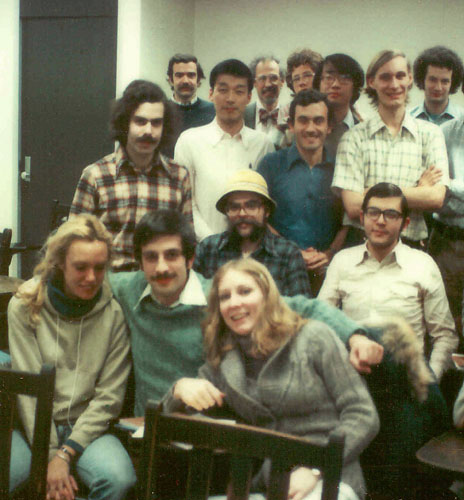
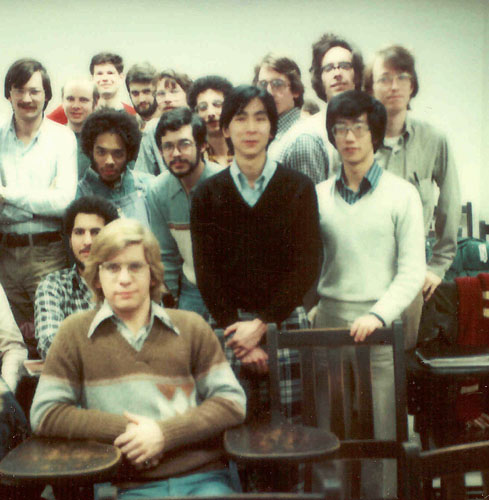
Lynn Conway, co-author along with Carver Mead of "the textbook" on VLSI design, "Introduction to VLSI Systems", created and taught this historic VLSI Design Course in 1978, which was the first time students designed and fabricated their own integrated circuits:
>"Importantly, these weren’t just any designs, for many pushed the envelope of system architecture. Jim Clark, for instance, prototyped the Geometry Engine and went on to launch Silicon Graphics Incorporated based on that work (see Fig. 16). Guy Steele, Gerry Sussman, Jack Holloway and Alan Bell created the follow-on ‘Scheme’ (a dialect of LISP) microprocessor, another stunning design."
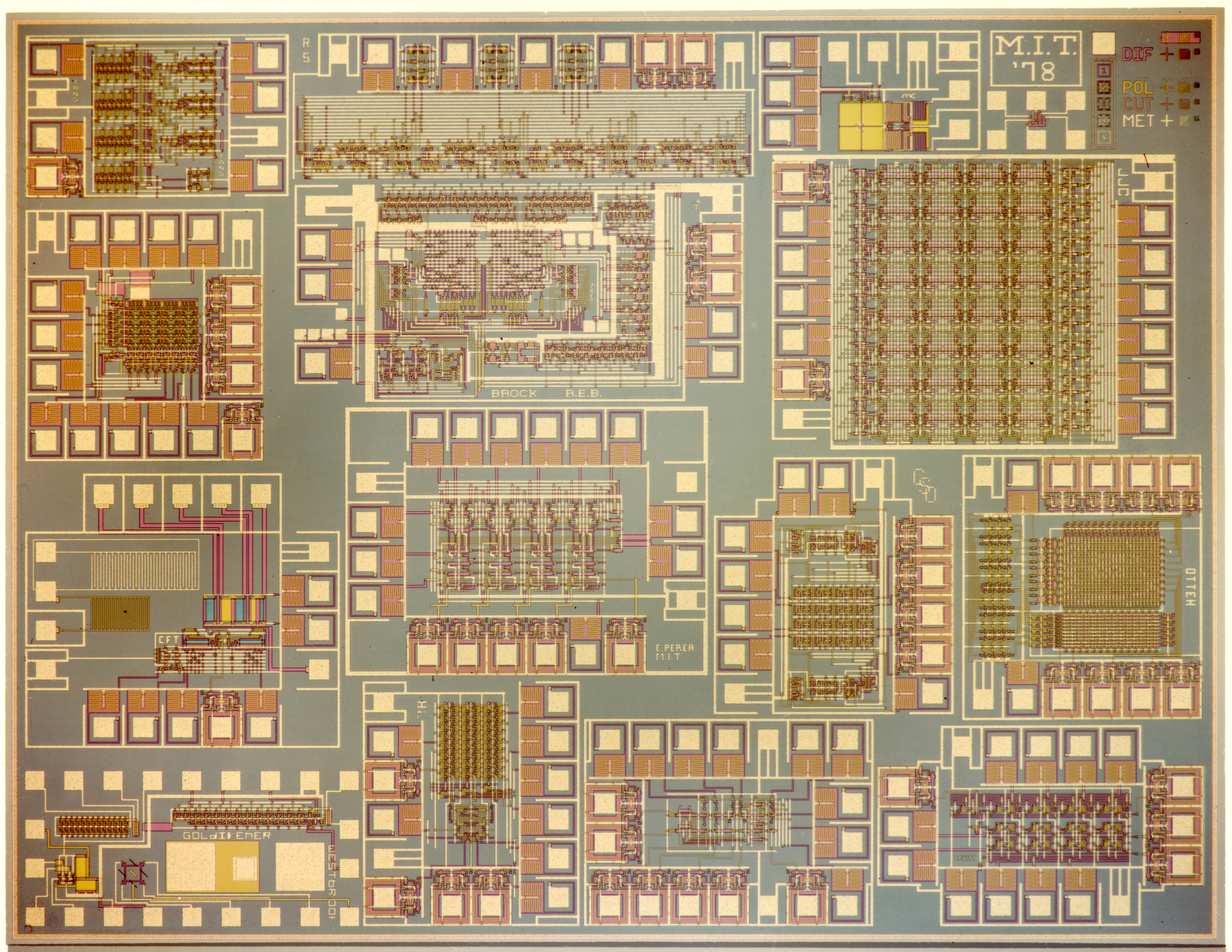
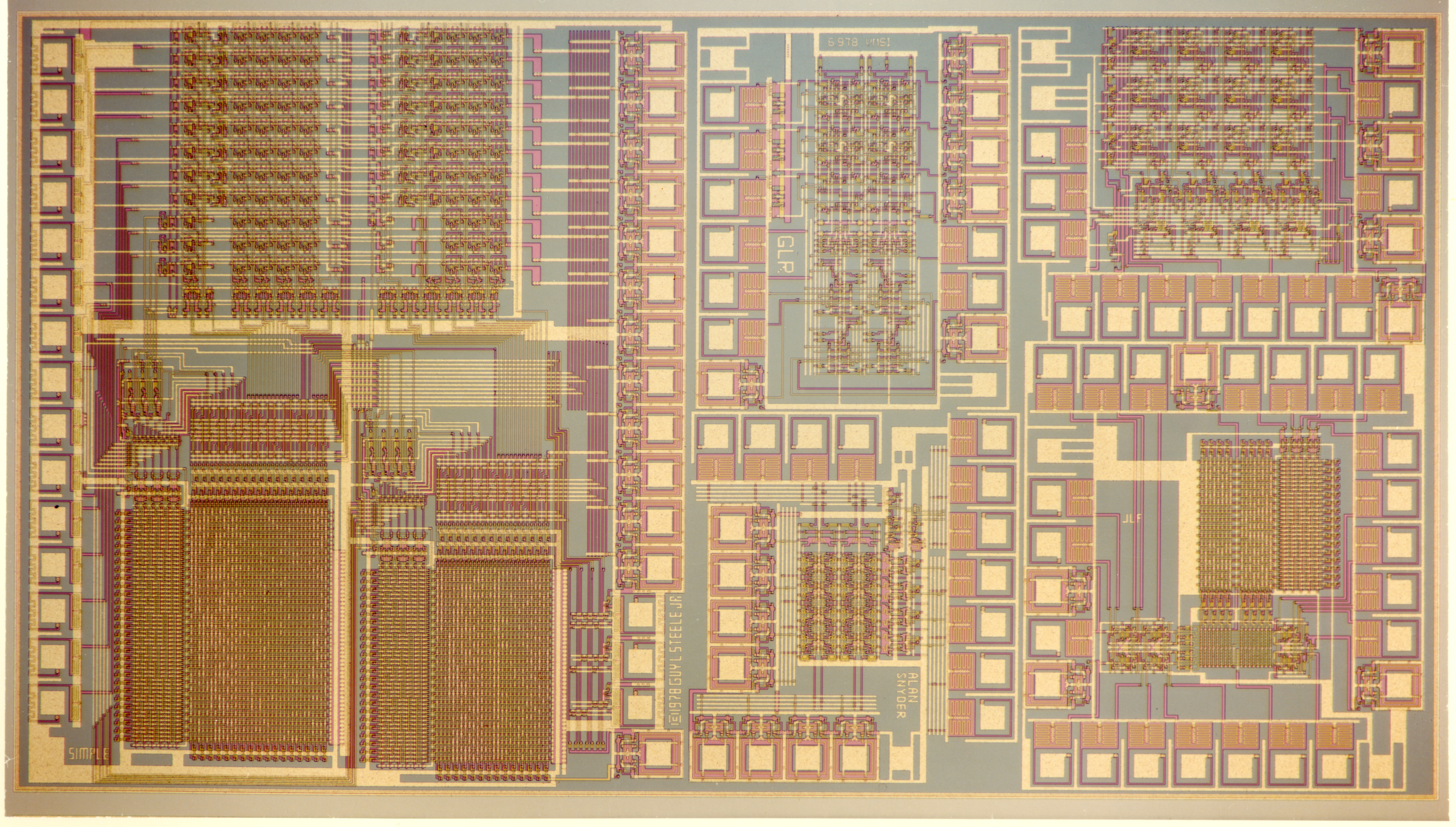
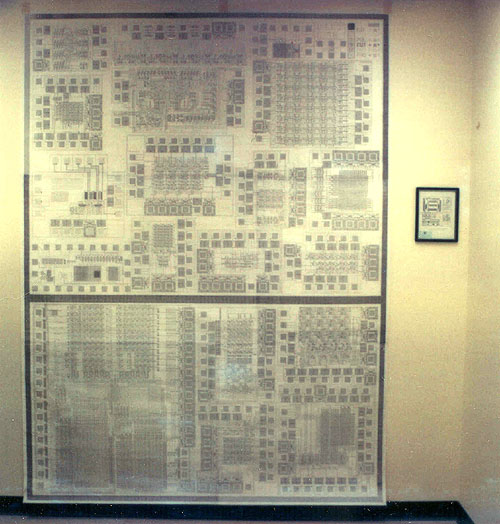
The Great Quux's Lisp Microprocessor is the big one on the left of the second image, and you can see his name "(C) 1978 GUY L STEELE JR" if you zoom in. David's project is in the lower right corner of the first image, and you can see his name "LEVITT" if you zoom way in.
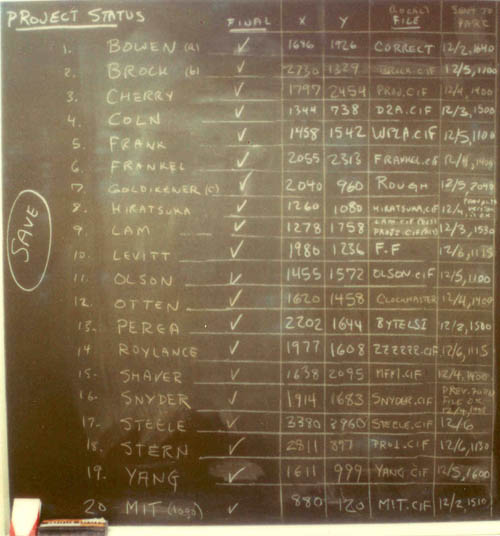
Here is a photo of a chalkboard with status of the various projects:
The final sanity check before maskmaking: A wall-sized overall check plot made at Xerox PARC from Arpanet-transmitted design files, showing the student design projects merged into multiproject chip set.
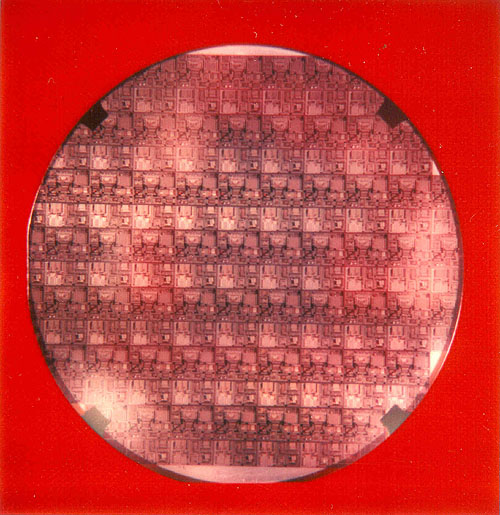
One of the wafers just off the HP fab line containing the MIT'78 VLSI design projects: Wafers were then diced into chips, and the chips packaged and wire bonded to specific projects, which were then tested back at M.I.T.
We present a design for a class of computers whose “instruction sets” are based on LISP. LISP, like traditional stored-program machine languages and unlike most high-level languages, conceptually stores programs and data in the same way and explicitly allows programs to be manipulated as data, and so is a suitable basis for a stored-program computer architecture. LISP differs from traditional machine languages in that the program/data storage is conceptually an unordered set of linked record structures of various sizes, rather than an ordered, indexable vector of integers or bit fields of fixed size. An instruction set can be designed for programs expressed as trees of record structures. A processor can interpret these program trees in a recursive fashion and provide automatic storage management for the record structures. We discuss a small-scale prototype VLSI microprocessor which has been designed and fabricated, containing a sufficiently complete instruction interpreter to execute small programs and a rudimentary storage allocator.
Here's a map of the projects on that chip, and a list of the people who made them and what they did:
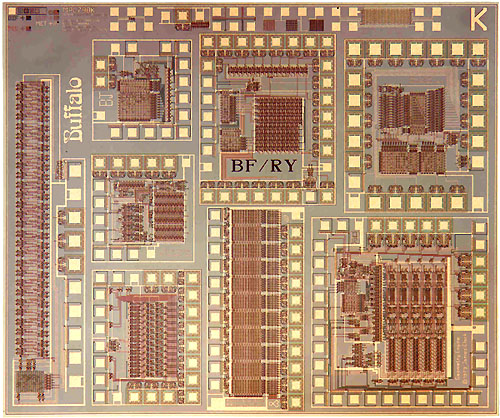
Just 29 days after the design deadline time at the end of the courses, packaged custom wire-bonded chips were shipped back to all the MPC79 designers. Many of these worked as planned, and the overall activity was a great success. I'll now project photos of several interesting MPC79 projects. First is one of the multiproject chips produced by students and faculty researchers at Stanford University (Fig. 5). Among these is the first prototype of the "Geometry Engine", a high performance computer graphics image-generation system, designed by Jim Clark. That project has since evolved into a very interesting architectural exploration and development project.[9]
Figure 5. Photo of MPC79 Die-Type BK (containing projects from Stanford University):
The text itself passed through drafts, became a manuscript, went on to become a published text. Design environments evolved from primitive CIF editors and CIF plotting software on to include all sorts of advanced symbolic layout generators and analysis aids. Some new architectural paradigms have begun to similarly evolve. An example is the series of designs produced by the OM project here at Caltech. At MIT there has been the work on evolving the LISP microprocessors [3,10]. At Stanford, Jim Clark's prototype geometry engine, done as a project for MPC79, has gone on to become the basis of a very powerful graphics processing system architecture [9], involving a later iteration of his prototype plus new work by Marc Hannah on an image memory processor [20].
[...]
For example, the early circuit extractor work done by Clark Baker [16] at MIT became very widely known because Clark made access to the program available to a number of people in the network community. From Clark's viewpoint, this further tested the program and validated the concepts involved. But Clark's use of the network made many, many people aware of what the concept was about. The extractor proved so useful that knowledge about it propagated very rapidly through the community. (Another factor may have been the clever and often bizarre error-messages that Clark's program generated when it found an error in a user's design!)
9. J. Clark, "A VLSI Geometry Processor for Graphics", Computer, Vol. 13, No. 7, July, 1980.
[...]
The above is all from Lynn Conway's fascinating web site, which includes her great book "VLSI Reminiscence" available for free:
These photos look very beautiful to me, and it's interesting to scroll around the hires image of the Quux's Lisp Microprocessor while looking at the map from page 22 that I linked to above. There really isn't that much too it, so even though it's the biggest one, it really isn't all that complicated, so I'd say that "SIMPLE" graffiti is not totally inappropriate. (It's microcoded, and you can actually see the rough but semi-regular "texture" of the code!)
This paper has lots more beautiful Vintage VLSI Porn, if you're into that kind of stuff like I am:
A full color hires image of the chip including James Clark's Geometry Engine is on page 23, model "MPC79BK", upside down in the upper right corner, "Geometry Engine (C) 1979 James Clark", with a close-up "centerfold spread" on page 27.
Is the "document chip" on page 20, model "MPC79AH", a hardware implementation of Literate Programming?
If somebody catches you looking at page 27, you can quickly flip to page 20, and tell them that you only look at Vintage VLSI Porn Magazines for the articles!
There is quite literally a Playboy Bunny logo on page 21, model "MPC79B1", so who knows what else you might find in there by zooming in and scrolling around stuff like the "infamous buffalo chip"?
I would upvote this x100 if I could! Times like these, one is reminded of what it that makes HN so special. Having people like Don here and engaging and sharing this stuff, is just magnificient.
It's neat to see this on the front page of HN -- I got the chance to take an Intro to Semiconductors class from the professor in the article a couple of years ago while getting my EE degree. Semiconductor design never really piqued my interest so I probably didn't get as much out of the class as I ought to have, but Lundstrom was clearly quite passionate about the subject and taught well. Looks like a neat program and it's one that I'm confident will have a lot of resources behind it.
Currently, it's typically a mixture of physics, material sciences, and/or EE.
FYI: DeAnza College in Cupertino, CA has or had a small-scale wafer fab. There are also MOSIS and CEITEC types of fab services for small runs in education.
For those interested, but coming from a software background. Suggest looking into Georgia Tech's ECE 3056 course. There's lots of public material you can find online.
Well. I don't get the point of this program. Did they want to ease the semiconductor supply chain problem? I got my master degree on the field of condensed matter. In the past, our group has strong link to the semiconductor industry. Right now, there are more and more classmates tend to change the field from hardware to software after they graduated.
Excited to see this. The computer engineering curriculum at Purdue was very high quality, including one of the few courses in the nation where multi-core CPU design was taught. Purdue also has strong chemical engineering and electrical engineering programs so there ought to be plenty of facility talent and student interest to make this work.
"non-China" Asia, they got all the top-notch foundries (Taiwan and South Korea). They don't manufacture some critical tools yet, but they should be able to if they want to.
China wants its silicium automony and is seriously working on it, India too as it seems.
US/america is actually restoring its silicium full autonomy.
Meanwhile in EU, we buy intel fabs... amazing way to build EU silicium autonomy.
At least, if RISC-V is a success, many chips from anywhere could move around and software should interoperate anywhere without toxic IP in the way or horrible compilers for abysmally complex computer language syntax. A part of the spectrum of chip types won't be able to move around due to "trust issues", but it should happen anyway for a still significant part of this spectrum.
China, Taiwan, South Korea are heavily investing in semiconductor industry as they see it highly important for the future. US doesn't want to be left behind and takes action.
Forget this nonsense and just go where the easy money is. You can work on all the hard and low-paying problems you like on your own terms once you have your fuck you money
This seems like a smart cross-section of the existing ECE major and IE majors offered at Purdue, and would likely be a good way to lighten up the major (IE was considered easier than the other programs when I was in undergrad).
Intel hired over 20,000 people this year alone (likely a record for them both in terms of absolute and relative percentage). The freeze is similar to that of other companies: Uncertainty over economic conditions.
Most people here are dunking on this specific industry not paying enough for skilled labour but the problem is more generic- that’s how we build the society around capitalism and we still seem to value capital more than labour.



Most of the coursework here seems to be very similar to what was available over a decade ago at the state university I attended for graduate school (my concentration was semiconductor device theory related). While I think this material is very interesting I don't know that the demand is going to be there for this type of field. Companies like Intel have dedicated smaller departments for process development which do the more academic work (for example the D1X facility).
My experience with fabrication organization is the need is much more process engineer and technician focused rather than semiconductor engineers. The high volume hires are in improving reliability, reducing cost etc. I don't think you really need the EE degree for this, more likely industrial engineering, chemical engineering or statistics.
This said, Purdue has always had a very strong program in the more device oriented semiconductor courses (Until his passing Robert Pierret the fellow who wrote some of the best and most used grad textbooks on devices called it home).