It looks rather good! But I do wonder if I'm the only person who was more than a little put out once I found it was the "hostage" model of open source - i.e. pay us enough money and we'll release this. Of course, there's nothing to say you can't do this, and I do applaud people finding ways to make OSS pay. But this way leaves a funny taste - it feels somehow counter to the spirit of the thing.
Possibly my ire was raised a bit further by the fact that I found that out in what seemed a slightly bait and switch-y way - "Try this!" click "Maybe later if you pay us!" Hmmmm.
Agreed. Seems a bit disingenuous to espouse the virtues of 'open source community' and putting yourself at the other end of the spectrum with 'evil' Facebook, then actually engaging in hat passing. Not dissing your efforts or your product (looks cool), but leave the colorful, evocative terms like 'open source' to the side next time and be honest about your marketing exercise intentions.
Yea, it looks okay, it's pretty much bootstrap with a black and white theme. The 'markdown live preview' seems neat, but it's nothing that hasn't been done before. The dashboard looks neat, but it's obviously not finished yet, and perhaps that's why they need money. Responsive layout isn't anything too difficult to implement for a blog. It looks like he did pay someone to make the corporate site, or spent a bit of time on it, but yeah, this is nothing special. It is MIT licensed, so in theory, they could take 'poet' (also MIT licensed) and release it themselves and take investors money.
I like this model far more than the one that depends on declaring information to be property. In fact, I hope (and largely expect) it will become the predominant means of getting developers paid.
I don't think you can build a vibrant community if you use the hostage model. Without a community, it would be hard for an OSS project to stay relevant for very long.
It's fine to ask for money, but they could solicit money without declaring themselves open source yet, with a promise to do so in the future, or they could actually release the source now, and continue to solicit money. Instead they are claiming to already be open source but not actually opening anything. I think that's what got people a little put off.
The bait and switch is what got me too. I don't see the need for giving us the run around. It would be easy to be up front about what's going on. Changing a few sentences from present tense to future tense would go a long way.
Could anyone tell me what's written at the bottom of the dialog box that pops up when you click the "Ready? Try Ghost" button, please? My computer is a 10'' netbook, and the box is outside the visual range of my screen. Unfortunately, the scrollbar scrolls the grayed out background, not the box itself, so I have no chance of doing anything other than hitting the back button.
(To give them credit, what I can read is: "We've built a prototype, and it's working really well! But there's a lot to do.")
Is there a page I can access directly to try Ghost out, without having to go through that box?
Right now the leading open source new media publishing projects are driven by PHP communities. It's easy to see why, with a well-established and vibrant ecosystem, the PHP community is strong. But, it comes with its limitations, and recently other technologies have taken the lead on innovation.[1]
Which limitations are that? I'm curious as to who their user is here. My grandmother or my friend who is a developer? For my grandmother, Wordpress suits perfectly. For my developer, Jekyll.
I feel like this is solving a non-problem here. The UI looks great, but then why not just stick it on top of the Wordpress admin?
For delivering a CMS, your server side is totally tech agnostic. The major innovations left are all client side.
If anything, people's major complaint with Wordpress is that it's a horrible tangle of spaghetti. What's the state-of-the-art for Node.js web frameworks?
There'd be a lot of irony in launching an aesthetically pleasing CMS admin panel overtop yet-another spaghetti engine that is hard to augment.
I've got high hopes for this. The currently popular web framework for Node.JS is Express (built on top of Connect), which has built on the success of stuff like Sinatra and Rails, and (dare I say) improved on them in some areas. Express/Connect uses the concept of middleware which helps to make defining functionality extremely modular and encapsulated, so hopefully together with the active JS community, plus the excellent package manager npm, should make it really easy (and not too spaghetti-like) to work with a Node.JS based platform.
A platform itself may have technical limitations, most of which can usually be worked around or improved on, but often the limitations of "accomplishment" are often in the developer's mind.
Indeed. Wordpress is a very easy product to use, and adding tech-community loves like markdown will do absolutely nothing in the general community (how can markdown be superior to a WYSIWYG toolbar-formatting model when dealing with generalists?).
The project -- while looking good -- seems somewhat confused in focus, as it seems to strive to pander to the hacker community (node, express, etc), yet argues usability benefits that I don't think really hold water.
I am not sure I like this trend of people kickstarting things that they actually dont need money for.
For example, these guys are web developers and designers, what could possibly stop them from building it and putting on the web? Hardly the 25K pounds they are asking for.
I think the product is awesome, but I dont understand what you need the money for especially if they are boasting Open Source and not for profit.
Well if you give your product away under a liberal license like MIT, then you either need a lot of subscribers to your paid hosting plan or you have a problem.
Therefore, I like the trend of kickstarting open source project:
- the initial phase where you have to work hard and yet don't have a lot to show gets funded
- you are forced to think about it in terms of a product to attract backers
- there's less incentive to pivot the hosted platform into a user-tracking and data mining outfit later.
Please don't be contrary and think your process through.
They do a kick starter today, what about tomorrow? not for profit doesn't mean they dont charge fees, I am sure they will charge. I am not belittling their efforts but they have all the required skills and enough financial ability (seems like they have held jobs previous to this) to pay for hosting till that can become a reality.
Your supporting arguments sound like, they were made up to back your purely contrary conclusion.
Makes sense. If they drive £25,000, then that would compel them to build the product at a quicker pace. Otherwise, maybe there's not enough desire for it. And so they won't bother upping the pace.
Seems like we have come full circle and now blogging is again the new "it" product. I would be interested to see this compete against Medium in the space (though they have different use cases). Would be interested to know why blogging has become a hot button product all over again.
in case you are forgetting all the awesome blogging related items that have cropped up in the last few months:
File based locking. If you want to write something to the database file and something else is writing there (User stats, logs, new blog), the database just gives you an error instead of a database connection.
I went for a pretty tiny install of a webapp with SQLite, figuring being the only user, what can go wrong, but had to migrate to postgres pretty soon because I kept getting errors when my actions clashed with one of the background task (that ran every 15 minutes).
Im a little confused by the choice to use Node.js, whats the purpose? The creator says that ghost is not a blogging platform for developers, but then builds a node.js blog?
Why not use Node.JS? It's technically feasible to use it, and it'll be fun to fill in the blanks in terms of coding new tools and utilities that are missing the community right now. If they make something good it'll remove a lot of the friction for web developers to write plugins for it too ... we get to use JavaScript and a first class modern package manager. For non-developers I reckon it'll be much easier to host and deploy their own Ghost apps ... using npm its practically the equivalent of a one click install, and super easy to get onto a Cloud host like Heroku too. Much easier I'd say than provisioning Apache, PHP, a database, then installing Wordpress.
Anyway, what's all this negativity towards somebody trying to do something with new tech? I thought we all like that sort of thing?
Maybe because modern quality products can't be backward-compatible with el cheapo php over ftp platforms forever. Supply meets demand and point-and-click PaaS are on the rise.
I feel exactly the same way. I've worked on a few large node.js projects, and I really don't like it when people think, "I'll make a blog" or "I'll make a forum" and use node.js simply because it's "cool." Node is powerful if used in the right environment. I just don't think this setup provides a better solution than Ruby or Python frameworks.
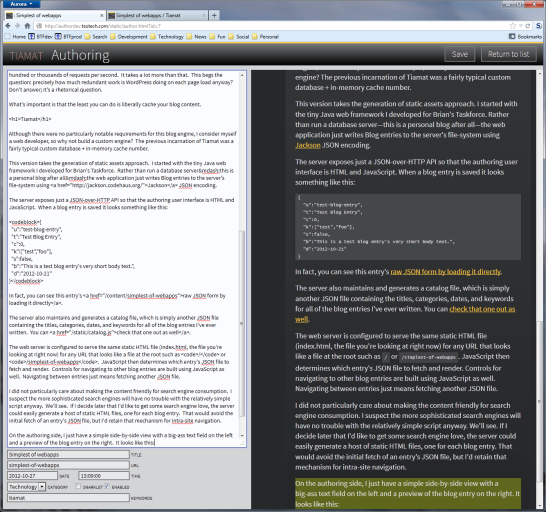
I love the markdown editor, especially the auto-scrolling feature.
The only problem is that it doesn't really scroll to the part you're editing - instead it assumes that if you've scrolled to 50% in the markdown code, the preview should also scroll to 50%. Add a couple of images and this assumption becomes false.
I know this is hard to do (involves hooking into the markdown parser) but it would truly be a killer feature.
I posted this in the other thread, so I apologize if it's redundant. I agree, auto-scrolling the preview panel is important. In my personal blog, I didn't use Markdown, but rather just plain HTML (with some minor tweaks). What I did to synchronize the editor and preview was:
1. Find the shortest path out of a currently-edited tag (look to see if the cursor is between a nearby set of < and > characters). In most cases, the cursor is not in a tag, so this is not needed.
2. Insert an empty marker span.
3. Find that span in the preview pane.
4. Find the span's parent block, add a class to that block to highlight it, and then scroll to its location.
Go ahead - type in some markdown, then edit the page. You'll be presented with a two-pane view. Your markdown is rendered dynamically. When you're done, just choose the access level for the page (public/private) and you're good to go.
I'm willing to bet they will finish it anyway. I'm sure a lot of us know that feel when you get something to prototype, holy crap it works stage. Something that you would use in the future with the bonus that many others may too. That feeling when you have to finish the project at least to a point where it works properly.
They have that feel, but they also want some money for their troubles - to justify/legitimize it as worth their time.
It's a blogging platform after all. Their feature set could be done by one man in 2 to 5 weeks time with some experience and perseverance. I hate to belittle it below its merit, as I do think some features of Ghost make for something potentially useable. The project also could be nice because of the so-called committed team behind it maintaining it into the future, as Wordpres does.
I'd like to back this but, it looks great but there seems to be some conflicting info between their words and the kickstarter parameters. They say they want to deliver something, I'm guess it's alpha-ish code by summer, but the 120 pound pledge level says you get access 3 months before everyone else (meaning it would have to be right around the corner) but it's slated for a November 2013 estimated delivery?? Are they tying the Nov 2013 date to the release of the community site?
I'd just like some clarification of when I can get my grubby little hands on some code, especially if that date will change based on funding levels.
Probably as good a time as any to mention this, but I've pushed up a work in progress Obtvse 2[0] to my github. With a user account system, live filtering, easy themes via pull requests, and quite a lot of improvements. It will be undergoing many changes over the next few weeks but is worth taking a peek:
My first reaction to "Free. Open." is where's the github link? I know you're funding the development with KickStarter, but free and open projects should still having the planning and initial development in the open. That way you can get feedback more easily, solicit contributors, as well as get early adopters.
If you want me to give you money, I'd like to see progress (and provide feedback) along the way, not just wait for the v1.0 release.
So in this case, it seems like you're using "Free and Open" as a label to get interest, but you're not really that keen on actually being open.
I understand why kickstarter exists, and I think it's a decent tool for some projects. That said, it's difficult for me to back something that's only screenshots and a brief "this is totally how it works" box on the main site. I want to be able to check out how the product works from the inside out. If I believe in it, I'll put money towards it. If I don't, I won't.
In this case, I can't demo it to a point where I'd say "this is a worthy product."
> if there was a decent node.js based jekyll replacement, I would be using that.
I wrote https://github.com/marijnh/heckle to fill exactly that role. Though it only does the parts of Jekyll that I happened to need for my own blog. Calling it 'decent' might be pushing it.
Interesting project, I don't really have anything to say beyond what the other comments here point out. Slightly off-topic, the /features.html page makes a really nice informative homepage. Their actual homepage is useless; it reminds me of the "Enter here" landing pages of the 90s. Is there some reason to structure the informational site this way that I'm missing?
What happened to the original plan to base Ghost on Wordpress? I love Node as much as the next guy, but surely basing it on Wordpress and therefore PHP would make it much accessible.
Basing this on WordPress is a bad idea. At a certain point to move in a different direction, you can't be shackled to an existing thing just because it's popular.
"I see the future of WordPress as a web operating system" - Please no no no. Having worked with Wordpress for the past few weeks, I sincerely hope I never have to again.


Possibly my ire was raised a bit further by the fact that I found that out in what seemed a slightly bait and switch-y way - "Try this!" click "Maybe later if you pay us!" Hmmmm.
Those gripes aside, it looks pretty.