This is going to be a lot more revolutionary than a lot of people think. I mentor Lego Robotics teams, and this year's season will mark my eighth year doing Lego Robotics. During this time, I've shown the kids (ages 9-14) hundreds of programming-related things, ranging from quadcopters to Arduinos to WebGL experiments to Leap Motion devices, and what never fails to captivate them is when they make the Lego Mindstorm brick display something.
When kids on the team seem reluctant to start programming, I always bust out the smiley face demo: they push a button and the smiley face smiles. It's ridiculously simple, but that's part of the appeal - they see that it's simple and they want to know how to do it themselves. If I were to show them an Arduino blinking out a message in Morse code using an LED, they assume that it's over their head and could care less how it was done, but when I show a simple demo using the Mindstorms display everyone's captivated.
Each Mindstorms brick costs $200-$250, and parts can add hundreds of dollars to this cost. Since the price of the MicroView is 4-5 times smaller, there can be 4-5 times more people captivated by them - not to mention how school districts that have fewer funds can now introduce students to programming as well.
Yeah, this would be great for kids, especially with a good library. Mindstorms really is a great start, and I think that comes down to two things, the physical, and the programming- physical because it's fun making things move, especially things you made, and mindstorms programming is so unbelievably simple in design, and yet so very effective. This seems to grab both parts, it has a nice interface, not too big as to be daunting, nor too small to be useless, and there are tomes written about arduino programming
If you're interested in more advanced mindstorms, check out robotC and similar alternatives. They offer a lot more freedom with coding, so for the more advanced kids, it offers actual code, and a variety of very cool functions.
I've tried to get the kids to start with robotC and friends but with the short length of the season and the "intimidation factor" of writing actual code I rarely get past a simple "Hello world."
The kids that are interested in coding usually get started when I show them Eloquent Javascript - I suppose its introduction is more simple and captivating than most other books.
Looks interesting. I would have chosen this for a couple of past projects. $45, but you get a display for that. Even if you think you can communicate enough information with a few LEDs by the time you think about assembly time, packaging, and explaining the LED meanings this is an easy choice even if you just need to indicate a few states or a scalar value.
• 64x48 monochrome OLED
• In a forward facing case suitable for exposing to users. You'll still need to enclose the back.
• Tiny. Looks to be about 2.54cm square, depending on the size of his fingers. Not Arduino form factor.
• ATmega328P (32k flash, 1K EEPROM, 2k RAM)
• 12 I/O pins, 3 with PWM, 6 can be analog inputs, 5V logic
• Serial pins, no USB (but you can make ghetto if you need to with a couple resistors) There is a USB sled available for programming.
• 3.3V to 16V power input. No external components required.
• 600% funded, 25 days to go. Estimated delivery is August.
> if you think you can communicate enough information with a few LEDs
We actually started with that concept and made an Arduino compatible called the Magpie (basically an Uno with an LED on every IO pin see: http://littlebirdelectronics.com/products/magpie-100-arduino... ). Whilst the Magpie was a step forward it wasn't quite good enough, hence building the MicroView.
Few comments on here suggesting that it might be over priced, and yes it probably is, however some people like my self just want something simple to play around with, without buying loads of different parts when you don't really know what's required, if that costs me a few extra dollars to be lazy well that's ok with me :)
Never used an Arduino before and like the idea of having a screen to use, so ordered one to play around with.
Good luck with the project!
Edit: Just realised, I'm a long time lurker on KickStarter, but this is my first backing!
I don't think it is overpriced at all, I think the price is pretty perfect for what it is; not really that much higher than you would pay for one-offs of other small Arduino-alikes (sans any kind of display, but sharing the same lack of meaningful physical shield compatibility) and the screen would be really useful and/or cool in a lot of situations.
Hmm, cute. A bit perplexing though. My sense is that at $20 each this would be something one could use as parts to other things, at $45 each one definitely has to be more reserved. And what about four or five? Given they blew through their Kickstarter target I'm guessing a lot of these will be out there and I'm really interested in seeing the cool applications that people will put them too, but I am still struggling with the value proposition.
A large portion of that $45 goes to the "Free Worldwide Shipping". We're looking at offering multiples in a package but it's a grey area on Kickstarter:
>Offering multiple quantities of a reward is prohibited. Hardware and Product Design projects can only offer rewards in single quantities or a sensible set (some items only make sense as a pair or as a kit of several items, for instance). The development of new products can be especially complex for creators and offering multiple quantities feels premature, and can imply that products are shrink-wrapped and ready to ship.
We might be considered a sensible set, or we might not. We're reaching out to Kickstarter now.
I have a feeling this is where hardware prototyping is going to head, at least part of the time. Smaller, specialized and perhaps plug-able units coming together. Anyone can make a wonderful little device, I would hope.
Rather than components, they'd be like 'appliances' in a data center.
A teeny-tiny little data center that was itself an appliance. neat!
This looks nifty, but I think it's a touch overpriced given that you could buy an OLED breakout on eBay for £5 and a tiny Arduino clone for about the same price. If you're at the level of programming the thing anyway, it's not that much more effort to clip two things together and find a library. Granted it wouldn't be in a fancy box, but I would be willing to sacrifice aesthetics to save £20.
I'd be interested to see one with an Atmega32U4 so that you didn't need the USB backpack. Having native USB would make things a lot more compact.
Also it looks like it's going to possibly block the second port on the Pi depending on which one you use.
Thanks for your feedback on price. A large part of the $45 is FREE Worldwide Shipping.
A huge point of the MicroView is that it's finished in a way that allows beginners to just plonk it into a breadboard and get up and running with Arduino. It's a bridge so they can ultimately get to the point where they can go to ebay and stitch parts together.
Re: Atmega32U4
We are aware of the Atmega32U4 but, we really wanted to build an Arduino in a chip form-factor. We'll be taking into consideration the Atmega32U4 for future versions.
A large part of the $45 is FREE Worldwide Shipping.
I think that's a disingenuous use of the word free. It's more like subsidized worldwide shipping, or normally-priced worldwide shipping paid into by everybody (even locals).
In that case is there any benefit in waiting until you have widespread adoption and/or local distribution?
Pricing is always going to be a delicate balance. On the one side you want things to be simple for beginners - and in this regard Arduino is right up there - but on the other hand it needs to be affordable. To be clear, I think this is a great looking product and I'll probably get one.
One of my hangups with the Arduino ecosystem in general is that you can buy the core for $20 or so, but you're stung when you buy any of the shields to go with it. This has kept me to using plain AVRs or 'minimalist' Arduino boards with just the bootloader. It got to the point where I taught myself PCB design because it was cheaper to make my own breakouts and buy the components from Farnell/Digikey.
Does the 32U4 really limit you that much? It comes in a QFN44 which is ridiculously small - I have a Sparkfun Pro Micro which fits into a breadboard with room to spare (and could be shrunk further if you removed the silkscreen labels). USB would possibly add a bit to the length, but it would fill a niche.
Given that:
- ATmega328P AVR CPU is ~$2 / 5k units
- a 64 x 48 monochrome OLED display is ~$2 (<http://www.aliexpress.com/item/0-66-inch-oled-64-x-48-Amoled...)
- Given its small size and simple shape, I estimate the mold for the enclosure to be ~$2000, so < $0.50 per unit
We are speaking of a $5 cost. Ok, let's get a margin and double this figure.
Even counting for Premium Worldwide shipping, I can't reach the listed price.
This is what I think of almost every 'hot new thing' on kickstarter, and they invariably smash through their targets without batting an eyelid, as this one has done (over 6.5x goal with 25 days left). Price aside for a moment, it looks great.
I'm both charmed and appalled. Connect your Arduino to your RasPi? Convert it into an OLED necklace? If this campaign was starting a week from now I'd wonder if it wasn't a stealthy parody of Arduino hobbyism... But it does seem both charming and useful.
Yeah. I'm sure the current case is useful for the stated purpose ("easy to grab and use in a breadboard"), but for people trying to use it in some application, the pictures of the raw (really tiny, hardly any bezel!) display and accompanying (slightly larger) processor board look much more enticing....
I'd be interested in seeing statistics on how well Arduinos that aren't compatible with shields sell. In my opinion, Arduino's biggest contribution to making it easier to get started in embedded development has been shields and the compatibility they bring.
Code can be shared easily. Users can debug others code over the internet. The same cannot be said with hardware, at least to the same degree. Schematics and the physical implementation of a circuit are not the same thing. Having the peripheral hardware on compatible PCBs fixes that problem.
> Arduinos that aren't compatible with shields sell
You mean, bare AVRs? ;)
(And a separate USB-to-UART and AVR ISP devices, as one-time purchase or even DIY project. Actually, I use Arduino solely as those two and do all prototyping - including MCU - on a breadboard.)
Have a look at circuits.io. It's a platform for collaboration and sharing of complete design: schematics + pcb's a modules, with plenty of shared modules.
I'm a fan of Marcus' work; I would have backed this even if it was half as useful. Given how great it is, I didn't even need to worry about that. :) Looking forward to receiving mine!
I'm sure there's a reason for not having the package flat all around but the convex shape on the pin-header side seems to make it a lot thicker than necessary.
I would have liked to make a watch out of this, but something that big would look obnoxious. Great idea nonetheless, I really enjoy seeing all these ready-to-work solutions for the maker community.


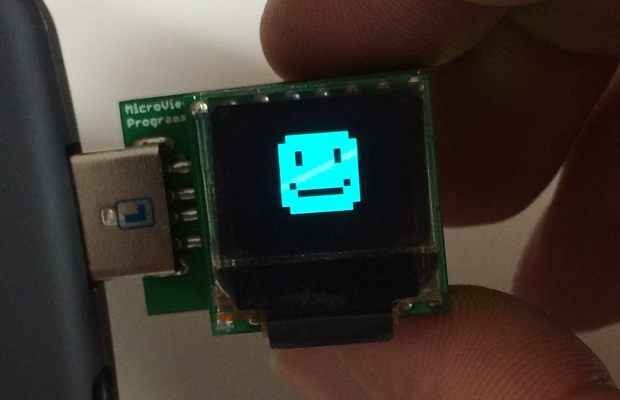
When kids on the team seem reluctant to start programming, I always bust out the smiley face demo: they push a button and the smiley face smiles. It's ridiculously simple, but that's part of the appeal - they see that it's simple and they want to know how to do it themselves. If I were to show them an Arduino blinking out a message in Morse code using an LED, they assume that it's over their head and could care less how it was done, but when I show a simple demo using the Mindstorms display everyone's captivated.
Each Mindstorms brick costs $200-$250, and parts can add hundreds of dollars to this cost. Since the price of the MicroView is 4-5 times smaller, there can be 4-5 times more people captivated by them - not to mention how school districts that have fewer funds can now introduce students to programming as well.