I love playing sports and always have. But I have major issues with categorizing everyone who has issues with them as elitist.
Some of us dislike them because they're destructive to society. I'm sure I'm not the only one who went to a high school where athletics were more important than academics, and not going to the football game was worth a couple nitpicked points off on your chemistry quiz or some teacher who became a teacher solely to coach had you spend their class taking notes from a text book every day while they jawed around with other coaches in the back room.
I feel like sports culture deprives lots of regular public high school students of an education, and I don't think it's elitist at all to dislike professional sports for their contribution to this mess.
I love sports, but every time I watch or support them I feel like I'm destroying civil society and undermining democracy and helping to destroy the last vestiges of effective public education.
> I feel like sports culture deprives lots of regular public high school students of an education, and I don't think it's elitist at all to dislike professional sports for their contribution to this mess.
While I respect your position I feel that you really don't understand the perspective of sports from the athletes side.
You're completely glossing over the positives that sports bring to the lives of people involved in them, especially those who take it serious. I've been writing code since I was 13-14 years old, but I've been testing myself physically and mentally since I was 8, thanks to a life long 'career' of playing baseball. Nothing in my life has taught me more about who I am and what I'm capable of, both mentally and physically, than my time spent in team sports. And that's saying nothing of the social growth and life long friendships and connections made.
I'm just a middle class white kid who had far better options in life than to pursue professional sports...but for those less fortunate, the education they get from their sports teams/coaches/careers my very well be the best 'real life' education they'll ever get.
Calling sports destructive to society seems so completely asinine to me that it's comedic. Then again, my perspective is quite different than yours.
That's not his point though. His point is that for every bit of handwringing of how ghastly some people's comments on sports are, there's the reality that the football coach is the highest (in the millions of dollars range) paid position at almost every university in the US, how the sporting department despite those figures manages to be a net budgetry drain on almost every school which has one, and the reality that college-level sports is hugely abusive and exploitative to the players which actually play it.
>how the sporting department despite those figures manages to be a net budgetry drain on almost every school which has one
And so are music departments.
Which I think is part of the point here. I firmly believe that playing right tackle can teach you just as much as playing the oboe, yet intellectuals tend to look down on former and praise the latter. Organized sports are not only a hobby and social gathering, but they can also serve as part of a greater learning and education experience. There is a reason why a few of the Ivy League schools rank near the top of all universities when it comes to the number of varsity athletes.
>that college-level sports is hugely abusive and exploitative to the players which actually play it.
You need to be specific here. Big revenue college sports (basically only Div I basketball and Div I-A football) are definitely exploitative, but most college athletes participate in sports that generate little revenue and it would be hard to argue they are being exploited.
Music departments are budget drains since when? The arts and humanities are actually rather cheap, they need nothing more than buildings, staff and a library. Science and engineering are the real whoppers, and as a rule cross-subsidized by A&H. Tuition per credit hour is the same, after all. The dean of the School of Arts & Sciences at a certain state school is on record saying that for the price of a chemistry professor she can pay a whole department of English.
That isn't the point. The point is that the mission of universities is academic pursuits, not athletics. If anyone wants to practice sports, power to him, but let him join the sports club, or let him start an inofficial intramurine league.
The wider point is that in America you can't earn much social capital by being knowledgeable about any academic subject, you have to be wealthy instead. That's a problem, and probably also explains many things about American society. Universities finally getting rid of organized sports might perhaps be able to change that.
Music departments tend to be expensive in terms of faculty, sine most of their time is spent in private lessons. If an oboe studio has 10 students, that's essentially 10 hours a week in lessons alone. In that same 10 hours, an English professor might teach 60 students (if you figure 15 students/class with 2 hours MWF and a different 30 students Tue./Thu.). Those are numbers for a small school; at larger universities an English professor might lecture to 300 students a week in 10 hours, but that oboe professor is still seeing just 10 students.
Huh? Are you talking about college? I thought the OP was talking about high school. We never had any private lessons. "Band" class was... 35+ kids in one room at a time, all playing at the same time. Band was almost always the largest single class I had, relative only to gym class. Sometimes gym was larger (40-50 at a time), but I think I had a year with more people in band class than in my pahys-ed class.
Like you say, a distinction has to be made between big and small schools. I did my undergrad at a college where the starting quarterback was a physics major. There were no athletic scholarships.
Where I went to grad school, that would have been unthinkable. There was a special major that most of the football and mens basketball players chose, one of the departments of "studies."
There's no university where the oboist in the orchestra has to be given a fake education. Indeed, most music majors these days wisely pick up a second major.
> >how the sporting department despite those figures manages to be a net budgetry drain on almost every school which has one
> And so are music departments.
If the band directors made millions of dollars, you would have a good point.
If band directors brought in millions in revenue and PR value to a school, then YOU would have a point. Nobody would have ever heard of Gonzaga university if it weren't for basketball. At the schools with million dollar coaches, they bring in millions in revenue in both tickets, licensing as well as intangible PR value. I am not defending or disparaging college sports, I am making the point that a school's band program isn't generally adding revenue. It rarely attracts big donors. While Div I sports might have an operating loss (maybe,) the net income to a school, through donations, PR value, etc far exceeds the cost. How many kids want to go to Florida State that don't live in Florida? By attracting more national applicants, a school can charge out of state tuition that directly benefits their bottom line. There are many benefits to a school that aren't measured with the myopic view of "athletic income - athletic cost = profit of the program."
If the donations go to the athletic programs, then it doesn't matter. There are also numerous hidden costs associated with athletic programs, like law enforcement and extra tutoring for athletes. On top of that, most schools require ALL students (even those who don't attend sports games) to pay a fee, which acts as an additional subsidy. Even further, many public universities use part of the money they receive from their respective states to fund athletic programs.
The band students pay tuition to be there. If the football players paid tuition to be on the team and the sports teams were subsidized at the same rate as the band program, I wouldn't care.
There are a handful (maybe 20?) of schools that probably make an overall profit from their sports teams, but the rest of the thousands of colleges and universities in the US operate their sports programs at a loss. Those are really the schools I'm talking about.
I can't speak for every school, but I will share my own insight on a big football university
I attended a state school where the "highest paid public employee" was a football coach. I was lucky enough to marry a then student president of the professional students (Med, Vet, Opt, Dentist, Pharmacy, Law) and as part of her duties she sat on the athletic counsel. Our tuition did not go to the coaches at all, the athletic dept was entirely self funded and donated the excess to the school itself. They helped fund a library renovation while we were there, among other student oriented needs.
Also, because of the success of the football team they are able to fund (again without student money) all the other sports "no one cares about" eg men's badminton or women's olympic weight lifting or something... The majority of THOSE student-athletes truly are students then athletes.
Take away the good football and the other things become harder or impossible to achieve. I'm not saying sports should be considered a loss over academics, but some people enjoy both and are not going to the NFL
In contrast, at my university the football team had two 1-11 seasons in a row, and the head coach was finally fired after losing the first four games of the next season. It took so long because the school was wary of the $1.4 million cost of letting him go early. (He wound up getting paid for the entire third season, and $150,000 each for the next two years.)
Somehow I doubt UNM’s football team is able to cover the cost of the athletics department. The coach in question was Mike Locksley.
Sports is a huge financial drain on the school? Do you have any data? What I heard was that college football tends to pay for all of the other sports at a school. If anything sports creates a lot of opportunities for students that otherwise could be done due to budgets.
> What I heard was that college football tends to pay for all of the other sports at a school.
Yeah, at the most successful football schools. That's a minority among schools that have football programs. [1] [2]
>If anything sports creates a lot of opportunities for students that otherwise could be done due to budgets.
No, sports diverts scholarship funds from scholars to athletes, and the athletes rarely take full advantage of the academics in college, going for easy classes and easy majors. It actually destroys a lot of opportunities, particularly at schools that are losing money on their sports programs.
Feel free to search that image from other sources too.
And the data backing it.
And yes, this is not the same as it being paid for by academics...but then you have to deal with the fact that most top-tier sports departments also fail to break even, and it's extremely murky if they contribute anything back to academics at all - whereas it's pretty visible that they are allocated money out of the academic takings. [http://www.ethosreview.org/intellectual-spaces/is-college-fo...]
EDIT: All of which again, would probably be worth turning a blind eye to if it were a good thing for the players...except it isn't. Because they don't get paid.
I didn't say anything about coaches with million dollar contracts. I was responding only to the claim that football pays for the rest of the sports, which, other than men's basketball, are pretty much universally unprofitable.
If only a few schools' football programs fund the other sports, and all schools have a lot of sports, it only follows that most schools are losing money on sports, no matter how much money they pay their coaches.
That said, many unsuccessful football programs still have coaches with multimillion dollar contracts, so you're still wrong.
>It's a nice bait and switch you constructed. A "trick play" if you will.
This added nothing to the discussion and wasn't even a fair accusation, since I wasn't arguing anything like what you suggested I was. If I were being uncharitable, I would accuse you of intentionally misunderstanding my argument for the chance to be snide.
Scholarship money comes from a lot of places, but usually from wealthy alumni.
It definitely doesn't come from sports at most American universities.
There's something for the argument that sports attracts students who will become wealthy alumni and donate after graduation, but AFAIK, there's no data proving it, and some that contradicts that notion.
I loved playing basketball, too. But then in high school I could choose between taking advanced math classes or basketball PE, which was required to play on the basketball team. That kind of choice shouldn't be the kind of choice a high school student should have to make.
There were many more example of trade offs like this, almost all of which undermined any ostensible focus on education.
These kinds of things have nothing to do with whether playing sports (on a team or not) can be a positive experience or is good for people.
I love sports, but every time I watch or support them I feel like I'm destroying civil society and undermining democracy and helping to destroy the last vestiges of effective public education.
I'm not a big sports fan, but pro sports does serve a purpose.
Sports in general is ritualized hunting / warfare. A civilized and less brutal version of war, but the roots are clear. The skills used are the same as our ancestors used to survive: running, throwing, tackling, hitting things with sticks. That's war.
Watching sports is a celebration of those ancient survival skills, though they don't have much place in modern society. These urges exist within many of us, and need an outlet. Sports is highly preferable to the small-scale skirmishes that frequently occurred in centuries past.
Many people feel the strong call of tribalism too. Us versus them. Rooting for the home team, and feeling their ups and downs as your own is also wired into us at a deep level.
It would be a lot more effective for society if we were pitting city governments against each other, seeing who can deliver the best services at the lowest taxpayer cost. But I'm not holding my breath for someone to set that league. :-)
> Sports in general is ritualized hunting / warfare.
Ritualized, sure. Hunting / warfare? Depends on the sport.
Dancesport is a thing, and its assuredly not ritualized hunting / warfare.
> Sports is highly preferable to the small-scale skirmishes that frequently occurred in centuries past.
Sports is -- and has been for quite some time -- a frequent focus of the small-scale skirmishes much the same as those you paint it as an alternative to. I'm not sure its much of an outlet.
> It would be a lot more effective for society if we were pitting city governments against each other, seeing who can deliver the best services at the lowest taxpayer cost. But I'm not holding my breath for someone to set that league.
Actually, before those "small-scale skirmishes" were so frequently outbursts about sport, they were often outbursts between the backers of different political factions, ideologies, or groups striving to shape society (we still sometimes have those, too; sport may have kept the violence while removing the social purpose to a certain extent, but not entirely.)
Dancesport is a thing, and its assuredly not ritualized hunting / warfare.
The main topic of conversation is the widely popular professional sports such as Football, American Football, etc. These sports have attackers, defenders, and so on.
Sports is -- and has been for quite some time -- a frequent focus of the small-scale skirmishes much the same as those you paint it as an alternative to.
I don't see that as the proximate cause of most conflicts throughout history. Mostly, it seems to be about resources, and sometimes ideology too.
> I don't see that as the proximate cause of most conflicts throughout history.
No one said it was the proximate cause of most conflicts throughout history. Nor have conflicts in general stopped since sports became popular, nor were conflicts in general part of the discussion.
What was asserted upthread was that sports was an outlet that prevented "small-scale skirmishes". I simply pointed out that, in fact, professional sports are -- and this is true globally -- well-known as focuses of small-scale skirmishes and social violence, rather than an outlet which prevents them.
Ah, are you talking about modern-day football hooligans?
When I say "small-scale skirmishes", I'm talking about relatively small border conflicts and the like that last less than a year and kill tens to hundreds of people. As opposed to regional or national conflicts where the casualties get into the thousands or much higher.
Are you talking about football in the American sense or to describe soccer?
I can't speak for the rest of the world, but in the UK football hooligans are a dying breed. There have been a few Hollywood films made about UK football hooligans, but it's more about the situation at it was in the 70's/80's.
I'm not an expert on it, but it strikes me it was born out of boredom. You'd travel to an away match, see some goalless draw, and had wasted your weekend. The scrap may have started as some sort of consolation prize. Anyway, now the games are televised, prices are more expensive and the audience has become broader so the environment that bred it has gone. Some firms still have a reputation, but it's increasingly irrelevant.
I wonder what fuels the hooliganism where you are.
Are you talking about football in the American sense or to describe soccer?
No, I was asking if dragonwriter was referring to football (soccer) hooligans from the UK or other countries. Argentina guys in particular seem to get pretty rowdy, and there have been murders too.
But there isn't any sort of hooliganism where I am, I was just trying to figure out what dragonwriter was talking about with regards to pro sports being the focus of conflict. Which I don't see being anywhere close to the level of conflict (like actual war) that I was talking about.
Okay then, in that case I'd say sports aren't the focus for conflict, they're a convenient excuse for it. Fighting is always its own domain, other surrounding factors are just window dressing.
> When I say "small-scale skirmishes", I'm talking about relatively small border conflicts and the like that last less than a year and kill tens to hundreds of people.
Football skirmishes that kill people on that order aren't unheard of, and I know of no evidence even suggesting that the popularity of professional sports even correlates with (much less causes) a reduction the kind of small-scale skirmishes you discuss (even before considering whether the degree of such effect is offset by violence directly associated with sport.)
Swimming is ritualized warfare? That argument sounds like something one might come up with if they had a freshman philosophy paper due the next day. We could say that grocery shopping is ritualized hunting or that a piñata is an encouragement of ritualized torture. There comes a point when the intellectual threads holding together an argument approach absurdity.
High school athletics is a problem in some ways, but don't throw the baby out with the bathwater.
Robert Putnam is a political scientist of some renown. One of his major contributions was a study he did in Italy over 40 years. His question was why was government in in the north generally more efficient and just all around better than politics in the southern portion of the country.
His conclusion was that northern Italians were much more heavily involved in civic clubs like religious groups, labor unions, and ... soccer clubs, which created social capital, and horizontal networks, unlike the hierarchical networks in the south which created clientelism and gangs.
Sports fanhood and clubs may actually make democracy better. They certainly foster community. There are bigger problems in this country.
>I love sports, but every time I watch or support them I feel like I'm destroying civil society and undermining democracy and helping to destroy the last vestiges of effective public education.
Hyperbole. In a lot of ways, sports can bring a city or group together in ways that other events can't.
I feel like this is where I have to make the usual acknowledgement that yes of course the NFL is run by a bunch of morons and yes of course head injuries when you're a young kid are a bad thing.
It's the coming together / tribalism part that unnerves me. There's no rational reason for people to get so excited about it, so it rubs me the wrong way the same way most political rallies do. Small scale sports don't have quite the same effect on me, but large heavily marketed ones do as there is a pressure to conform (i.e. care, participate, hold certain opinions that positively reflect on the enterprise).
>It's the coming together / tribalism part that unnerves me.
Why? Is community bad? I need that argument to be unpacked a bit more, because for me my experience living in several different cities as their teams make a playoff run has been a fun, electrifying experience. Neighbors are hanging out. Kids are having sleep overs watching games. There's a (usually very) healthy bump to the local economy. For all the room-for-improvement there truly is with managing the sport, the sense of community is what's actually valuable to me.
I think those effects are good, but I also recognize that because these effects are unmoored from anything real we're dealing with nearly pure social signaling amongst a mass responding to tribal tendencies.
Of course, having something that serves as a community focal point that crosses faith boundaries is invaluable - nearly any time new people meet powerful things happen.
However, I take issue with your point about the economy: A local bump means that there was a withdrawal from somewhere else in the economy. If it came mostly from savings rather than from shifting consumption from other locales, then it generated increased consumption, which depending on the macroeconomic condition, could be good or bad (though during the latest recession, inducing an overall increase in consumption sounds like the right thing to do). It's not clear whether this is a good thing or not. Why should I prefer the shop owners in your town versus some other town to temporarily enjoy increased profits? There might be a good reason, but for a disinterested third party, odds are it's a wash.
Your argument is cogent and expresses my own thoughts well.
>> having something that serves as a community focal point that crosses faith boundaries is invaluable
This is true up to the point that team allegiance is weaker tribalism than faith. Growing up in Manchester and not swearing fealty to red/blue, admittedly less so than orange/green in Belfast, was still more troublesome than it needed to be.
Yet all this seems a matter of identity development. My younger brother felt the opposite pressure of having to grow up in a family uninterested in sports. Each of us were yin surrounded by yang (or vice versa).
I feel the article's writer may have given up something more valuable when he arbitrarily adopted another identity for the sake of broader communication. Unless he had a latent need to belong to a group more deeply and is merely rationalising it in the article.
>> There might be a good reason, but for a disinterested third party, odds are it's a wash.
That's the nub of it. Tribalism in any form wants adherents to reinforce that there are no disinterested parties. You are either with us or against us. Depending on your starting assumptions, that's either valid or completely spurious.
I think that's a very sad and depressive way to look at sports fans, and indeed I think the argument that they're part of some fascist tribal conspiracy is silly and immature. I guess my experience growing up as a baseball fan was less "tribal" than football fans in Europe, but I don't think that's reason to decide that the whole experience is without value...which I think is what's being implied here and elsewhere on this thread: that if you haven't experienced this terrible tribal nature of sports fanatics then you've been duped and don't know it yet.
On the whole, I think everyone is reading into this wayyyy to deeply. If anyone wants to enjoy a beer and a hotdog at the ballpark of their choosing, let's do it. 20 days until pitchers and catchers report.
I deliberately delimited my position to mitigate counter-arguments like this. We do agree that, to the extent following sports is low or completely non-tribal it is innocuous. Presumably, baseball was/is like this for you. I also allowed that for some people such as my brother and, perhaps for the article's writer too, belonging is a deep need which can be satisfied by some form of tribalism.
My next point might be a bit of a stretch, but I would invite you to consider the possibility that your comment is itself a weak exemplar of the tendencies I disliked growing up in Manchester.
"othering" the others :
>> I think that's a very sad and depressive
Appealing to the in-group for emotional support :
>> If anyone wants to enjoy a beer and a hotdog at the ballpark of their choosing, let's do it. 20 days until pitchers and catchers report.
deliberately misrepresenting outsiders and making a loud noise doing it :
>> the argument that they're part of some fascist tribal conspiracy is silly and immature
Baseball is... much slower than european football. I grew up as an american baseball fan, but could never understand the fascination with american football. Ever. It's just a weird game, but it tends to be faster than baseball, and certainly more physically intense (tackles, etc). And soccer, basketball and hockey are even faster. The speed tends to hype people up, I think.
It feels easier to watch a baseball game from the stands without getting "worked up". I can easily watch a bb game and be relaxed. I never felt able to relax at a basketball game (by comparison). I imagine it's easier to relax at a cricket match vs a soccer/football match too.
I guess I grew up always thinking about the math aspects of the game (dad was a bond trader), so even hockey for me, which is probably the least deterministic of the professional sports, is fun to watch. American Football has always been my least favorite...but probably because that sport's been immune to the kind of deep-level analysis (at least until recently) that a sport like baseball (and even basketball) are subjected to. So, I guess I agree with your perspective insomuch as it involves how "deep" someone can get emotionally involved with a game. Soccer though to me is just mind-numbingly boring - so the "tribal" nature and violence associated with European soccer fans is a complete mystery to me.
I also have the same reaction, but not so much for the irrationality of being excited. Generally it feels good to win, and it feels good to watch someone you like win, regardless of why you like them. What I really really dislike about the affair is group signaling. (Which is a signal of my belonging to the small group of people who detest group-signaling, but nevertheless...) Enjoy watching the game all you want, even as a crowd, but the moment the "we" comes out I have that reaction. I see so many society-wide problems stemming from mere classification of people into groups, and the so-natural next step of individuals of those groups making the group part of their identity. One of the creepiest social experiments I know about is the Robber's Cave experiment: http://lesswrong.com/lw/lt/the_robbers_cave_experiment/
Is there a 'rational reason' for anything animals do by instinct? Perhaps you are entirely rational, but most homo sapiens are not so different from our primate ancestors who lived in tribal groups.
I have the same almost instinctive reaction. I think we're probably guilty of it as well, just not as aware of the shape it takes (just look at the emacs vs vi folks, perl vs php, .net vs j2ee).
You said Nuremberg, not me. ;) That's an extreme case.
It's more that when I see that effect, I have an uneasy feeling that a trigger could set things off the rails or shut off critical thinking or modify social standards for certain acts. I'm a bit of a contrarian at heart, so it's something of a non-specific mental immune response.
In fact, at (EU) football events, soccer hooligans are widely known for being violent. In the US, commercial and government propaganda are often dispensed in a socially validated environment. An alarming trigger (or a home-run that lands in the stands) can cause a stampede at stadia. I recognize that the more extreme examples are relatively rare occurrences, but they are more common than on say the street per square foot.
The irrationality of the crowd is something that unnerves me. I've been to games, so it's not like it's some paralyzing anxiety, but I feel some creepy crawlies at times.
Let me give you an example of a cohesive social situation that wouldn't creep me out: A town coming together for disaster recovery, where the people signaling cohesiveness are actually directly affected or are participating in the recovery effort. On the contrary, when people that are totally unaffected come together, it feels more uneasy to me because they are responding to a story being told on the news and are in a condition where simple manipulation is possible as they are not responding to advance their own interests (so certain sanity checks are disabled) and they do not have a good way to verify the story they heard.
That's an interesting perspective, in a similar wheelhouse to my own, but I don't blame professional sports for the many ills caused by school sports. You picked on high schools, but the problem is far worse in colleges. I much prefer the european model, which focuses on clubs rather than schools.
The clubs model brings a different set of problems, especially in populations already divided by religion or class. See the sectarianism and tribalism that have developed around the Old Firm derby in Glasgow, for example.
If sports weren't the basis for cliques, it would be something else. Eliminating sports would not make high school any better, people would just organize into different exclusionary groups.


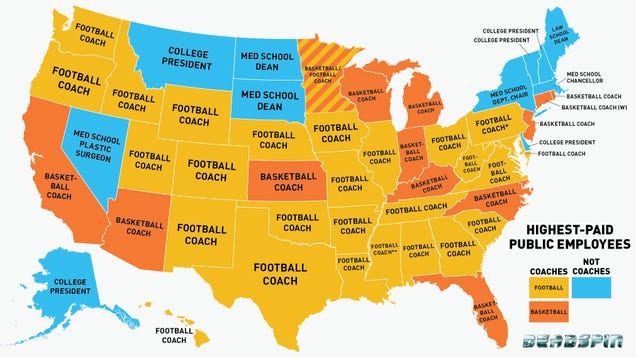
Some of us dislike them because they're destructive to society. I'm sure I'm not the only one who went to a high school where athletics were more important than academics, and not going to the football game was worth a couple nitpicked points off on your chemistry quiz or some teacher who became a teacher solely to coach had you spend their class taking notes from a text book every day while they jawed around with other coaches in the back room.
I feel like sports culture deprives lots of regular public high school students of an education, and I don't think it's elitist at all to dislike professional sports for their contribution to this mess.
I love sports, but every time I watch or support them I feel like I'm destroying civil society and undermining democracy and helping to destroy the last vestiges of effective public education.
And I'm not elite or upper class.