For me, the biggest problem with Twitter are their Draconian rules concerning third-party apps. I had several ideas for cool apps built on top of the Twitter API (e.g. a Twitter-based news aggregator, an online volunteering app, ...), but each time I gave up on the idea after reading the terms of their developer program:
No showing of tweets with content from other social networks, no altering in the presentation of tweets, very severe rate limits, ....
I think if Twitter wad a little less paranoid about protecting their content they could actually become a viable and useful communication tool for a large part of the Internet (even more than today).
>No showing of tweets with content from other social networks
Where does it say that? I've been working with folks and using products that do exactly that and they haven't had issues. Yes you have to display it like Twitter wants, but I've not seen any limit to also showing FB or other content.
That only applies to showing a timeline. So you can't mix @user on Twitter with @user on Instagram in the same timeline. But if they aren't grouped, no problem. It also doesn't apply if there's human selection going on, a manual process. (Dunno if you can automate that with e.g. MT, heh.)
That seems reasonable. I don't like any of this social media stuff, but Twitter has the best APIs. Maybe because they sell access, so they want it to be a good product?
There are similar clauses in the requirements that apply to single tweets, and which e.g. prohibit the display of any social media buttons like "Like", "Share" etc. along a tweet, and that are pretty strict on the formatting of the tweet content itself.
They mean you can't mix the timelines together into one timeline. That seems to make sense to me. If you have a twitter timeline (which is different than tweets being displayed), it can only be Twitter.
The way I see it, third party applications increase the value of using twitter, bringing more users to it. Twitter as a social sharing tool has very little value to me, personally, but as a chat tool, marketing tool, or customer support tool I think it has a lot of potential. Its presentation/UX is not very optimized for those experiences, though -- and that's why third party apps exist. If an open source project builds its chatroom on top of twitter, that's a huge value-add and would bring people to use twitter in order to efficiently communicate with the company, in the same way people use Slack because companies host their support on it.
By the way, I think their rate limiting is fine for most third party apps. There is a lot that can be done with intermediate caching and the Streaming API.
1) Ads via the in-line feeds [removing ads is a ToS violation, same way the real world ad networks now is basically a js/link configuration...can sell CPC this way]
2) Charge for API calls.
3) Charge for "premium membership" that unlocks the api at like $10/user/year
--- For in-house development and/or SaaS software that interfaces with Twitter. Even something like $.10 per 1,000 requests would add up pretty fast for large deployments.
These people could be milked by Twitter. Its a SaaS webapp so they can protect their API access.
3) Charge for "premium membership" that unlocks the api at like $10/user/year
--- app piracy isn't an issue if a user is paying to unlock the API for their account
Also, if app piracy is an issue because they can get ahold of your API keys, that just means you need to route it through your internal API and secure things properly. It isn't Twitters job to fix the fact you don't want to have any infrastructure.
I used to be on twitter. Left because nobody talks with you, just at you. And when you do actually get a conversation going, it's hard to follow when it's thrown in the same chronological time line with other conversations. The hashtag doesn't do much to foster conversation either. Merely a way to label slogans. This dichotomy between being a public feed but also being a place for conversations is at the core of why twitter sucks.
These lines for conversations are new. If you follow the original poster and one of the people replying, it will pull out their responses and put them right in the timeline with a blue line. It sorts in your timeline according to the latest reply from someone you follow. Below that, you can see someone replying to themselves in a longer series of tweets, and Twitter folds them up so they don't clutter your timeline too bad.
I ended up questioning some news anchors for an hour yesterday on one of the feeds, and the thought hit me about how much better this was than just the news.
I agree. They owned the 'better than the rest' crown, compared with G+ and Facebook. With a crippled conversation model.
Now, with the recent articles about Twitter's apps collecting the list of applications you have installed on your mobile, I tend to think that Twitter is as broken a concept as 'You can shout 140 characters - but no more - and people need to reply just as terse' sounds to your granddad. There's no way to justify the crazy limitations and the owner of the platform turns out to be another FB.
Tweets are threaded now. Conversations work, though can break down if people compose new tweets with an @mention instead of the reply button.
Can break down with sub-conversation trees a little, but that's hardly only twitter's problem. I'd be more than happy with reddit-style @reply threads.
That depends on whether you carry your friends there with you or not, I guess. I don't see why it should be different to Facebook in that regard. (I have probably sent thousands of DMs over the years.)
The thing about Twitter is that it should have been TV vs trying to be channels. I don't know why they were never comfortable enough in their skin to let third parties extend the living heck out of their platform. Using Twitter and getting a Gen 1.0 iPhone were very similar experiences. Pretty much wow and thinking the sky was the limit (vs what they actually were initially). Apple harnessed an app developer community and made their product 10x more valuable. Twitter locked everyone out. I always thought the Twitter competitor launched by Dalton (App.net) totally missed the boat. We didn't need a paid service to save us from ads we needed an open free platform that drew in millions and millions of users to draw in app developers etc. That would have crushed Twitter.
hah well all analogies break down if you peck at them long enough. Twitter should have enabled developers to create great things on their medium vs trying to be both the platform and the app creator.
But the analogy doesn't break down. The value is in owning the medium. This is exactly why entities like comcast don't want to become dumb pipes. yes it is better for everyone if they do, but in their shorter term interest, it's much better to own the high value stuff.
It does breakdown. Twitter done right is a marketplace with network effects. ISP is an easily replaceable service. If I'm CNN I can't just pick up and leave Twitter for another Twitter at a lower cost. Same thing all the way down to a tech company with 10 people who use it to communicate outrages. People are already there. They expect you to be there too.
This might sound very weird in this day and age, but in my professional life (web developer), Twitter and G+ compete content-wise. And G+ wins easily.
Disclaimer: I'm a very light Twitter user. I'm almost surely missing out on features I never bothered to discover.
The main advantage G+ has in my eyes is its signal to noise ratio. It seems far better than Twitter's. Again, specifically in my professional world, quite a lot of relevant people post on G+. I guess they either don't post personal stuff or efficiently use Circles. Many, but definitely not all, are of course close to Google.
Some other advantages for me: the fact that you can read the whole story (not just sentence-per-sentence) and the -theoretical- ability to drag in non-professional relationships (yes, I like Circles).
I realize no one takes G+ serious anymore and that it's a graveyard for most. But it seems to work well for some (professionally). In a way it can make Twitter lose (one of) its edge(s): follow tech-people.
This isn't meant as a G+ promotion. I just wanted to make clear why Twitter might not be a good fit for some.
There's a single thing G+ can offer that Twitter doesn't: Long posts.
The rest? Bullshit. G+ is a closed and broken platform, built by an advertisement company. It made lots of questionable decisions in the past (this very same person has a blocked G+ account - for real name policy violations - that, combined with the amazing Google customer support means that I will never ever be able to rate an app for my Android phone). There is _nothing_ good about G+.
Twitter sucks in various ways. But G+ is not better. Not at all. Unless we're really just talking 'character counts'. In all other ways? Worse, so. much. worse.
Long posts, the ability to embed media, and the simple, granular way to group contacts (friends, family, random people I'm "following" a-la Twitter, integrated live text/voice/video chat, etc.) are all things I prefer about it.
There are definitely negatives but so far the largest one I've found is that it was positioned as an alternative to both Facebook and Twitter but since none of those platforms are built on any open protocol (nor is G+ for that matter), it requires creating and maintaining yet another profile and platform for users. For the vast majority, that's just too much friction and it would require more than a nicer interface and a few features to see any large-scale adoption.
Whereas some people I know have twitter and very few use it regularly, I have never even met someone who has a G+ and very few people I know would even recognize it as a social network over a simple rebranding of their gmail account.
G+ is what you have to use for YouTube insults and to rate the applications on your Android phone, ignoring that they might be free, cost a couple bucks or be > 10 $currency.
If you want to give feedback, join the 'social network'.
(That's especially fun if applications, even 'paid' applications, try to 'encourage' you to rate in the Play Store. "Look, Yatse. I love what you are doing. But I CANNOT rate you. Firefox? You guys are my heroes. But I CANNOT rate you.".)
G+ is not a failed social network, it's no network and certainly not social. It's a constant slap in the face.
So...it's your Google profile that they use across their services. That's like saying you can't rate an iOS app because it requires an iTunes account. The social stuff can be used or ignored as you see fit.
I cannot talk about anything iOS, I wouldn't know how that works and don't know what an iTunes account is.
But here's the thing: I have a Google account. Otherwise I wouldn't be able to put down cash in the damn Play Store¹. Just recently I bought a couple of $10 apps. They take my money. They know who I am. I cannot rate any application.
Because my 'Google Account' isn't good enough for that, I need that 'social stuff'. Which I cannot, because my G+ account (I gave it a try, didn't like it all that much and got nymbanned²) is ~dead~.
That's actually like Amazon requiring an account to order things (fine, 'normal'), but you have to connect Facebook to post a review. In one word: Insane. Or broken.
①: Now that is a moronic name and never gets better.
②: I used to change my name from my ~real name~ to 'Ben .'. Account locked out and lots of things are broken. Of course, a while later they changed their minds and now ~real names~ are optional and if you don't want to give a last name they suggest that you use .. '.'. I wish I was making this up.
Twitter’s biggest problem is that Twitter increases or decreases in value along with user’s willingness to curate their feed. Many will never do that.
So Twitter tries to do the work for you, but guessing exactly who/what you’d be interested in without tons of info is virtually impossible.
The closest they can get is the current logged-out homepage: “Here are a bunch of random categories. You like the NBA? Maybe celebrity chefs? Cute animals? Country artists?” (Those are literal examples.) Total shot in the dark.
I tried to get into Twitter for a while and ultimately stopped using it.
Part of the problem I think is I have kind of a wide range of interests -- sports, software, entrepreneurship, etc. So Twitter probably can't gauge my interests very well. I ended up with a lot of those self-promotion feeds and ESPN writers, but nothing ultimately with substance (except for certain people that I found via other sources -- like if I follow their blog, I'd follow their Twitter too).
It'd be better if it was easier to categorize the feeds I'm following and view by category depending on what I feel like at the moment. I know they have lists, but I only just found that a little bit ago -- and it's so hidden that I actually have to type the URL into my address bar because I can't get there from a link on the homepage. Viewing by category should be, if not the default, then one big link away from the initial page.
Conference or other temporal hashtags are a good way to discover users who are focused on a single topic, who you can then curate into a list. Once you find a few topic experts, they become a discovery source for other experts.
Exactly. I had several abortive attempts at Twitter before I 'got it'. You have to build up your feed slowly and organically. Start by making the effort to follow a few, very high-quality accounts based on your interests, then use these accounts to find others, and so on (unfollowing as necessary to keep the signal/noise ratio as high as possible). This requires substantial effort on the user's part.
I use TweetDeck. It's like the power user version of Twitter. I generally have 20+ columns on my screen at any given time.
Most of the people I follow I found through people I know retweeting them or through looking at the feeds of other successful/important people (for example, I recreated the feeds of other investors/entrepreneurs) - http://theireyes.austenallred.com/
Twitter is like any other social network in that it works better if the people you know personally are using it. The only way to build up a good feed is to explore out through your friends' retweets to find accounts they follow that you also like. Then periodically look at your feed volume as a whole and delete anyone too high-traffic or recently uninteresting.
There are a few methods I've found for finding good lists.
1) Google with "site:twitter.com inurl:lists big data"
Google's listings are decent indicator of higher quality lists. Substitute whichever topic you are interested in.
2) Look at your sources' memberships. If there's someone on twitter you follow closely for a topic, check out their memberships to see who has already listed them for that topic and that list may be one to start with.
3) We have a list search you can try out and sort by various metrics to find higher signal lists
>"guessing exactly who/what you’d be interested in without tons of info is virtually impossible."
That was my intuition as well. But it turns out that you can generate good recommendations without tons of info -- as long as you are selective about what signals you use.
We learned this firsthand when building https://recent.io/ for news recommendations -- the backend is able to generate relevant suggestions that appear in the app after users have read an average of 5 articles. That's based on real-world user testing.
If Twitter recognizes repeat visits by people who don't (yet) have accounts, it should be able to try a similar approach. On the other hand it took a while for us to get it right.
At first Twitter was awesome because of their API but then that closed off so now I have to use their stuff only I feel as if they haven't done anything in the past few years but scale.
I've tried being a user for years but they really need a better way to manage and view lists. The frequency of celebrity tweets vs. friend tweets vs. company tweets is all different. How I ingest that content is differs depending on my mood or what I want. Thus far, there's no easy way to sort through the content to quickly find what I'm looking for or interested in. It all requires endless scrolling and weeding out the noise.
It's really tedious to see which users you are following are not in a list and to organize and add them to the list you want. Also it takes 3 clicks to get to the list you want and in general I just feel like sorting the people you follow should be a bigger part of the Twitter UI.
Tweetdeck provided an easy way for me to read tweets from different lists that I had created. And then Twitter bought them and killed off their Android app. And from that point there has been no simple way to follows lists on Mobile.
It sounds like the effort of keeping the lists updated and current to provide that separation. It is possible to consume Twitter in this way, but perhaps not worth the effort of keeping the lists updated, you've really got to work at it?
Thanks. Not present on my iOS app version, but perhaps it was added in the last few months. I've delayed app updates because of the risk of auto-playing video ads.
The scariest statistic in that article is that one billion users tried twitter, then walked away. I'm sure some of those are novelty accounts that just never took off, not truly unique users, but that is still a ton of people who already wrote twitter off as irrelevant to their life.
That is a large hurdle to overcome. Where are you going to grow your userbase if that many people already made their decision against you? I can assure you, that is not a tech question, it is a marketing issue.
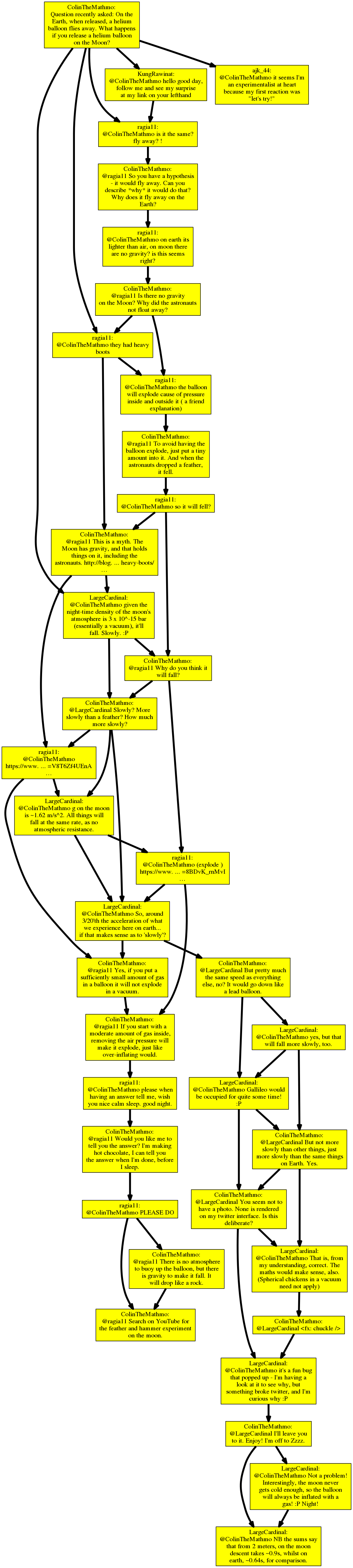
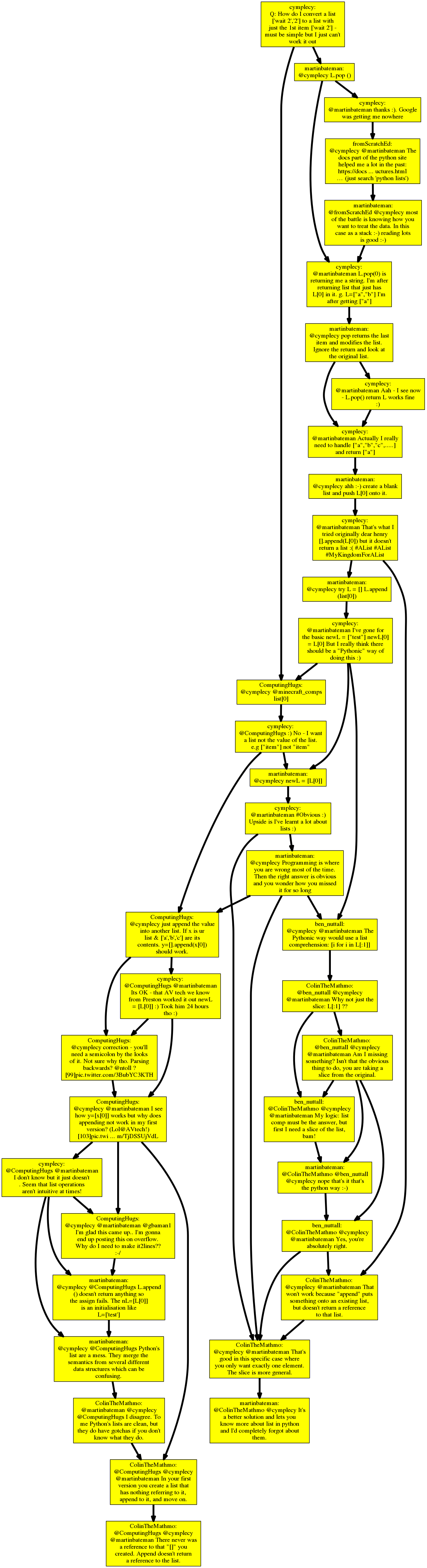
Have you created a web service or app around it? Or is it on Github? A visual conversion graph would indeed help, the Twitter UX isn't really useable to follow up any longer conversation. I assume the Twitter UX has been even slightly degraded a bit over time for A) scalability reasons B) so that users stay longer on Twitter (good for advertisement statistics)
Currently it's a complete dog's breakfast of scripts and hacks. People seem to like it, so I might look to package it properly, unless someone else wants to do it.
I curl the tweet, look for references to other tweets, curl them, lather/rinse/repeat until there are no more. Then I build a dot file and call GraphViz on it.
Trivial stuff - people seem to like it, and I've found it very useful. I should learn how to use GitHub and throw it up on that.
That's really interesting. I created something similar for App.net - see http://shkspr.mobi/hyper/?thread=1 would love to chat with you about doing the same on Twitter.
One of the best use cases of twitter for me is customer service, a few complaints about @comcast is way more effective than calling and waiting on the phone for 20 minutes and fighting with the customer service agent... I was able to resolve my issue with a few back and forth DMs with @comcastcares ... I don't think many people have enjoyed this experience, it's like night and day.
I've had a Twitter account for years but the only times I've used it were for customer service (harder for them to ignore public complaints, dedicated "social network" reps are probably better supported than the people staffing call centers), and for local "breaking" news (following demonstrations and riots here in Baltimore).
Otherwise it's always seemed to live up to its name and feels like a billion voices "twittering" about everything and nothing at the same time.
I see the customer service via Twitter as a way to shut up the people that complains the loudest. You have a Twitter account, fine we'll deal with you before this dude that called in, because he's not going attract any additional attention.
Customer service via twitter just feels wrong to me. I'm a low-frequency twitter user so maybe I don't "get it", but it feels very much like shouting into the void. There's no feedback saying "yeah, we heard you".
Whereas with a phone call you're actively navigating their support structure, or with a contact form, where you have a tracking id in your email box.
Does it feel right to a part of the consensus customers should have regarding large companies? It does for me.
The Comcast site has a form you can fill out to remove you from their snail mail list. As someone has been a customer for 4 years, getting advertisements in my mailbox made me irrationally angry. I filled out the form but saw no drop in volume. Taking my silly issue public via Twitter helped get the problem resolved.
I had a sense of pride knowing I publicly shamed Comcast enough that they did something about their poor mailing practices. And it only took a few days and maybe 500 total characters.
I couldn't agree more. Comcast is a great example of customer service handled perfectly via Twitter in my opinion. I can get Comcast issues resolved in minutes via Twitter compared to hours trying to explain it over the phone.
I admit that I have used @Amazon to make a Smart Alec comment about a missing/delayed delivery and was pleasently surprised that I was contacted within an hour to DM them the details so they could resolve the matter.
"Shortcomings in the direct response advertising category have resulted in the company coming in below the financial community’s quarterly estimates."
Well, yes. The problem with all social networks is that ads interfere with the "social". Ads are a big annoying guy getting in your face when you're trying to talk to someone. Or worse, they're your (soon to be former) "friends" who've been tricked into "sharing" (i.e. spamming) ads.
Remember, Twitter's big period of growth was before they had ads. They only put in ads when they had users hooked.
The direct effect of Twitter ads isn't that bad; by the standards of web advertising it's hardly intrusive. It's the probable side effects of optimising for that revenue stream that are the trouble. One of Twitter's virtues from an advertiser's perspective is that most recent Tweets are often barely more compelling than than whatever message or link they're trying to promote. Streams which efficiently filter out irrelevance mitigate against that[1]. Reverse chronological order with ads interspersed is probably a local optimum for ad discoverability, and I bet the marketing guys test that....
Same goes for the risks of allowing any old third party to build the next successful Twitter platform on their API when they know "filter out the ads" is going to be a much-requested feature.
Being more controversial, I still can't help thinking that whilst Twitter has long made a virtue of brevity, 140 characters is just too restrictive for the average non-regular user. It's often not enough to convey the reason why people should go to an obfuscated link, never mind enough for a person not used to truncating their thoughts to express a view that doesn't involve an image or a third party site. I'm not interested in receiving Tweets by SMS, but would find Twitter streams a whole lot more engaging if they tended to be 250-400 characters.
[1]of course this is what the portal promoters thought in the pre Google era. But since then Facebook and LinkedIn's heavily polluted streams have been highly successful, and Twitter has even less potential to become primarily a search tool rather than a way to stumble over moderately interesting content, some of it promoted.
Twitter lists (especially in combination with Flipboard) are useful for filtering/curation, but have seen few improvements and remain unavailable in the mobile app.
Lists could exhibit business value comparable to Pinterest curation, if Twitter paid any attention to the feature. They are micro-social networks that amplify the value of Twitter's main accomplishment: a directory of pseudonymns for writers, marketers, subject-matter experts and other publishers of time-sensitive content.
Maybe its just me, im too old and not famous enough...but Twitter just seems to me to be a celebrity (that includes fame of any kind) circle jerk...and if you're not famous, you dont exist. Its weird. I hated fb towards the end of my usage of it...but at least like the old sitcom 'Cheers', at least sometimes you could go 'where everybody knows your name...'
Honest question: I've tried Twitter a bunch of times, tried to engage with it for a couple weeks, then given up when I felt that either the tweets were not curated enough for me or that nobody was listening to me. Is there some guide for technically literate people to start using Twitter effectively? Right now I use Feedly and blogs to serve this purpose, but the appeal of real time news a la Twitter seems quite sweet, if only I could tap into it.
Yes, please! From other peoples' descriptions, I can rationally understand what benefit Twitter brings them, but I have never been able to replicate that for myself.
I have always walked away, convinced that it's a real-time medium that requires constant attention, because I find it to be nigh impossible to read up on any discussion ex post facto.
That is especially true for any discussion with more than two participants — those are tree-ish in nature to me, and for the life of me I cannot figure out how anybody makes sense of them in Twitters one-dimensional chronological organisation.
To steal someone else's metaphor, try thinking of Twitter as a river. If you try to bottle it up or consume it all you'll drown. If, on the other hand, you dip in for a swim as you please, you might find it all bit more manageable. As the rush of tweets flows by you, just check out some, then turn your phone off and carry on. When you load it again, don't feel you have to go back and "catch up" or give it the constant attention you mentioned.
YMMV, but I also think the emphasis on "conversations" is a bit misleading. Lots of people do have conversations on there, but I personally love it for breaking news, link-sharing, jokes, and photos. If your frame of reference is a forum with posts, or an article's comments, or a real-life conversation... you're going to have a bad time.
I've heard this too; it drives the completionist in me nuts. After reading a Twitter stream for 5 minutes, I look up and wish I had caught up on the news, or read a short article from Instapaper / Pocket.
I have no doubt this says more about me than about Twitter, but I never could never see a way around it. Similar experience with Reddit, comparing the default front page to one tailored to the subreddits I enjoy the most. Of course I gave up on Reddit too after a while...
I didn't get much out of twitter until I had a community I became involved in and had a product I wanted to promote. Though I don't have a ton of followers I mostly use it to track what other people are talking about and start conversations when possible.
So to answer your question, I think users get the most out of it who have a need or want for actively engaging in <em>something</em>. My followers who I do interact with most are either other creators or heavily-invested fan.
of course the author misses the biggest reason twitter sucks. Abuse, fake accounts, and trolling cause more "authentic" real name users to leave every day. Twitter does nothing to punish people who can just grab a picture of you from the net, create and account and start ruining your reputation instantly. And we all know you can't win against a troll unless you out troll them with your own bots. Twitter is the stained toilet bowl of human interaction. Twitter would instantly better if it forced real names and banned people for abusive comments outright. Until then, Twitter is unusable.
"In 2007, South Korea temporarily mandated that all websites with over 100,000 viewers require real names, but scrapped it after it was found to be ineffective at cleaning up abusive and malicious comments (the policy reduced unwanted comments by an estimated .09%)."
"The better thing to do is to verify what someone knows, not the name someone goes by. Our fear of anonymity is an extension of our fear of the unknown. Without a recognizable name, these commenters could be anyone! But if we could associate an internet history, even a brief one, to that handle, the human connection becomes instantly apparent. A great example of this is Disqus and its universal login, which creates a history of comments (and flags) across all sites."
The idea of an everyone-can-talk-to-everyone social network is initially appealing. You can write (and there were) thousands of articles about twitter extolling the virtues of the "internet community" or "the conversation" and "personal brands." It was all very 1995 internet enthusiasm with a new coat of paint. Then everyone tried it, and it turns out nobody wants to hear from everybody.
Trolls/abuse/whatever aren't the problem. They're the most extreme manifestation of the real problem: everyone wants to broadcast themselves to as many people as possible but nobody actually wants to listen to anyone but a subset of the people they've already decided to hear from.
But twitter can't restructure as an RSS reader for worthless thoughts (and links to worthwhile thoughts) for those with short attention spans. Maybe they can clamp down on abuse, it might give the flash in the pan a few more years of life.
So lets see. in about 30 minutes I can deck into the Twitter API and create about 100 accounts and cron job your Twitter account for a post and then inundate you with thousands of crazy insults from random accounts. I can do all of this because you said you didn't like blue cheese and I for one sir think you are an IDIOT and should be taught a severe lesson for not liking blue cheese. ~Twitter Reality.
I'm sorry, but I don't think I understand what your post is trying to say.
I just see a non sequitur about twitter abuse. Did you interpret when I said abuse is not THE problem with twitter, that I meant I don't find abuse on twitter to be A problem?
That wasn't what I was trying to say, but otherwise I'm confused as to how your post is a reply to mine.
Just in case you don't get it. This is the typical train of thinking on Twitter. You say something intelligent looking for conversation, and eventually you are going to run into the crazies on the platform just looking to broadcast thoughts that have nothing to do with the original point and then quickly turns into negative, abusive slop. (the blue cheese remark should have clued you in.) I understand fully what you are saying, but respectfully disagree. Clearly tales of abuse and outright ugly human behaviour turn millions upon millions of core users off the platform. This has been said a dozen times by Dick Costello himself. That being said, I can see your point, and will pontificate on it.
This is very true, not just in Twitter but in real life as well. Most people just want to talk, they don't really want to listen to what you have to say.
Good, fair, well-explained banning for abuse policies would be great. Real names would destroy it, because a lot of the most interesting stuff on "Weird Twitter" is from bots, joke accounts, parodies, shared accounts (e.g. @sweden), people who daren't post under their real name, activists, etc.
Unusable? I'm sure there's a lot of noise for people that have a decent following, but I think most people don't have these problems. Certainly not to the extent that the entire platform is unusable.
That search actually turns up nothing of the kind, but googling for Twitter impostors and Twitter impersonation resulted in scads of relevant stories. I was totally unaware of this behavior. It's kind of fascinating, and sad, and infuriating.
"Though you wouldn’t know it by looking at the stock price or by reading the headlines, Twitter is owed recognition for ramping up their product development"
Sacca is incorrect when it comes to Twitter's stock price. They're being given an epic benefit of the doubt on their valuation. Few companies get that sort of charity; ask Groupon, Angie's List, Etsy, etc. about that.
They're substantially overvalued by any normal market standards. A $24b market cap for a company that has never - in nearly a decade of existence - earned a profit; worse, they've bled a billion in red ink over that time. It's also trading at a rich sales multiple of about 16.
That's what I was thinking by the end of the article as well. He definitely described a platform that I would be excited to use. And I am among the 1 billion that tried Twitter and didn't stick around.
His idea reminds me of a hackathon project I worked on a few years ago with some friends. We built an app that communicates its location to the backend. Our backend runs k-means clustering and decision forests to cluster tweets coming in realtime through the Firehose API to associate them to an event that's happening nearby. The app then uses the incoming stream of tweets to provide realtime coverage on an event that was algorithmically detected.
I think what you're imagining is pretty much what we've been building for a year or so, but I could be wrong.
It seems obvious - a lot of "news reports" nowadays are pretty much a couple lines of text with a bunch of tweets dropped down beneath them. But making that scalable is actually pretty difficult.
The first difficulty (and we've confirmed this and talked about the problem multiple times with directors of product at Twitter) is finding what the "best" stuff is.
We tried some time ago doing that for news - can we just algorithmically find the best tweets with regard to topic x? Even given full API access, the answer is either "not really" or "yes, but austenallred and his team aren't good enough programmers to figure it out."
There simply aren't enough inputs - it's the same reason Google has always struggled at real-time news. There are favorites and retweets, but those are largely a function of how big someone's following is. Some guy walking on the street taking amazing photos will never have as many retweets as CNN, even if you try to control for the number of followers, or measure retweets as a function of the number of followers somehow.
Then even if you could get that, the tweets aren't always analyzed in the right context. Run that type of analysis and the top tweet is likely to be a joke tweet or something like "OMG I'm praying for Boston."
The best solution that we can come up with is crowdsourcing the finding and curation of tweets. It's working OK, but there's a long way to go. Basically we let everyone find and submit tweets, tag them with specific topics, and then upvote/downvote and fact-check for accuracy. (for details on how it works, see https://grasswire.com/about)
Once you add a couple lines of text, you can turn the raw firehose of Twitter into something that can be consumed by somebody like my mom. That, I think, it a really big deal. It's working fairly well for news right now, and as more people join and submit it gets better. Our hopes are that we can expand into different verticals, and create daily digests of the best stuff with regard to topic x that you can consume in 30 seconds.
One thing the article writer comes back to several times is the idea of human editors.
He's right.
The insistence of tech companies on algorithms is understandable, but it's also incredibly limiting. I think of it as the "Google mindset" (it hurts them too).
In the end, you need live people involved. You can do SO much more with even just a few live curators. Looking from the outside, insisting that they aren't needed is deeply weird.
IMHO, Twitter should only act as a digital news platform. I usually search for (the same) specific terms and look at nothing else. If Twitter knew this, they could make the whole experience way more seamless and pleasant for me (saved searches and following is a pretty long work-around).
The problem with such a platform would be how to know if someone in a riot (for ex.) is posting 'news' or not. This seems to be where channels would go a long way to sorting through the hay to find the needle.
This article at one point proposes splitting content into separate apps. I'm unsure of the end goal of this; I guess that it's trying to provide a clearer divide for users, allowing them to filter content in a sense. It seems like this would be better solved by filtering better within the app, separating apps is just going to lead to more confusion, imo.
That's a tricky question, because while I would pay, say, $5 per month for it, if every existing user had to pay $5 for it, the value would decrease significantly as most people probably wouldn't pay that much and it'd decrease my reach. If I were to pay merely for added benefits over what I have now, it entirely depends on what they would be..
I used Twitter quite a bit for work purposes (before I left CNET/CBS last year to found a recommendation startup) and might have paid for it then.
But the value for me was in interacting with a large number of people, and I suspect even charging a few dollars a year would lead to the vast majority of accounts disappearing, reducing the remaining users' incentive to pay, leading to more accounts disappearing, etc.
I'm not a twitter power user, so what exactly do you want to control about your twitter content? More than just deleting tweets/pictures? Serious question.
The complaints about Twitter on this forum all basically follow the same theme: Twitter won't let me do such-and-such when I try to read/write the content, or Twitter forces me to read/write in such a way. You can read each of those at your own leisure.
The major shareholder of the article wants Twitter to provide a more Facebook-style algorithm-decides-what-you-read, which Twitter indeed seem to be insistently experimenting with. That's a major turn-off for me and I think a misjudgement. People currently move from Facebook to Twitter as their primary social network because of exactly that problem. Personally, I want to decide for myself.
I like to see my network content, the content that I have already curated for myself, in chronological order. For whatever reason, social networks would prefer me not to have easy access to that any more.
Ideally, I would like to have the ability to take everything I have written on Twitter (content that I have provided) and easily transfer it to an alternative host.
I would like Twitter to give me the freedom to do that - so that I don't feel that I have to do it.
The users who have the most to gain from Twitter are those with a huge following as they monetise their following outside of Twitter. Be it that they have something to sell or that they are campaigning. I there would find it reasonable to charge accounts that have more than 1000 followers per tweet a small fee.
This is a great essay (and shows that even if it’s predictable, it’s always good to balance criticism with praise, support, and a sense of a positive path forward.)
As for Sacca’s suggestions, I have mixed feelings on the specific features he suggests for encouraging people to Tweet more (“Tweeting Shouldn’t Be So Scary”) and increasing engagement (“Using Twitter Doesn’t Need To Feel As Lonely”) but I like his suggestions about improving the timeline:
“Live Is The Biggest Opportunity Yet.”
This is the section he describes most lucidly and is the simplest to implement on top of the existing product. It’s currently done in a ham-fisted way—where I am in India it prods me with modal dialogs about cricket matches!—but there will need to be less prodding if it’s built as a standard set of pages where you can follow the best tweets for a sporting event, TV show or news topic while the situation is ongoing even if you’re logged out. It’s a bit like following a hashtag, with some curation and highlighting of popular tweets on the topic thrown in.
“Channels Will Make Twitter Easy, Easy, Easy.”
I sort of lost the thread in the middle of reading this in terms of figuring out exactly how this is different from Live or other category based curated tweets but I kinda get it. These are his examples: “Want to know what are the most popular articles linked to on Twitter? That should be a channel. What are the most popular sites linked among the people we follow or people that our friends follow? Great channel. Which books are people Tweeting about? Channel. Which videos are garnering the most attention? Channel. Any particular .gifs blowing up? Channel.”
“Twitter’s Save Button Would Let You Keep All The Good Stuff.”
This is a relatively complex concept and would be difficult to implement in a clear way but I like the idea. “We could keep every product we saw mentioned, every book that looked interesting, every destination we wanted to visit someday, every concert we wanted to go see, and every ad that piqued our curiosity. All of this could be saved to a Vault within Twitter with just one button in line with the RT and Fav buttons in each Tweet.”
Interestingly, Tumblr already implemented some of these suggestions. With such features like "explore" or new search, The discovery of content is unmatched by other social networks. It is also way easier to get likes and reblogs than on Twitter (if you're a regular person, not a celebrity). Having your post go viral (into 1000s of notes) is quite satisfying and would never happen on Twitter if you're not already popular.
"Tweet nearby" & "Encrypted tweet nearby" & "P2P Tweet": These three functions would blow the lid off active user growth. Across the globe Twitter remains a key means for promoting events, demonstrations and encouraging political action. Give users the means to reach by locale (Concert), and securely by locale (Flash mob), and P2P (Iran, Syria, China) -- and sit back and watch the audience skyrocket.
You are right to point this out. The United States has tried many times to use social media platforms to cause uprising in other nations. These very same nations (including the ones enumerated above) do cut off the services. Take the US installation of ZunZuneo in Cuba and the governments crackdown on personal phones in response - China's ban of Google for US influence and foreign surveillance - Russia's machinations against Facebook for influencing its audience - Kiev's ban of CSOs as Western organization through UNITER was revealed - North Korea's hacking of SONY in response to its partnership with the US State Department and CIA on The Interview - Israel's hatred over Jeremy Bird's participation in "OneVoice" political campaigning over Twitter - etc, etc.
Continuing to use US private companies as soft weapons will increasingly harm the reputations and global standing of these corporations. The military-industrial complex gig is up. Other nations know what's happening. It's merely a matter of denying the company access to a population while making it look not so bad from the PR side.
You have to remember that in the early days Twitter and a log of competition. Jaiku, Pownce, Google Buzz, FriendFeed, etc.. Then you had the open source versions: Laconi.ca, Status.net, Friendi.ca, GNU Social, Twister, etc..
Say what you will about Twitter, but it's the only thing that ever got traction or had any sticking power.
News people started paying attention early because Twitter was faster than anything else - I think due to the 140-character limit and, believe it or not, dumbphone support. When e.g. an earthquake happened, Twitter was where you'd see it first.
Once the news folks were paying attention some of them started reporting tweets directly and then it snowballed - there's a real positive feedback loop between news/politicians/celebrities - politicians and celebrities use twitter because the newspapers pay attention, and the newspapers pay attention because politicians and celebrities use it.
I think it's because they iterated really fast on new features, and presumably stayed with what was popular. Original Twitter isn't even all that close to what Twitter is today. gnusocial is playing catchup featurewise, moves much slower, and frankly the default theme is really ugly.
I assume they can see what uptake there is for features using analytics, but what comes to mind are native retweets and subtweets. Those are relatively new. They have also changed how blocking works multiple times based on feedback.
Sure, I observe that it has succeeded. I'm just not willing to invest any time or attention in it, since I've learned my lesson with proprietary communication platforms!
Information is too important to be siloed and dominated by a single service. Identities are too valuable to be contracted into an @whoami which is more or less owned by one organization.
My guess is that the downvotes are because the comment was mostly content-free, expressing only a tangential opinion, with a mildly derogatory tone. That you agree with the opinion doesn't make it a good comment in the general sense.
I'm sorry that it came off that way. I was trying to point out the fact that there is a fundamental problem with twitter's model which this article completely fails to address: the tension between Twitter the company and its need to make money, and Twitter the communication service which needs to facilitate connection between human beings.
For the most part I try to ignore Twitter and its problems don't bother me, but one area that I can't avoid, that is a direct problem because of its centralized proprietary nature, is that now some people now provide a twitter handle in lieu of a plain old email address. Some people on twitter are even openly hostile to email because it isn't public.
Perhaps he should have included this, "we stopped talking about arab spring once we realized how it was a bad job that pushed people into depeer shit, perhaps now is the time to lift the carpet again and start talking about how we can build better tools that are powerful enough to put these fucked up countries back together"
I think their time has passed. Social media is not like tv. With t.v., People want good new shows, they don't care if they're from nbc or hbo or someone new. With social media people actually want a new medium every few years. I don't think there is any feature Twitter could add that will overcome this fact.



No showing of tweets with content from other social networks, no altering in the presentation of tweets, very severe rate limits, ....
I think if Twitter wad a little less paranoid about protecting their content they could actually become a viable and useful communication tool for a large part of the Internet (even more than today).