Wait, what? Branding is an important solution to the problem of validating product quality, as it attaches consequences to selling an inferior product, and thus saves on search costs.
Yes, it's possible to waste too much money on branding, but the existence of brands, which creates incentive for consistent quality and attributes of a product, is not a bad thing in itself, even for commodity goods like flour and soap.
IIRC, one of the old problems with general/convenience stores was having to ask around about which products are good, and branding has mostly solved that.
(To answer the obvious objection: yes, regulation is another way to ensure consistent quality, but that has its ups and downs, like being slow to catch up with changing consumer preferences.)
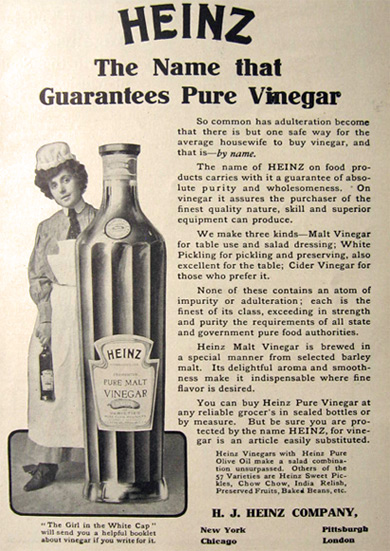
Consumer brands pre-date the FDA. The earliest adverts for branded foods tended to emphasise purity and safety above any other merit of the product, at a time when adulteration was rife.
In the absence of other oversight, a brand name provided a degree of trust - advertising is a form of costly signalling, indicating that the advertiser is investing in their reputation and would have something to lose by selling a shoddy product. The brand of flour I've never heard of is far more likely to be padded out with gypsum or chalk than the brand of flour that has advertised in the newspaper every week for the last four years.
We're seeing the inverse trend today, with sites like Amazon being flooded with white-label products of unknown safety and quality. In many product categories, there just isn't a brand with widespread recognition, or the sheer number of off-brand products has drowned out the branded products. These white-label sellers have little or nothing to lose if they sell a shoddy or outright dangerous product - they just take down the product listing, put up a new listing and buy enough five star reviews to get the ball rolling again.
"Silver hallmarks in the UK date back to the medieval period and the practice of applying them as a guarantee of the purity of the precious metal represents Britain’s oldest form of consumer protection."
You didn't have mass distribution on the scale you have today without middlemen, and so word-of-mouth and personal recommendations should have probably sufficed for most markets, as they do in some markets today (e.g. job and employment)
In all probability, people's names were their own brands, like they still are in small towns today.
I can imagine two Romans walking down the street, and one saying to the other "Oh our family has been buying meat from Spartacus' family for generations now, they're the best when it comes to that sort of stuff."
I don't know about commercial brands but some gladiators were paid quite handsomely by sponsors[1], not unlike top-tier athletes today (actually, some arguably earned more than modern athletes[2])
The baker down the street was the only "brand" of bread available, I suspect. Although personally knowing who is making the product fulfills a similar function to branding.
You absolutely can still grade commodities. A discerning distributor who has discerning retailers who have discerning consumers has plenty of incentives not to comingle inferior material into his shipments.
The fact that consumers aren't very discerning is exactly created by brands -- they have learned to discern based on identity instead of by quality, because brand recognition is less effort than material inspection.
Additionally, a brand certainly does not provide the attachment to consequence that you claim, once a brand has consumers' loyalty and a sizable market share it can adjust quality with relative impunity.
Less than the "price differential" difference. And artificially created - not because of real extra cost needed to make it better, but for market differentiation. So that the same manufacturer, under two brand names, can sell to the poor and the middle/upper class at different prices.
Of course there are different qualities of toilet paper. In a commodity-style market for toilet paper there would be competition on both price and on quality axes and there would likely be multiple points of equilibrium between quality and price.
I think the point is that, in the opinion of many people, the basic, stupid strategy of walking to the toilet paper aisle and buying the first thing that matches something you saw on TV actually works in terms of getting a pretty OK objective quality instance of the product pretty much all the time pretty much anywhere you go, for a ton of different household products and commodities.
People choose to differentiate by superficial brand identity specifically because it creates the experience they want: reproducible access to consistently acceptable quality.
Which actually doesn't work when buying a car, because some premium car brands are notoriously unreliable, prone to basic manufacturing defects, expensive to run, and inefficient.
Their only selling point is a certain mid-market bling. No one making a rational decision would ever buy one.
But this is basic US MBA strategy. Cut corners on tangibles, replace them with hype and marketing bullshit targeted at a specific demographic, then leverage The Brand™ to charge the highest possible prices.
Use both formal traditional advertising and informal online astroturfing to maintain the illusion of value.
It's called marketing, but in reality it's industrial-scale behaviour modification.
> The fact that consumers aren't very discerning is exactly created by brands
But we use a lot of different manufactured goods in our daily lives today, many manufactured in ways that require expert knowledge to appraise. It's unreasonable to ask for the average person to be well-versed in them all.
Hey, a discerning distributor builds a brand around its being discerning. This may be entirely organic, because reputation accretes all by itself, through merely doing transactions with enough customers.
The point is that branding often has little relationship to quality. It does allow brands to charge higher rates for basically identical homogeneous products.
As a teenager I worked in a potato chip factory. We also made chips for competing brands. Often this amounted to changing the bags the chips were put into. These brands would then charge different prices for the identical product.
I once sat in on a lecture by a former CEO of a very successful grocery store chain. He noted that if you buy anything in a can you might as well buy the cheapest good because there were basically identical behind the label.
Choose almost any kind of product. Often times multiple brands are created by the same parent company to provide the illusion of competition. Sometimes there are differences in quality/features but sometimes not.
I've eaten a lot of cans of food in my day, and I can say with certainty that they are not all the same. That's not to say that the expensive brands are the best though.
Maybe it's different in the USA, but there's definitely a huge variation in quality across canned goods in Australia. Most cans under a dollar aren't worth buying in my experience.
They aren't all made in the same factory either, the cheaper cans tend to be made in Indonesia or other developing countries. I try and avoid food manufactured in developing countries, I've seen what their food safety standards are like, not to mention the pollution and heavy metal risk, or if it's even what it says on the can (even Europe isn't immune to this, see the Horse Meat Scandal). I have no particular reason to believe that my can of Tuna from Vietnam actually contains Tuna, or that it's free of mercury or lead.
A 50 cent can of baked beans or spaghetti doesn't taste anything like a proper Heinz can, the beans are usually fine but the sauce is atrocious. But there are brands that are cheaper than Heinz that are just as good (don't taste the same though).
Cheap cans of fruit are almost universally terrible. The fruit in the tins is terrible quality: underripe, overripe; too sweet, sour, or bitter. Bottom shelf tinned pineapple feels like I'm eating timber.
Vegetables tend to be fairly consistent, although the cheapest cans of tomatoes often contain added water or tomato juice.
Coconut milk/cream is worth paying for the premium brands, the budget brands are so watery. Pacific Island sourced coconut milk tends to be better, at least in my opinion.
Fish is a real mixed bag. Not just for taste, but for sustainability, human rights, and pollution. It's worth doing some research into what brands are best. Some of the more expensive brands are actually the worst.
Plain legumes (chickpeas, lentils, kidney beans etc.) are the only canned goods where the cheap brands seem to be the same quality as the premium brands.
Your statement [branding often has little relationship to quality] still stands though. You can get high quality, cheap packaged food, you just need to spend a bit of time looking for the right brands (which may involve trial and error). Going for the most well known or most expensive brand is definitely not the way to ensure you're getting the best quality food at a modest price.
Here in Brussels a few years ago, it was found that 1 in 3 kinds of fish that was served in restaurants did not match the type of fish on the menu.
150 restaurants were visited, 5 types of fish were ordered and 36 different types were served (lots of Pangasius). In 95% of cases, "red tuna" was actually white or some other kind of tuna.
I used to work at Sysco foods and while I never attended one, the sales guys used to talk about "can cuttings" as a big sales tool.
Basically, they would cut open cans of other providers and cans of Sysco products to show how much more product vs liquid they provided, or maybe the quality... Not really sure.
You can debate endlessly the merits of different products in theory or in actual cases, but not that there are differences in quality. If multiple things are made on the same assembly line, don't you think they have dials they can adjust for different clients?
I remember buying a generic roll of aluminum foil once, because what could possibly go wrong with something that simple? Why should I pay the premium for a brand name? Well, it was not wrapped around the spool quite right. It wasn't completely worthless, but it reminded me that there is a huge amount of detail that needs to be gotten right even for products that occupy little if any space in your mental world when you don't work in the industry. And a factory can turn dials to make infinite variations for different clients, including quality control. I remember trying some generic cereal, and it was very similar to the branded equivalent, but there was something odd and gritty in it.
However, I think what leads to people being receptive to claims that it's all the same is the degradation of brand name quality - as soon as someone recognizes that brand equity exists, they can exploit it by cutting costs until people notice it. There's always going to be a lag that is profitable in the short term and information technology is making this more efficient, measurable, and tempting. My suspicion is that this is why white label goods are becoming more popular - it's not that brands are less useful in principle than they ever were, but everyone who owns a brand is succumbing to the temptation to strip mine it and this is making consumers become more cynical and devalue brands in general.
> IIRC, one of the old problems with general/convenience stores was having to ask around about which products are good, and branding has mostly solved that.
I lived in Africa for a little time, so I had to learn to do that. As an introvert geek, it was painful.
But going back to France, what strikes me is how much more efficient eventually this solution is.
So many brands failed us: intel, oracle, facebook, etc. They haven't paid nearly close to half the price of how they misbehaved with their customers.
Brands don't allow me to build much trust.
Local sellers however ? Well, once I befriend local shop owner, I trust him or her to really tell me which products is worth what.
Pressed ecstasy pills are probably the best example of this. For instance, the old White Doves back in the 90's. People are reluctant to buy a press they haven't encountered before, and are more happy and willing to buy a familiar "brand" of pill.
Of course, once a particular press has a reputation for quality, the fake imitation presses come in, diluting the market and eventually destroying the brand's reputation.
Branding is an important solution to the problem of validating product quality
Yes and no. Any number of brands now is coasting on quality it’s not had in years, it’s made in the same factory in China as the “knock-off” version and just gets a different sticker on it.
Indeed but only after the consumer has been shafted. If only the reputational damage passed transparently to the actual owners and people started to say “I’m never buying anything owned by XYX Private Equity Firm”
Branding is an important solution to the problem of validating product quality..
Often the only difference between a brand item and the generic version is the label. The contents are identical. Branding doesn't validate quality in that case.
Here in the UK Kellogs actually ran a campaign telling consumers "We don't make breakfast cereals for anyone else." The generic shop brands cereals started to get good enough that people thought Kellogs were making the cheaper stuff as well.
I think "validating quality" here means "you always get the same expected quality", instead of "branded product A is better quality than unbranded product B", so I'd say it still applies.
In other words, unbranded cereal can, and most of the time is, better than shop brands, but that does not remove the fact that, when buying Kellogs in any shop you get exactly what you expected.
>Wait, what? Branding is an important solution to the problem of validating product quality, as it attaches consequences to selling an inferior product, and thus saves on search costs.
For the products mentioned (soap, detergents, toothpaste, and tons of other stuff, etc) it was just an artificial way to differentiate the same thing, and make people pay for the brand name...


Yes, it's possible to waste too much money on branding, but the existence of brands, which creates incentive for consistent quality and attributes of a product, is not a bad thing in itself, even for commodity goods like flour and soap.
IIRC, one of the old problems with general/convenience stores was having to ask around about which products are good, and branding has mostly solved that.
(To answer the obvious objection: yes, regulation is another way to ensure consistent quality, but that has its ups and downs, like being slow to catch up with changing consumer preferences.)