We purchased a farm many years ago that had become eroded after many years of conventional farming. In our quest to transition to regenerative practices, and things like organic, we've definitely had the realization that most people have no idea where their food comes from, or why it costs what it does.
The margins in most farming are razor thin. Our neighbors who grow conventionally spend tons on inputs like fertilizer, for a shockingly small amount of money [in return per acre]. A year of extreme weather – more and more common – throws the whole thing out the window.
People say they want organic, but then they balk at the price without realizing how much labor goes into it when you're not just spraying to control weeds (or, more shockingly, to stop growth on your food crop at just the right time).
All of that said, a lot of the negativity directed toward anyone who has the dream of growing their own food is often coming from a conventional mindset. There are alternative approaches. A few great books are "Permaculture" by Mollison, "One Straw Revolution" by Fukuoka, "Restoration Agriculture" by Shephard.
As I mentioned elsewhere in the thread, it doesn't have to be all-or-nothing – you can start with some perennial herbs on your balcony. Larger scale, I'm an advocate for things like agroforestry practices, becoming more and more interested in agrivoltaics. You can go a very long way with a few dwarf fruit and nut trees, an understory of berries, and a few raised beds managed with no-dig methods.
If nothing else, you learn first-hand the challenges (and joys) of growing food, become more connected to the world that sustains us, and maybe gain a better appreciation for the people who work really hard for very thin margins to keep us all fed.
People may like/not like Jeremy Clarkson, but his show on Amazon about him buying a farm was fun and informative. He's rich (so has a lot of startup capital) and struggled the whole show trying to make the economics work. He also spoke with other local farmers so you got to hear their struggles with the economics.
I actually really loved his show. It does a good job of showing how hard it is. He farms a bit conventionally, but he's also keen to try things that are regenerative – from his hedge rows and pollinator crops, to his second season quest to create a locavore restaurant that would support the farmers in his area. He's constantly playing up his persona of petrol-powered gear head to set up a joke at his expense that says, "actually, maybe this sustainable approach _isn't_ so bad." Say what you will about Clarkson the person, but the show seems to have done a lot of good in raising awareness around the issues that farmers are facing, particularly in a post-brexit UK.
I find it difficult to dislike Clarkson even when he's pushing things I believe to be utter bollocks.
Conservatives can enjoy Clarkson because he backs up their belief system and his humour is based around taking that belief system to humorous extremes. Lefties can enjoy Clarkson because he comes across like an exaggerated caricature of a conservative.
It's like an inverted version of American conservatives enjoying Stephen Colbert despite his character being a liberal caricature of a conservative. Clarkson's actual beliefs are ambiguous though. I'm not sure that there's any real ideology behind anything he says - he's a shrewd man and his persona has always been based around being outrageous.
Jeremy Clarkson plays an arsehole in the media (or is he really such an arsehole?) but I agree about his farming show. It's funny, instructive and touching at times. However, I also found him funny on Top Gear - maybe it's because I assume he was being ironic.
You’re exaggerating a bit. He punched a producer for the show who was responsible for organising catering, it wasn’t a random waiter. A random waiter would be much worse. Who knows what relationship he had with that producer previous to the incident… He is (probably) an arsehole but let’s be accurate.
Not to defend his actions, but his mom died and he went through a divorce when this happened. Stress and a bit deep in the cup made him lose his composure.
Indeed. I don't think his actions were called for either, but I appreciated that he apologized profusely afterwards, and pointed said - repeatedly - that the producer hadn't done anything wrong and that his fans needed to leave the producer alone. I appreciated that he seriously tried to make amends and didn't try to shove blame on the other guy.
I thought he punched a junior member of staff? And called him an Irish something or other. That put me right off him. Something about that saying on judging people on how they treat people that they don't need to treat well.
But yes I've heard good things about his farm show.
He has consistently been an arsehole for many years in public (a quick scan of his Wikipedia page provides high level details). Whether or not it's an act doesn't change what he's chosen to do to further his own career. The fact that he is now wealthy and established enough from doing so to make a TV series on his own terms about something that interests him as a more genuine version of himself shouldn't excuse this.
He often was. Like any challenge or segment with his tagline "I mean, really? How hard can it be?" where he'd leverage his critical person to point out "Yes, it's actually really hard."
Check out Harry Metcalfe's Harry's Farm on Youtube for more insight into British farming. It's a serious version of Clarkson's Farm. It's eye opening how much bureaucracy comes from politicians towards farmers.
It's worth remembering though that Jeremy Clarkson is exactly the kind of person who first makes up their mind about something, and then looks for ways to "prove" it. I'd very much assume the initial pitch for the show described the message they want to portray, and then they filmed the show to tell that story. Scripted television isn't reality.
To your point, you're talking about processes that while impressive in many respects are HIGHLY labor intensive. The benefits from modern agriculture are the low levels or required human labor and the low prices, both of which free up most people to do other things and to spend far less on food. In the not distant past most Americans spent 30+% of their income on food, which I doubt is a world many of us want to return to.
I think modern agriculture is miraculous, don't get me wrong. But we ignore the negative externalities – the cost to our health, and to ecosystems, and to the sustainability of civilization long-term. Even conventionally-minded farmers know that things like soil loss are a huge looming problem. And the labor issue is also complex – while big corn fields may be farmable via GPS-enabled, air-conditioned tractors, there's still a ton of migrant labor without which the system would cease to function.
The idea behind a lot of the regenerative methods is to work with nature to reduce the need for inputs. I am a pragmatist and will tell you that, it's really hard! On this I agree. But a lot of the ideas from more fringe communities like permaculturists are becoming more and more integrated into the mainstream. I just think we need to accelerate that, and put a lot more research into alternative methods like agroforestry – because I think we all rely on a food system that's way more brittle and tenuous than people realize. One with a lot of negative externalities that we can't paper over forever.
This seems highly debatable. Sure cheap calories and cheap corn based sugars make it easy to develop so called lifestyle diseases, but on the other hand we've essentially eliminated famine and in most parts of the world malnutrition.
In terms of ecosystem loss, it seems to me that concentrating most calorie production onto the smallest amount of land makes sense.
> And the labor issue is also complex
You're right of course, but I don't see how the manually intense process of regenerative and/or organic ag makes this better. Every small farm like this that I'm aware of makes heavy use of children, unpaid interns, and extremely low wage workers. It's not exactly comparable to migrant workers picking strawberries en-masse, but that's more of an issue of sacle and where these boutique farms find their labor IMO. I say this as someone whose parents and grandparents were all farmers, and my sister-in-law worked for a few years on a regenerative/organic farm.
> But a lot of the ideas from more fringe communities like permaculturists are becoming more and more integrated into the mainstream
This is the part that's actually really interesting to me. Finding ways to scale up and integrate ideas about soil health, water use, etc into mechanized, large scale agriculture is really great. People seem to be doing cool things with no-till and drip irrigation right now.
> alternative methods like agroforestry
My concern with this is that it definitely require LOADS of labor, and isn't likely to produce that much food. It also may put pressure on forest land may not be sustainable long term. On a small scale on you your own farm, it's probably great. But I have trouble imagining how it could ever make up a significant portion of overall fruit and nut consumption.
>Sure cheap calories and cheap corn based sugars make it easy to develop so called lifestyle diseases, but on the other hand we've essentially eliminated famine and in most parts of the world malnutrition.
I think this is letting the good be the enemy of the perfect (a rare construction, to be sure). Yes, we've solved a very bad 1st order problem. That frees us up to work on 2nd order problems that we've never had to deal with before. This is a thalidomide-style problem in that the side-effects of the "cure" are a disease in their own right.
I'd rather have diabetes than be dead, certainly, but wouldn't it better to not risk diabetes just to stay alive?
I'm substantially in agreement with you though. The less land we use on food production, the better. The less labor we can expend growing and harvesting that food, the better.
All of that said, the parameter space of agriculture has a complicated shape, so optimizing for any one parameter will be at the expense of other parameters.
> I think this is letting the good be the enemy of the perfect (a rare construction, to be sure). Yes, we've solved a very bad 1st order problem. That frees us up to work on 2nd order problems that we've never had to deal with before. This is a thalidomide-style problem in that the side-effects of the "cure" are a disease in their own right.
I actually agree with you.
> I'd rather have diabetes than be dead, certainly, but wouldn't it better to not risk diabetes just to stay alive?
Again I agree, but I also think there's a huge cultural component to food/eating that is often missed in these discussions.
> wouldn't it better to not risk diabetes just to stay alive?
This is a mischaracterisation. If you have any choice in what you eat, you risk diabetes just to stay alive.
There is so much food that far fewer people are dying of malnutrition than in the past. As part of there being lots of food available, it's also possible to eat yourself into heart disease and type 2 diabetes. Great availability requires some responsibility.
Thanks. I appreciate you assuming that I need the help./s
Since I reached the "can afford to shop at whole foods if I wanted to" stage of my life, the combination of lifestyle, genetics, and diet means I'm pretty far from diabetes at the moment.
But when I was a lot worse off, I bought the food I could afford, which tended to be the low-cost, high-calorie stuff that leads to health problems. Maybe (and I'm just spitballing here) we should find a way to lower the cost of higher-quality food. The decision for huge swaths of the world should not be "afford enough food to not starve, but the food is of such low quality that it leads to long-term health problems" vs "starve while eating food that, if eaten in sufficient quantity, would not lead to long-term health problems". Optimizing for dollars per calorie means you end up picking high carb options.
Telling people in Somalia or wherever "have you just tried keto?" is a pretty problematic stance.
> In terms of ecosystem loss, it seems to me that concentrating most calorie production onto the smallest amount of land makes sense.
Incorrect. Agroforestry is the practice of integrating livestock and orchards. The orchard is designed to serve as the basis for an extended ecosystem. Trees provide shade for fowl, sheep and small cows and help limit swale evaporation. Fallen fruits attract a wide variety of animals and birds, providing prey for cats, hawks and owls. Systems like this sustainably produce a high quantity and quality of food per acre while encouraging diversity and natural beauty, at the cost of being less accessible to automated farm machinery. The best case scenario for sustainability and diversity would be if everyone lived in small communities with shared food forests, eating mostly locally grown food.
Truthfully, as someone who has done a lot small scale growing between over the last few years, using everything from soil to hydroponics, I find it hard to believe that natural techniques will ever come close to mechanization and artificial means. Pesticides and chemical fertilization are so extremely effective. You get hand over fist yield with them.
A world with shared food forests and locally grown food is probably a world with far fewer people.
I think high population and natural farming are mutually exclusive.
You can get more yield/acre with a food forest, because you have multiple canopy layers so you can have multiple heights of trees, bushes and low ground plants all capturing light and being productive together, in addition to the animal productivity. Soy/corn monocultures only capture light in one layer, so even with all the other stuff you do to try and push fertility they're never going to be able to be as productive. Even worse, pesticides and chemical fertilizers come with a lot of externalities and are clearly not sustainable.
It's ironic to note that high population and sustainable farming are mutually exclusive. When we can no longer sustain our current system of agriculture due to resource exhaustion, environmental destruction and climate change, a lot of people are going to die. Even worse, if we wait until the 11th hour to adopt sustainable agriculture there will be a lot of avoidable suffering and death that will occur during the transition.
There is an alternative - gradually adopt sustainable farming now and let food prices rise. That will signal to people to have fewer children, and also encourage people to grow some of their own food or otherwise get involved in agriculture. That way, our population will move towards a level that can be sustainable fed as our agriculture system moves towards sustainability, and we won't have an "oh shit" moment where human civilization collapses because the rich are hoarding food in the face of mass starvation.
This is straight Malthusian nonsense. What you're talking about in effect is slowly starving people to death in the developing world, particularly as weather patterns change and some traditional bread baskets undergo aridification.
I can't express enough how morally reprehensible I find your position of "let food prices rise. That will signal to people to have fewer children".
Since it seems like you just don't get it, let me give you an analogy that might be more accessible.
We are in a car rocketing towards a brick wall at 100 miles an hour. We can slow down gradually (controlled population decline) or we can slam into the wall (unsustainable agriculture practices turn the earth into a toilet, sudden mass starvation, civil unrest leading to the collapse of civilization).
You seem to be under the enchanted fairy tail notion that there's an exponential curve of infinite resources just awaiting the power of human cleverness to save us from this grim fate, but I'm sorry to inform you that's delusional. You can see clearly that most areas of human technology are already in the logarithmic portion of the (sigmoidal, not exponential) progress curve, and those areas that are still in the exponential phase like AI aren't going to magically transform agriculture.
The shear volume of food that is left to rot in fields, in storehouses, in American pantries, suggests to me that there's a lot of slack in the resource chain before we actually face mass starvation. People are starving to death in places like Somalia or Haiti right now specifically because there's no profit to be made selling them food that's already grown and been harvested. We could afford to cut back food production, switch to less productive (but less destructive) farming practices if we were just willing to ship the food to where its needed, irrespective of profit. I don't disagree, we're heading towards a resource cliff, but I do not think even for a second, that the Earth is incapable of supporting 10+ billion people, even with much more constrained growing capability. The constraint on the food supply is that there are huge swaths of the global population that are unprofitable to feed. And that's really where you're catching flack. We don't need population control policies. We need to stop deciding that selling food at a loss is worse than letting children starve.
If you're concerned about overpopulation being a drain on food resources, then you should be agitating for overall better living conditions, better access to healthcare, better access to education in the global south. We have seen repeatedly that a healthier, happier, better educated society has a lower birth rate.
I get your argument, it's just morally reprehensible. Your analogy about a car is not related and shows weak reasoning.
> You seem to be under the enchanted fairy tail notion that there's an exponential curve of infinite resources
Resources are definitionally raw materials coupled with human ingenuity.
> You can see clearly that most areas of human technology are already in the logarithmic portion of the (sigmoidal, not exponential) progress curve
I don't see this at all. This is just your opinion.
You're essentially talking about starving people on purpose, "controlled population decline" is eugenics and you should take that nonsense somewhere else. Seriously your ideas are disgusting.
Well in the western world, we're going to have a pretty marked decrease in population pretty soon. That also means fewer people to work the land (among other serious challenges), but it appears overpopulation will not be one of those problems to the same degree.
And the state of industrial AG isn't static, robotic micro pesticides are interesting for example. Not that I'm a fan of them, but it would be great to see us move away from showering everything in loads of agent orange and have more targeted application.
Humans are driving one million species to extinction - United Nations-backed report finds that agriculture is one of the biggest threats to Earth’s ecosystems
We should reforest most of that land. It was previously mostly forested anyway, and doing so, together with a rapid phase-out of fossil fuels, would enable us to store enough carbon to halt global warming, restore biodiversity, and repair the water cycle to prevent droughts.
What do you mean by empty? Have you ever flown in an airplane? I just mean there's lots of undeveloped land. Perhaps I'm a bit biased by my daily surroundings the state of Georgia is almost 2/3rds forested. Almost all of which was previously clear cut agricultural land, but I've flown all over and it's pretty empty in a lot of areas.
To steel man a bit here, grazing isn't necessarily a win for biodiversity and then there is all of the land that used to produce supplemental feed. Its a set of problems worth considering, even as I disagree with the myopia of the link riddled comment above.
Why is endless growth desirable? Why not quality over quantity, allowing for higher quality food supply instead of mass production of with unhealthy trade-offs?
Because the world population is growing, whether we want it to or not, and I'd prefer we feed everyone than not. So we're gonna need to keep food output growing.
A global shift towards healthy and more plant-based diets, halving food loss and waste, and improving farming practices and technologies are required to feed 10 billion people sustainably by 2050, a new study finds.
Developed countries have dwindling population (well, at least exclusing immigration). And I think it's safe to assume when other countries catch up similar thing will happen, at the very least to the point of levelling up. Hell even India, the biggest country by number of people, is already at 2.0
We don't need to feed more, we just need to bring the education and standard of living if the world up. And maybe figure out how to make the people in developed countries to have sustainable birth rate...
You could boil all of this down to the fact that our current best effort at feeding 9 billion people has a lot of unfortunate externalities. If your proposal is to revert back to high land and labor input methods, then maybe it would make a difference insofar as a few billion people would probably starve. For my part, I'd prefer we try innovating our way through it.
No. Just reduce your meat consumption to about 1kg per month or less. You can still enjoy a really good steak from times to times and you reduce your load on the ecosystem massively.
That's quite the presumption about MY consumption. Moreover the word "just" is doing a lot of work here.
I'm responding primarily to the overall land use picture here. Agriculture even as efficiently as we're doing it now takes a lot of space, even removing most meat from the equation.
A global shift towards healthy and more plant-based diets, halving food loss and waste, and improving farming practices and technologies are required to feed 10 billion people sustainably by 2050, a new study finds.
> If your proposal is to revert back to high land and labor input methods, then maybe it would make a difference insofar as a few billion people would probably starve.
Not necessarily. The crop lands we already have would be sufficient to feed the whole population.
Sustainable and regenerative agriculture is entirely possible. You may want to explore practices such as natural, syntropic, permaculture, and agroforestry farming, to name just a few. While it may require more knowledge and labor, advancements in technology and automation could potentially mean only a slight increase in the workforce, from around 2% to maybe upto 4%.
The benefits would be enormous. And with 40-70% of jobs being bullshit jobs I'm not even afraid we would fill those positions. It's just a matter of regulation and preferences.
> For my part, I'd prefer we try innovating our way through it.
Plant-based diets are an innovation. Restorative agriculture would require new machinery, agroforestry, smaller fields instead of vast monocultures, the incorporation of companion/nitrogen-fixing plants and compost instead of artificial fertilizers, among other changes. Many things would need to change.
> I'm responding primarily to the overall land use picture here. Agriculture even as efficiently as we're doing it now takes a lot of space, even removing most meat from the equation.
Animal ag. brings just 18% of calories and 36% of proteins, while destroying and polluting so much. We should dedicate the land to forests (carbon sequestration) and to the restoration of biodiversity.
My whole point and I discussed this up thread is that things like restorative agriculture and agroforestry require a fuck-ton more human labor.
> The benefits would be enormous. And with 40-70% of jobs being bullshit jobs I'm not even afraid we would fill those positions. It's just a matter of regulation and preferences.
This is total nonsense. When most people worked on farms, food comprised more than 30% of peoples' budgets. The idea that we could have a modern society with 40-70% of people shifting to agricultural labor is on its face ridiculous. You're making a utopian argument here and hand waving away the real problems involved in sending so many people back to agriculture.
> Plant-based diets are an innovation
Nowhere am I arguing against plant-based diets. You're arguing against a straw man. I'm also not anywhere here or at any point saying that the status quo of human calorie composition is ideal. I said that as it stands, our best effort to date to feed 8+ billion people has AT PRESENT negative externalities. I agree that problems are worth addressing, and you seem to be dead set on having an argument with me about something I'm not saying.
> the idea that we could have a modern society with 40-70% of people shifting to agricultural labor is on its face ridiculous
I never said we'd need 40-70% of people in the agriculture. I've talked about the possibility of the increase upto aproximately 4% , with a pool of 40-70% people to choose from. Is it clearer now?
> you seem to be dead set on having an argument with me about something I'm not saying
Ditto :)
> If your proposal is to revert back to high land and labor input methods, then maybe it would make a difference insofar as a few billion people would probably starve. For my part, I'd prefer we try innovating our way through it.
This has triggered my response. I can't agree with that at all.
There's no need to revert to high land and labor input methods. I'll simplify a lot. We could grow more veggies and fruit, plant more nut orchards to replace milk, grow more legumes to replace meat, on smaller fields separated with rows of productive and nitrogen fixing trees (agroforesty) and reforest more lands to let biodiversity rebound and work with it, not against it ... nothing that is particulary hard and nothing of that means that billions would have to die. It would need new (smaller) electric machines and more workers, but maybe 1-2 times more, not 20 times more.
> I never said we'd need 40-70% of people in the agriculture.
> with a pool of 40-70% people to choose from
> There's no need to revert to high land and labor input methods.
> We could
> It would need new (smaller) electric machines and more workers, but maybe 1-2 times more,
This is all very squishy and utopian. I just don't see a practical proposal here. You're talking about completely reworking agriculture with no viable path to providing sufficient calories at a cost that developing nations can bare. We can see the recent debacle in Sri Lanka as a cautionary tale of what can happen if you try to force such a change. On a more personal note I've seen a lot of people try to spin up hobby farms using "restorative" practices and they're producing relatively little food, using unpaid interns, still having to charge 4x grocery store price for worse food, and havign to rely on government handouts to even do that.
Sustainable and regenerative agriculture is entirely possible. You may want to explore practices such as natural, syntropic, permaculture, and agroforestry farming, to name just a few. While it may require more knowledge and labor, advancements in technology and automation could potentially mean only a slight increase in the workforce, from around 2% to maybe upto 4%.
> We can see the recent debacle in Sri Lanka as a cautionary tale of what can happen if you try to force such a change
Without a transition period, education, or support, it was poised to end up badly.
> hobby farms using "restorative" practices and they're producing relatively little food
Again, take a look into syntropic agriculture (Ernst Gotsch) and natural (or 'do-nothing') farming (Masanobu Fukuoka). Their yields are comparable to or better than those of their traditional counterparts, all while repairing the soil and without using any external inputs (thus saving significant costs).
> In the not distant past most Americans spent 30+% of their income on food, which I doubt is a world many of us want to return to.
I mean - I think I understand the motivation behind that but
I am pretty convinced that the value of "low-carb" / "no-carb" diets has less to do with the impact of carbs (after all, wheat literally was the symbol of European civilization for a really long time) and more to do with how they're used as cheap caloric filler (looking at you, Panda Express). Pretty much a "get what you pay for" kind of situation, in my eyes - so maybe spending that much on food isn't as bad as was thought.
also, on the gripping hand, looks at cost of housing - so maybe if it's not one thing it's another.
30 years ago (within that generation-or-two span), at least here in the parts of the US I was in around that time, blackberries and lots of other stuff were both expensive, and only available seasonally. You could get canned year-round, not fresh.
But were those Europeans healthy? We can see a life expectancy and height increase in most European countries these days. And this is with us having subpar diets where most people get insufficient amounts of some pretty important stuff like magnesium and vitamin D.
For that matter, it hasn't been all that long since around 90% of the people were agricultural laborers -- pretty much world-wide before the European Renaissance and Enlightenment, and in many areas of the planet, well into the 20th Century.
Generally unfree laborers at that (i.e., slaves or serfs).
I wouldn’t mind spending a couple of hours a day doing physical labor instead of working in the office to guarantee that my food was made in a sustainable and safe way, heck I even think it would be good for my health.
That is a lot harder to say after the age of 35 or 40. My social circle includes many alternative people in organic farming where I have occasionally pitched in to help, and I have also volunteered with WWOOF for food and accommodation when traveling. This kind of work, even if a mere couple of hours a day, really, really starts to suck after your knees and back begin to age. And it is not that I have given up and settled into a sedentary lifestyle – nowadays my travels are bikepacking/bicycle-touring where I do 100 km+ day after day, but that exercise is a lot easier on one’s body than the repetitive motions of farming.
My dream: we give up on bullshit jobs. We implement UBI. We localize the majority of our agriculture. Humans, largely freed from fake labor, work communally on their local farms, splitting up the labor so nobody has to wreck their health and finances gambling on a lettuce crop.
The pandemic stimulation was an example of UBI and what it leads to - more inflation.
America needs more stimulation that's less direct cash and more services based. A guarantee for a one-time provision of free housing for non-asset holders. Proper zoning and less NIMBYism to make it more affordable (even massed mixed-purpose zones). Medicare and Medicaid for all, and making it easy for people to avail of these. More educational funding to state and community colleges, after diverting funding from private universities. Food stamps with rationing for the neediest. A solid infrastructure programme like the WPA, to stimulate rural and blue-collar growth.
Imo, you can only be truly free if the major needs in the hierarchy - food, shelter, education, health and leisure - are taken care of. Then you can help people get rid of bullshit jobs and working for a pittance.
Of course, they won't be implemented. Repubs would be crying out loud at "handouts" and "freeloaders", without saying that you can only stop further freeloading by pulling out the poor from their chasm.
That means continental-scale famine. I'm not kidding - loads of countries only have the populations they have today because they can import cheap food from Europe and the Americas. Without that trade, billions starve.
I'm not talking about cutting off trade overnight, though. I'm talking about building up community resources to reduce the need. But this is all very abstract anyway.
Yeah sure permaculture is ridiculous, but something like no till? There is nothing that prevents mechanization of it and it has seen significant success compared to conventional agriculture. The thing is, tilling resets your soil, so once you start tilling, there is not much you can do about soil health. In fact, tillage backs you into a corner where the only option is to spray back what you have destroyed through industrially produced synthetics. That also includes all the artificial fertilizer you're spraying. Once you till it, all the money you spent on the fertilizer is wasted. Once you stop tilling, there are actually ways to improve soil health that shouldn't be impossible to scale up. The biggest problem is that every soil is different and you need a complex "cocktail" of two dozen cover crops and another set of mycorrhizal fungi that is uniquely suited for your soil. Yes this does reduce yields, especially in the short term when you are building up soil health but conventional agriculture tends to reduce yields over the long term. This is ultimately a battle between "farm - regenerate - repeat" vs "farm until exhaustion - regenerate". It's not implausible that conventional agriculture is worse in the long run but we might not know it until it is too late, because it takes 20 to 30 years for soil to become useless.
2022 median household income after taxes [0] was $64,240, or $5,353/mo. According to the USDA [1], a moderate cost of food prepared at home for a family of four (with, say, a 16 year old daughter and 14 year old son) is $1,378.90/mo.
So, the median family on a moderate food plan (never eating from restaurants) ALREADY spends 25% on food.
People who make less money, dine out, have more children, eat more food, buy fancier food, or have food waste spend proportionally even more. A lot of people who read and comment here don't realize that there's no "return to" that world -- lots of the U.S. already lives there.
> a moderate cost of food prepared at home for a family of four (with, say, a 16 year old daughter and 14 year old son) is $1,378.90/mo
I’m not sure how they calculate that (and the page they link to with information is down), but that really doesn’t make sense. For my five person household - five adults - we spend about $800-1000/month on groceries. According to that document, we’d be spending about $1400 on their low-cost plan or $1750 on their moderate-cost plan. But we’re not low-cost: that’s our costs shopping at a fairly upscale grocery store (not Whole Foods, but above average on price) and buying pretty fancy food. Maybe the costs assume no bulk purchases split between multiple members of the household?
That means you're spending $2-3 per meal per person assuming 2-3 meals a day eaten at home. This is effectively impossible in many places (in urban California I'd say it is actually impossible). I find it hard to believe you're incorporating anything but a lot of beans/rice and potatoes, or your portions are very small.
Another potential explanation is that they may be shifting some of the grocery budget without accounting for it in their comment: buying cafeteria meals, eating from restaurants, dining at friends' and families' houses, etc.
yes, we as well mostly cook at home, but if you add some occasional restaurant meals, plus fast food on the road, plus things like $ for NG to cook, and $ for electricity for fridge and freezer, $1200-1300/month looks about right
The median income is a lot lower than the average income.
Not even sure how food falls under disposable income. Sounds like a cute way of saying "after-tax income" as if "things to buy otherwise you die" is a luxury"?
From the chart after the one you quoted:
"In 2021, households in the lowest income quintile spent an average of $4,875 on food (representing 30.6 percent of income), while households in the highest income quintile spent an average of $13,973 on food (representing 7.6 percent of income)."
Pretty cool/sad to see the top 20% spending almost 3x/household on food.
Without knowing number of people per household, you cannot draw any conclusions on the top 20% spending 3x the bottom 20%.
The top 20% might have a disproportionate amount of family of 4+ with kids in their teenage years and parents in their highest earning years.
The bottom 20% might disproportionately be senior citizens collecting Social Security with no kids.
Also, top 20% are living in more expensive regions than bottom 20%. Lots of conflating factors to tease out that would result in 3x not being the correct multiple.
A lot of America is on food stamps (42 million, 22 million households), and have been since 2008 (Great Recession). Poverty hit, and it never went away.
Most are white native, not some ethnic issue. Spread over much of the age spectrum. Most are just stuck in constant unemployment (61.6% "Not employed in any month")
> The benefits from modern agriculture are the low levels or required human labor and the low prices, both of which free up most people to do other things and to spend far less on food.
I feel like it should be possible to have it both ways.
Right now we have a dichotomy with on one hand industrial methods that overuse chemical fertilizers and pesticides, and the other hand organic methods that are excessively labor-intensive.
Why is it not possible to use the organic methods, but automate the labor-intensive parts? I understand that we don't currently have the technology to do this, but is there some reason it isn't possible? Wouldn't it be a productive thing to fund the development of?
My understanding is that the availability of electricity is not the issue, but rather e.g. that manual weeding instead of using herbicides is labor intensive, and we don't currently have machines that can do this. But this is a problem of robotics and computer vision etc., not of powering the equipment.
I think spending 30+% of income on food is perfectly sensible, while spending more than 10% on shelter is complete madness. A house is built and stays there for decades without any extra work to speak of, yet even the most primitive house in industrialized nations is more expensive than an extremely advanced motorcycle that can go 200mph without breaking apart. Anybody can build a house by himself with primitive tools, trees and stones, given some time. Almost nobody can build a motorcycle by himself, even with advanced precision tools and all instructions given. Not to mention computers, cars and cell phones, which are tremendously advanced.
Considering the labour and resources needed to grow food, compared to the labour and resources needed to build houses, food should be much more of our expenses while housing should be much less.
Then why they are still getting subsidies ? We're essentially taking a part of the tax, give it to farmers, so instead of paying less tax we pay less for foods, except wasting a ton of it along the way for bureaucracy
The subsidy is a reduction in insurance premiums. Or, if you want to look at it another way, when insurance payouts are required, the public pays a portion of the cost. The math is the same either way, so take your pick.
This is considered a social good as it compels farmers to carry insurance instead of rolling the dice, the latter of which they would be more apt to do if they had to pay the full premium cost. Even with the subsidies, some farmers still opt to roll the dice. But perfect need not be the enemy of good. The split gets enough farmers interested in carrying insurance.
Farmers having insurance is considered a social good as it maintains some stability in food production. If experienced farmers are going bankrupt every time Mother Nature decides to throw a bit of a curve ball, you are at the mercy of the newbies who swoop in to replace them. Indeed, you always need some inflow of newbies to ensure that there are future farmers, and some farmers making mistakes can be absorbed, but when they are all newbies at the same time because everyone else went bankrupt, that is a big risk to the food supply. There is a lot of generational knowledge and experience required to make good management decisions in farming, so it is valuable to have some experienced people remaining in the business.
Well it aint working coz more and more people are moving away from farming, and the only way to start is to start big as small size farms are just not profitable.
> and the only way to start is to start big as small size farms are just not profitable.
Why do you say that? My small farm – just a traditional grain farm, nothing fancy – is quite profitable.
The big farm is a different business model. They are focused on wealth building, leveraging large amounts of debt to keep growing as much as possible, using most of the farm income to cover the debt requirements. In this model you need to be large to survive as the remaining profit margin after paying off the debt is tiny.
I have kept the debt to a minimum. That means growth happens at a snail's pace, but it also means that all the money that would have went to the bank ends up in my pocket instead.
I'll no doubt have a lot less wealth at retirement, taking the profitability now instead of later, but maybe that's okay? How much do you really need? I don't feel like I'm short of my retirement goals. I just might not be crazy rich in the end. Tradeoffs, as always.
My point is that labor saving efficiency may take a hit producing healthy food.
For example, if instead of fighting insects directly, everything is soaked in glyphosate, it might be too much of a compromise.
In fact there are lots of these compromises that end up killing fiber, or favoring starches or processing away nutrients that makes eating a faustian bargain.
I would think labor-saving solutions should try to get whole foods to the table quickly and cheaply, rather than say maximizing shelf life or storage convenience.
Food prices seem irrational. And I mean that - they are not reasonable.
People buy bags of potato chips for almost $5.00. How much does the potato cost? It seems like the potato has nothing to do with the cost - especially if we reflect on the idea that "less than have of the produce ... makes a profit".
What that means or appears to mean is that the cost of food goods is now driven by cost of production. And we may be underestimating that cost. Perhaps most cost of the potato cost is in the gas, fertilizer, equipment that go into growing the potato.
My question is, of the $5.00 for a bag of potato chips, where does that money go? Cui bono?
People buy hot water poured over roasted and ground up beans for $5+.
People buy tap water in plastic bottles at a ballgame for $5+.
I do not conclude from those facts that "that means or appears to mean is that the cost of food goods is now driven by cost of production".
People are willing to pay for convenience and comfort. A bag of chips, a cup of Starbucks, or a bottle of cold water at a ballgame represents comfort and convenience.
A 350 gram bag of potato chips takes up almost as much shipping volume as a 2 kg bag of potatoes, and needs much more cautious handling during shipping.
There are also lots of energy costs involved in deep frying (both the oil and the heat), special packaging to keep the chips from going stale, etc.
Chips, along with cereal, are an interesting case where the normal price is crazy high but then they go on sale for a fraction of that with extreme frequency.
There's a store near me that has had a particular $5 chip brand on sale for $2 for well over a year. For cereal, I just go to the cereal aisle and take my pick from the substantial range of cereals that are 50% off at any given time. You're only paying full price if you're picky and insist on one specific item, which to be fair maybe a lot of people are like that.
I'm sure the sales are loss leaders to get people in the store, but I have to wonder if the people who pay $5 are to some extent subsidizing the people who buy them for $2. Most other categories of goods don't seem to go on sale with such frequency or with such deep discounts.
I mentioned it in other comment but yes, subsidies essentially make it cheap not only to consumers but to processed food companies so they can make good margin on it as raw resources are essentially free compared to price of the product.
I have a vegetable garden at home, and there is nothing quite like eating food you have grown yourself! And as an extra benefit, it usually tastes better than the stuff you get at the grocery store anyway.
Even a small garden takes work, though, not to mention if you keep it "organic" like I do, you have to deal with pests, weeds, etc. So many weeds.
Most organic certification programs allow (or even require) the use of pesticides; they simply use those which are considered “natural”.
Some of these allowed pesticides, like copper sulfate, are far more carcinogenic than even the compounds (glyphosate, for example) that are considered dangerous enough to warrant public concern campaigns.[1]
It's possible that copper sulfate is more dangerous than the alternatives, but there's no evidence that it's carcinogenic. Your linked article claims copper sulfate "has not been associated with cancer".
Thanks for catching; I was doing some changing of my wording and forgot to finish it before submitting my comment. I had meant to type “far more deleterious to health, if not specifically oncogenic/carcinogenic […]”
I did not mean to state copper sulfate (or any of the organic farming compounds) is cancer causing and I would f have fixed the typo if I was still within the edit window.
The advantages of organic for produce are anywhere between dubious or marginal. I would have said there's it's better with animal products, but that's largely owing to the overlap with free range / grass-fed. I don't really care if the grain they happen to eat is also "organic".
In conventional farming conditions are so bad for pork that a large percentage of them die of disease, despite all the anti-biotics, before even heading to the butcher. I feel less inclined to touch that stuff unless it's from a local farm I know. Poultry and beef have their own set of problems.
Free range/grass fed/low density is great for meat. I don't want "organic" meat. Anyone who's killed a wild animal for food knows how crawling with parasites, worms and disease they are.
Do you really want a herd of food animals living in pain/suffering because you won't give them worming drugs? Or antibiotics for a bacterial infection?
Are wild animals in a constant state of pain/suffering? I would surmise not. Notwithstanding I don't think the organic label for meat is contingent on allowing them to be infested.
This is what surprised and humbled me about farming.
Imagine if my software dev laptop at home cost $5M and every year if my compiled code crop doesn’t come in I have to deal with a ton of insurance paperwork to hopefully not go bankrupt.
It’s like a high stakes career for low stakes payouts.
> we've definitely had the realization that most people have no idea where their food comes from, or why it costs what it does.
I think most people think it comes from big factory farms?
And that it costs what it does because of supply and demand like any industry, but that subsidies make certain things like corn cheaper, and there's tremendous fluctuations in certain prices (like berries) because there are wildly different levels of supply coming from different countries at different times.
A friend of mine in the apple business says you get 4 bad years in a row and then one great year to cover the 4 bad ones and make an overall profit. The weather is the main variable that can't be controlled.
Yeah it's crazy. My late dad's old farm just had basically a big room that had concrete crating above a hole in soil (I believe it was to just keep it cool in the warmer months) and they could be stored from autumn to spring. No AC of any sort, just a small furnace to give off a bit of heat when winter gets really cold and some big fans for forced ventilation.
> The weather is the main variable that can't be controlled.
This is what's extremely concerning - weather is getting less predictable every year. In a decade, who's going to want to start a farm when they have no idea what their local climate is?
> A friend of mine in the apple business says you get 4 bad years in a row and then one great year to cover the 4 bad ones and make an overall profit. The weather is the main variable that can't be controlled.
From my memory the years where crops were unusually high were also ones where price was shit... because everyone else nearby also had a good crop
> All of that said, a lot of the negativity directed toward anyone who has the dream of growing their own food is often coming from a conventional mindset.
The most I saw was mostly "well fuck you mister rich guy that can not only afford a house but enough space to do so and have the job to pay for that hobby"... not anything related to farming methods
> If nothing else, you learn first-hand the challenges (and joys) of growing food, become more connected to the world that sustains us, and maybe gain a better appreciation for the people who work really hard for very thin margins to keep us all fed.
I've lived on a "farm" (it had a bit of everything, grain, fruit trees, cucumbers etc) that was around 10 hectares. It went from "good living" (actually affordin new-if-cheap car etc.) to "going by" to my father basically selling land for development and getting "normal" job because it just wasn't paying.
Frankly I think current subsidies structure just made it worse and worse because farming on low scale is near-impossible to make profitable and even bigger ones live on small profit margins as stuff from subsidies just immediately gets burn on fertilizer and other stuff.
But yeah if average person did a year of farming and a year of designing and making something difficult we'd live in far less annoying stuf
> People say they want organic, but then they balk at the price without realizing how much labor goes into it
I think the way out for this is won’t be to make people grow their own food at small scale, but to make big farms use less labor for organic pharming. Farming robots are getting better and cheaper, electricity from solar is getting cheaper, so chances are those robots will compete with manual labor at some time, probably already now in some cases.
You can buy robots that zap weeds with lasers, for example. https://carbonrobotics.com/ claims a 1-3 year payback.
> People say they want organic, but then they balk at the price without realizing how much labor goes into it when you're not just spraying to control weeds...
My hope is that robots will not just save but boost organics, for the same reason solar and wind ultimately defeat fossil fuels for most use cases: they swap an op ex for a cap ex. Actually it's not just "same" reason: farming already requires mastery of cap ex, and the US tax code (at least) grossly favors cap ex.
So the tax system is already biased to replace pesticides and labor when robots catches up.
Is the cost mostly driven by labor? How much can autonomous pickers and “sharp shooting” spray robots/weeders help here?
I personally don’t find gardening that attractive and don’t see how that is a scalable solution anyway, but have been curious what larger farms can do to become more efficiently organic.
If you buy them; that's fine. I'm talking about the people who say they want organic food, but then buy on price and price alone. They go on about the horrible conditions laying hens are kept in, but then refuse to buy the eggs from free-range chickens because they cost two dollars more per dozen. Or they claim to care about climate change, but fly somewhere for a holiday.
Eh, I don't think that's it. I think it's just good old misinformation caused by skillful marketing. People think organic is healthier or better for the environment, so they prefer it, even though it's actually neither[1]. But it's real tough to get past the huge marketing push conveying that message for the past couple decades.
I think it's fascinating and looks like something an engineer / designer could have a lot of fun with. And on a larger scale, it seems like a really interesting idea that could bring food production closer to where people are – like cities. That said, I haven't had time to personally mess around with it much yet.
I do think after watching how unpredictable the weather is getting, that greenhouses and indoor growing will be a very important part of the puzzle in the mid to later parts of this century. I worry about the grain crops and things that are still very much an outdoor proposition. Genetic modification and experiments with different perennials may get us to a place of resiliency, but we're not there yet.
FWIW, I'm not anti-GMO. But I think an issue with GMOs is that a lot of what it gets used for is making crops tolerant of tons of chemical spraying.
That's the trouble with capitalism: basic needs are underpriced, because income rates have no floor.
If people are allowed to be too poor to afford food, then the system has failed. Our solution is not to pay people enough to live: our solution is to make food cheap enough for the desperately poor to continue living in squalor.
It's no wonder to me that the very people invested in perpetuating this system are constantly struggling to "solve" homelessness and healthcare by "creating more jobs".
In the USSR they ran Grapes of Wrath, which focuses on the plight of the poor in America, in theaters as an attempt at anti US propaganda. It backfired spectacularly because the mostly poor audience mainly came out of it saying "in America even poor people have cars!"
The Soviet bureaucrats who came up with the plan were of course all from the upper class, and they cared so little for the poor in their anti-capitalist command economy that they didn't even realize how much poorer they were than the poor people in the movie.
In capitalism we make food so cheap that even poor people can get fat. If we put anti-capitalists like you in charge they will starve.
Sure but I don't think current subsidy structure is all that great.
It makes food cheap to everything. Not every person, everything. Including corporations making "bad" foods
It also subsidizes per area of crop, or volume of that crop which means any "sustainable" practices get by percentage less of them per kg.
I think it would be far better if the subsidies were just directly to the people - drop food tax completely (maybe aside "truly unhealthy food") and subsidize the poorest so still everyone can eat, instead of subsidizing essentially John Deeres and fertilizer manufacturers
> If we put anti-capitalists like you in charge they will starve.
They already do. There are some cheats (cough welfare, cough inflation rate targeting) that reduce the amount of unnecessary starvation but proper "capitalism" would involve a lot of starvation.
why do people immediately jump to the USSR whenever somebody criticizes capitalism? it's an ignorant reaction, and assumes intention that was neither implied or explicit in the comment.
nonethelss, this isn't an argument for communism, i'm just pointing out the flaw in your assumptions: state sponsored agriculture (aka subsidies aka something resembling socialism) is one of the big reasons why food is so cheap. not to mention that our food system is centralized by a very small amount of companies, who centrally plan our food system.
> In capitalism we make food so cheap that even poor people can get fat.
That's entirely my point. You can get fat, then get prices out of the insulin you need to treat the diabetes you got from getting fat on a high-energy low-nutrition diet.
It turns out that being in poverty is always harmful, so why don't we just eliminate poverty? Because the USSR "tried" and failed 60 years ago? That's not a good enough reason. Like you said, it wasn't even an honest try to begin with.
For almost all of human history almost all humans spent almost all of their income/labor on feeding themselves. Not only is cheap food a good thing, it's one of the best.
Do you have any idea what poverty is like today? Now people spend all of their time and money on not being homeless, and then fighting the diseases that their food is giving them.
I appreciate the sentiment of your post, but I feel like we're living in the wrong time to be shaming the common person for A.) Wanting food that won't kill them, and B.) They can afford.
> People say they want organic, but then they balk at the price
Everything in life is getting more expensive and wages stay mostly the same.
I tried organic just for the family. It’s next to impossible to keep plants alive and weeds out. How did people do it before NPK and glyphosate? It’s probably climate dependent and contingent on not having cross continental pests. The first year Japanese beetles pretty much ate my whole crop over the span of 3 weeks.
Yeah, I still think not having every pest and weed from Asia helped as well. Most of the weeds and pests on my property are some combination of Japanese/Chinese/Asian ____.
Doesn't it make more sense just to ditch plant-based calories altogether and just focus on animal-based calories, which are so much more nutrient dense while also being dramatically better for the environment?
A fresh batch of basil at the grocery store is essentially a luxury item, exclusive to those who can afford it. What doesn't sell is waste. Perhaps it's time to consider community kitchens residing alongside grocery stores. This would be a place where a meal is always available, all hours of the day, for free, to anyone who walks in. These kitchens can consume food waste while providing a useful benefit to the population.
It's surprising we don't have this already in North America given how much surplus food is produced.
> A fresh batch of basil at the grocery store is essentially a luxury item, exclusive to those who can afford it
I grow a fair amount my food on my allotment, and one of the interesting things I've noticed is how little the grocery store prices are related to the effort it takes to grow it myself.
For example, I no longer grow potatoes except for rotation purposes, because the time and inputs (fertilizer, etc.) aren't worth it compared to £0.5 per 1kg of potatoes from the supermarket.
On the other hand, basil is extremely fast growing and doesn't need any fertilizer, other than a bit of manure/compost at the start of the season. From my basil bed, I get about 50kg in a season, which has an ASDA street value of about £1000.
This obviously comes down to things like the ease of mechanical harvesting, the complexity of cold chain logistics, etc. Still, if you have a free windowsill and find supermarket basil ludicrously expensive, it's worth sticking a few Sweet Genovese on there.
The reality is that farming only works in medium to large scale, people that try to grow food for themselves do it either because they have no other option and will die otherwise or they have too much money and time in their hands.
My grandpa was a medium scale farmer for most of his life and when he retired he kept a couple dozen cows for milk and he paid every single month to keep it going. It was his hobby and he knew that, he said he'd need a couple hundred again to make it at least pay for itself.
It's one of the reasons I LOL hard whenever I hear tech people saying they will "retire and become farmers", these people have no idea what it is like to work on a farm for real.
> people that try to grow food for themselves do it either because they have no other option and will die otherwise or they have too much money and time in their hands.
Most people that I know that have backyard gardens aren't doing it for the majority of their calories (I don't know people growing wheat in their backyard), but lots of people grow in their backyard because it is more convenient and the vegetables are always fresh and flavorful.
I grow an herb garden with stuff like basil, chives, parsley, oregano, etc. plus some smaller vegetables like peppers and tomatoes. I grow the herbs because many times they don't even have fresh herbs available at the supermarket or are inconvenient (e.g. a giant thing of parsley when I just want a few snips), and the vegetables taste better.
Herbs should be anyone’s starter for a garden and absolutely makes for an easy break-even.
We had a great run with heirloom (Cherokee Purple) tomatoes this year, purchased for $5.99 per plant at Lowe’s. Our raised bed cost about $100 to build and fill with soil. I spent $100 to build a deer fence. I also bought a $20 jug of Miracle Grow feed. Let’s just cocktail-napkin the water at $10 for the season, and say I have $250 in input to start my garden this year.
I got, at most, $15 dollars worth of tomatoes for the two plants. I could increase that and get into canning to reap some more value, but it’s a hobby to produce neat exotics I can’t even buy if I wanted to. Hopefully I can amortize the upstart costs over the years and achieve a break even on a long enough timescale :)
I'd love to grow tomatoes, but I live where it's too hot and they'll stop flowering sometime in June.
But I'm wondering if you're not growing your tomatoes right, or the cultivars you have are not great? One of the biggest issues I run into when I lived somewhere I could grow is the plants getting so large they uproot the posts I have them staked up with if it gets windy.
Good soil goes a long way, you'll want it to be mostly a decomposed manure. Then you'll really want to get the biggest plant you can find at the store as early as weather allows, then bury most of the plant you buy. If you're just planting it like a normal plant, you've wasted a ton of its potential.
In one of the best years I've had my plants grew nearly 8 feet tall and with only 4 bushes I had to have the kids load up a wagon with tomatoes and give away them to the neighbors I had so many.
Cherokee Purple and Black Krim are two of my favorites, but they admittedly don't always grow quite as vigorously as some other (less tasty) varieties. Still, they grow 5 to 6 feet high and produce 40+ pounds of fruit per plant. And the tomato growing season here is only mid-May through mid-September.
I've had great success with the 40% setting tomatoes all season and my temps push 110F in the summer. One thing I learned the hard way, in addition to this, leave the plants bushy so it shades internally.
Eh, this year we had over 60 days of 100F+ weather, with temps not going below 85 at night for a considerable portion of that. Even if I grow them in the shade of the porch they won't get flowers for a month at a time.
Ya I live in a very dry climate and the nights cool down and evapotranspiration cools a bunch, so maybe that's why it works so well.
I was very impressed with the material though. Complete game changer in my environment. I can grow all kinds of things through summer. Parsley, lettuce, I even had Brussels sprouts and rhubarb go through the heat this summer looking perky the whole time.
So you buy a tomato that is 8" tall at the store. When you plant it you'll only want 2 to 3 inches of it sticking out of the soil. You bury it deeper than the soil and roots it comes with. The now buried stem will grow roots and the existing roots will also grow and reach more deep soil.
No offense but that seems like most expensive way to farm it. I mean I get it, you want something that looks nice and works, and not is just an old bucket filled with dirt (which is perfectly fine way to recycle broken bucket, just ugly one), but if you just want tomatoes you don't need to spend all that much so that cost is a bit overcalculated imo.
But still, yeah, at that scale its not much more than a hobby, certainly not a way to save any actual money.
> Hopefully I can amortize the upstart costs over the years and achieve a break even on a long enough timescale :)
Or some disease or insect will destroy it. The wonders of farming...
Buy seeds, plant some in a beer cup of potting soil ~30-45d before the last frost. Don't need to worry with seed starting mix. Don't worry about how tall they get, just plant it almost all sideways.
> I got, at most, $15 dollars worth of tomatoes for the two plants
What were your lbs of yield per plant?
I do cherry tomatoes in 5gal buckets and get ~1.5-2 lbs per bucket. Soil mix is leftovers from contractors mixed with composter stuff and peat moss. Actual garden does better. Retail price for that qty is $7. I have too many buckets set up...
I own a farm and while I agree that people generally have no idea what goes into farming, I feel like the "tech workers would cry if they ever had to actually farm" statement that is so common on these types of threads is usually coming from someone with experience on a conventional farm.
There are alternative methods of farming like permaculture, and people all over the world use them to grow an abundance of food in an area not much bigger than a large backyard. They are specifically geared towards better utilization of space, and creating natural systems that replace the need for traditional inputs and labor.
Growing someone's entire diet is no small challenge, this is true. But it's also not an all-or-nothing proposition. Someone with zero experience farming could plant some perennial herbs on their balcony, and discover the joy of cooking with them (and replacing a $5 plastic clamshell of Thai basil.) From there, year-by-year, people can get more ambitious with what they grow.
> I own a farm and while I agree that people generally have no idea what goes into farming, I feel like the "tech workers would cry if they ever had to actually farm" statement that is so common on these types of threads is usually coming from someone with experience on a conventional farm.
But it's comparison of "job in IT vs job in farming" (i.e. actually making money in both cases), and not "just farming enough for your food needs"
"making enough for your needs" is few crates of apples, not working whole day with a bunch of temporary workers gathering it while tractors are going around gathering the crates, often in burning sun.
Turning it around it would be like saying "job in IT is SUPER easy" but meaning just setting up a home router once a week (because that's what "farming for yourself" is compared to running profitable farm)
I broadly agree, and certainly for staples and root crops, it blows my mind how cheap supermarkets can be. The amount of work, land, pesticides, fertilizers, seeds, etc. it takes to grow a few kilogram of carrots manually is insane compared to being able to buy at 50p/kg at the supermarket. That really shows the level of industrialisation and automation involved in large scale farming.
Which is why I focus on specific crops that I've identified as being valuable or useful to me.
Basil, of course, I already mentioned, and similar to basil is other green and leafy veg, such as spinach, mint, coriander, rocket, spring onions and cress. They grow so quickly and easily that I guess the majority of the cost in a supermarket is the packaging and logistics. I also grow a lot of soft fruits such as strawberries because supermarket fruits are expensive and bland tasting compared to a freshly picked ripe strawberry. Squashes are good to grow as they're quite prolific producers without much effort, yet fairly expensive to buy in the supermarket. Garlic, chilli, tomato, runner beans and leeks I grow mainly because I can choose the cultivars I like, and find they're tastier than the ones I can get in the supermarket.
Of course, the biggest input I'm obviously not accounting for is my time, but as it's an enjoyable hobby that's good for my physical and mental health, that doesn't factor in for me. Plus, I think it's a good life skill to know how to grow food, and it's interesting to try and do it in a sustainable way, e.g. permaculture, supporting pollinators, producing your own compost, propagating your own seeds, capturing and storing water onsite, etc.
I certainly wouldn't quit my job and become a farmer, but I do think growing some of your own food is something everyone should at least try once if they have the space. Also as a general rule, animals require a larger scale to make a profit than do vegetables.
Tech saying "I'll become farmer" to escape tech is very amusing, especially how data-driven the large scale farming is, and how small scale farming is getting priced out by large scale farming.
I'm not a farmer, but I did some tech for farming and you would be surprised how tech driven it is. Agriculture was probably the first industry that used satellite imagery outside of military on the large scale.
If someone is Silicon Valley web app developer and went farming, they actually could be going deeper into tech than escape it.
I think most people expressing this sentiment are referring to small scale homesteads or hobby farms, which I have found to be a great break from desk time.
This dynamic changes if they are growing produce to manufacture value added,preserves items.
If you are producing cheese, or tomato sauce, or pesto, for example, the farming activity makes a lot more sense financially. Trying to grow and sell produce is a non-starter. If you can turn it into a shelvable, in-demand, item you can diversify and greatly increase or even just capture profit that you would normally lose.
As I mentioned, diversity is key. You can just deal in one or a few crops. You have to have a range of crops and value added products distributed to a variety of markets and you need to be selling directly.
We have some ultra small farms working here in Ohio doing very well and many have been for generations. It's damn near foolish to shop Kroger for produce here. I know I don't. Not until the ice hits.
Even producing value-added items is a lot of work and mostly a labour of love than of business and this is assuming you have all the stuff you need available around you. These farms in Ohio are the outliers, even here in Florida, where you can technically grow almost the whole year, small farms are rare and usually pretty close to the big cities, most of the time serving as tourist destinations.
If you're going to make cheese, you'll need a lot of cows (even for cheap cheese you'd need at least 10 liters of milk to get to a kilo of cheese) or someone near you that produces enough milk for you to buy and make cheese out of it.
Food production is a heavily specialized, mechanized and complicated job, you need a lot of support and resources around you even for basic canning and dairy products. And then you also have to figure out a way to sell these products to someone at a price they're willing to pay.
It's not by accident you'll see areas heavily focused on specific products (like Winsconsin and cheese) because everyone is, intentionally or not, pooling resources and creating the infrastructure to make it all possible.
There's a traditional soft cheese that is a staple where I'm from in Brazil that is made like queso fresco, but we mix in clarified butter at the end of the cook (it's called butter cheese/queijo de manteiga) that is at risk of disappearing because it's getting harder and harder to produce it locally due to the lack of milk producers and other infrastructure as most milk production has moved elsewhere.
> There's a traditional soft cheese that is a staple where I'm from in Brazil that is made like queso fresco, but we mix in clarified butter at the end of the cook (it's called butter cheese/queijo de manteiga) that is at risk of disappearing because it's getting harder and harder to produce it locally due to the lack of milk producers and other infrastructure as most milk production has moved elsewhere.
are there no vertically integrated cheese production there ? If there is demand for milk why cow farmers are moving away?
Because due to climate change and human action the land has been drying up over the past 50 years and it's not economical to raise cattle there anymore.
Do you think people who say they will retire and become farmers think they’re going to become like legit, money making farmers? Or do you think they know they want a constructive hobby close to the earth to do while they wait to die, and “farming” (almost always meaning hobby farming) sounds like a constructive hobby to wait out the end?
It’s a meme at this point to make fun of people who want to do some form of labor that doesn’t make a good career when they retire. Of course farming is a worse job than being a developer, that’s why this person is a developer! But many things that make hard or even terrible jobs make great hobbies when you’re not doing it to make a career. And people who like to get things done still often don’t want their last accomplishment before they die to be “delivered corporate value in Q3 by…”
Yeah, if your granddad kept 24+ cows just for his own milk needs then that's surely a loss, but that's atypical and extremely inefficient. My family is similar, and my grandfather was a dairy farmer, but that was the first thing to go. A dairy is one of the things that scales very well and is just cheaper and easier to buy mass produced milk, but we still garden and raise animals for meat and produce an abundance on a few acres. Grazing animals take up a lot of space so I'm referring to just the garden. Cows, goats, chickens, geese, hogs to root out nutgrass. Deer and rabbits are so plentiful they are a problem. Our main external input that we can't really self source is fuel for the tractor. It's not a massive operation by any means and not a major source of income as everyone has normal non-farming jobs. But it's not a loss, produces far more than we need with not an extreme amount of labor. It's a 100+ year old farm and is mostly forest and timberland now but used to be cotton fields.
It's really not that crazy of an idea to be a mostly self sufficient farm. I would say that including non-grazed pasture we have under 8 acres for crops. Probably an additional 30 for grazing. Of course we buy groceries of things we don't grow but if that wasn't an option we would still eat plenty just less varied.
The important thing is to just have good land I think. Most of Americas farmland isn't great land for farming, it's just flat or ideal for a specific crop, which is great for mass production. The downside is that it's less productive and requires a ton of inputs with a limited and very time sensitive growing season.
My dad pretty much went from "doing well" to "dropping it and getting different job while selling land to development" within the span of my childhood and teenage years.
Small farming was viable few decades ago, now you'd have to make some speciality fancy food there to be profitable, not anything mass market.
Small vinery? Sure you might have some chance. Potatoes and wheat ? Good fucking luck.
> It's one of the reasons I LOL hard whenever I hear tech people saying they will "retire and become farmers", these people have no idea what it is like to work on a farm for real.
Clarkson's farm is essentially a documentary about that lmao. Rich man invests a lot and with ton of help earns less than a thousand a year from quite a lot of land.
When they say that, they might mean they live on a house on acreage and a stablehand feeds and maintains the horses and such. Such arrangements are actually pretty common among the "farmer gentry" class. I've even seen this expanded to the farm becoming a full on small business with sales done at the farmers market, again though the owners are not the ones digging in the dirt or selling product, they hire hands.
I largely agree, but I think there's room for small-scale operations to grow hard-to-transport food (mulberries!) while preserving local varieties and serving as a genetic repository. In a sense, it's insurance against failures and shortcomings of the global food system - it'd be more efficient to go without, but it's nice to maintain a backup system of plants, systems, and knowledge.
> It's one of the reasons I LOL hard whenever I hear tech people saying they will "retire and become farmers", these people have no idea what it is like to work on a farm for real.
When I hear this sentiment expressed and/or express this sentiment myself, it generally has nothing to do with the farming, but is rather meant to convey an interest in a life as far removed as possible from the stresses and bullshit and growing moral conflicts of working in tech.
Of course, there is probably no industry that is immune from any of these things, or even immune from tech itself.
But consider all of the posturing of the "farmer" being of-the-land and small-town and away from the chaos of city life and away from Silicon Valley ivory towers. All the folksy hokey drawl and front-porch iced-tea that people like to put up, especially politicians and entertainment performers in the country music industry. All the idyllic glorification of the people who "feed the world." It's all beautiful sunrises over fields of grain, people in work clothes who don't have much but still have it all. Obviously, none of that reflects reality any more than a tech worker jumping into that world. It overlooks the backbreaking, bank-breaking labor involved at the lowest levels, and the exploitation of an entire sector of the economy from top to bottom, beginning with government subsidies handed out to a rapidly growing corporate oligarchy swallowing up family farms that have produced our food for generations and converting them to nightmarish factory farming operations of unspeakable horrors. But if golden sunrises is what people want to pretend it is, then that's as good as anything for a tech worker to pretend to want when they fantasize about standing up from their seat at a row of workstations in a FAANG labor facility and walking out.
Of course "these people have no idea what it is like to work on a farm for real." Nobody who hasn't done it does. Just like nobody who hasn't worked in tech knows what it is like working in tech for real.
The point isn't to sincerely go into farming. The point is to imagine getting out of an industry that mills "intellectual labor" into advertising revenue for billionaires. If people like to imagine "flyover country" being some unspoiled unappreciated paradise, then people who genuinely want to get off of the "elitist coasts" are going to imagine going there. If it happens to call the cultural bluff on farming being some quaint, pastoral life of simple but rewarding hard work, that's hardly the tech worker's fault. The blame for that most likely lies with the people in power who stand to benefit from sustaining that fantasy — who are often among the same people who benefit from the fantasy that tech work is all pinball machines and free sodas for typing on computers.
LOL, if that's your coping mechanism. But while one might laugh at a worker wanting to jump from one bleak industry to another bleak industry, the people who profit from all of this bleakness go on profiting. If we have a problem with the fantasies, then maybe we should do something about the realities first.
I was taught by a couple of friends from Italy about how to harvest the seeds and re-grow them, very easy to do. Probably my favorite plant to cultivate now considering how simple it is to grow it, it's always nicer to have fresh herbs than store-bought (often going bad) or dry (no flavour). There is a key time to harvest but I think it depends on the climate you're in so I can't really advise on that unless you live in köppen zone AF.
Mint is about the same and I think even more easy.
One of the things about herbs is that alot of them are great chelating agents for soil. It's something to be aware of because if for example your soil is rich in arsenic, cadmium or lead, you can remediate some of it out with oregano or thyme but since these things absorb enough of that to become a potential hazard to health it's actually fairly prudent to grow your own as consumer reports has pointed out that all brands they have tested in stores have this crap in them [1], especially if you're gardening in an urban setting [2]
If you're growing the herbs in planters, it pays to use a custom potting mix that is 1 part peat moss, 1 part compost, and 1 part vermiculite. It eliminates most risk of heavy metals and provides a very light and fluffy medium with lots of aeration and water retention.
As fantastic as peat moss is, I have to recommend considering an alternative. Peat moss isn't sustainable, and at least in Europe, we don't have too many peat bogs left now. Coco coir is my favourite peat moss alternative, but as it's sterile, you do need to use a bit more organic matter or add some leachate/"compost tea".
Honestly the water retention alone is more than worth the soil costs with the potting mix. Many herbs can be very sensitive to water/heat and good control here allows the plants to grow much larger and more resilient.
So I haven't been keeping on top of this so please correct me if I'm wrong anywhere, but what I've seen to get around this in some experimental hydroponic designs is using piezoelectric ultrasound emitters to make a fog that plant roots hang into, keeping them at a certain level of humidity. The issue I recall they encountered was that the roots ended up making these dendrites that kind of went nowhere and it inhibited growth. I wonder if they've come up with some kind of hybrid method at this point which solves any of these problems because that sounds like a pretty good use case for that kind of technology if water retention is important. I think I saw something like this at a ritz grocery store in California growing basil somewhere but it didn't really look like it was making the best basil I've ever seen or anything, and I didn't really look that hard to see how it worked but it did look a little foggy in there.
I tried growing basil in my windowsill. The problem was that I don't use basil at a constant rate; I use it in big bursts or not at all.
Which just doesn't work. I needed to use a bunch of basil, and it was either cut off all the leaves or buy it at the store. So I cut off all the leaves and that was the end of it...
The "big burst" problem is usually solved by a few (say 4) plants, not one.
But another thing about growing anything is that it works better if you work around it's schedule rather than the other way around. Hothousing and international shipping have got us out of the habit of thinking seasonally or by growth cycle of a plant, but it's not hard to adapt to.
Also for a lot of our food stuffs, they exist specifically to deal with an excess you can't deal with at the time of harvest. Things like tomato sauce, various jams, etc. All of that is designed to take a bounty of a crop, and turn it into a form you can eat in the middle of winter when everything is dead outside. Today though, we think nothing of the implications of this as we buy a jar of ragu once a week.
The best thing about this sort of farming is you get ready access to heirlooms basically whenever you want thanks to how many indeterminate varietals there are these days (if you have greenhouse or no frost in your climate zone you can have a fruit bearing tomato plant at pretty much all times). Occasionally I can get an heirloom in the grocery store but its a toss up what exactly it will be or if its even available at the time. Meanwhile I can pick out of the catalog some very bizarre looking tomatoes or other plants, grow them up before long, and in a few square feet end up with more of these heirloom tomatoes (that might be sold for like $5 a pound normally) than I could ever know what to do with.
I can also grow various different herbs that are normally tricky to source, e.g. thai basil that can't be found outside asian grocery stores. Plenty of these heirlooms would be impossible to get other than growing them yourself because they have characteristics that make commercial sale a nonstarter: e.g. my heirloom tomatoes basically cannot be stacked up and sold in a market stand because they are sometimes larger than grapefruits, aren't very sturdy like perhaps a roma tomato is, and will crush themselves.
I make a lot of pesto also and freeze it to use it throughout the winter. Garlic is one of my favourite crops. It's not as cost beneficial to grow as basil, but being able to pick the cultivar is amazing.
It's unfortunate that pine nuts are so expensive. We base most of our pesto on other nuts to save money, but you just can't beat the taste of a pine nut pesto IMO.
In my opinion cashews are acceptable, but pine nuts definitely the best.
I make a vegan pesto using the following ingredients: basil, pine nuts, garlic, miso, olive oil. The miso adds the fermented and creamy flavor of the parmesan.
Remove stems from basil, wash and tap to dry, don't spin (a little water is good). Add ingredients to the food processor and blend until desired consistency. Scrape down sides and add oil as needed.
Walnuts are where it’s at (but agreed pine nuts are clearly the winner). Homemade pesto with homegrown basil was a revelation in our house. Better than any store bought and a fraction of the price.
I really think there's a market for a grocery store "herb bar." A self-service bed where herbs grow and customers just take what they want. I would think this could greatly lower the expense of selling fresh herbs, since it's probably a easy thing to set and forget with a little automation.
I maintain my own herb garden. $10 of plants and some regular watering keeps me very well stocked with everything I need from spring until fall. I haven't refreshed the soil in five years and everything still grows to fill the entire pot by summer.
Honestly it's one of those things you just have to try and figure out a bit through trial and error, especially as a lot can depend on your local climate, soil type, etc. If you have any local gardening or allotment groups, the wisdom of the elders can be invaluable, but sometimes you have to go your own way to find out what works for you. My advice would always be start small with easy things like herbs, then work your way up.
Besides that, there are a lot of great resources on YouTube. Personally, I mostly watch the British videos because - bluntly - Americans are very wealthy and always have loads of land, power tools, cheap resources, pick up trucks, backhoes, etc. and I don't have any of that. They also seem to be a lot more serious about it, with homesteading or even borderline industrial setups. The British videos tend to be much more about bodging things on a budget in a small back garden for fun, which is much closer to what I'm doing! Also I don't have to worry about climactic differences that way.
With that being said, some of my favourite channels are alexgrowsfood, GrowVeg, Charles Dowding, homegrown.garden, My Family Garden, Down to Earth with Jim, Castle Hill Garden, and of course, BBC Gardeners World. I also love (and am a member of) the Royal Horticultural Society.
I noticed the same thing, a few stores have basil plants for sale at prices which always confuse me. Buying a $6 plant (not sure what Trader Joe's has them for these days), even if I was immediately stripping all the leaves off it is sometimes a better deal by itself.
I think it's about 4 metres by 2 metres. I plant quite densely compared to what you'll normally see recommended on the back of a seed packet, and to save on space between rows, I built a wooden frame that I can use to walk over and harvest from the top. Probably not very safe, but luckily I don't have to report to the HSE!
I also start them off indoors and plant out early since London has a rather mild climate.
but what do you do with 50kg of basil... I love pesto and it's a great addon to many things, but I don't see myself using more than a couple hundred g per week.
Once you have an abundance of it, you can really just put it in everything. Anything with tomato is better with basil, plus any sandwiches, salads, pizzas, pasta dishes. I have rabbits, so they get through a lot of fresh herbs (especially the stems) and give me fertilizer back in the form of... little round spheres.
Besides that, I preserve it by making it into pesto, chutneys and other basil-based sauces, oils, jars of dried flakes and freezing it.
Anything I have left over, I give away to friends and family.
The subsidy/grant/handout system for food production and distribution is very nuanced and piecemeal so the individual price of foods ends up seemingly random.
I went to exactly this a few weeks ago in Ocean Grove, Vic, Australia.
A cafe and ‘market’ that was entirely sustained by ‘expired’ goods from the local super markets that was otherwise destined for the garbage bin. Trucks kept rolling in as we are.
The cafe was only open weekend (volunteers) but the market was open everyday.
It was a ‘pay what ever you can system’, and $0 was fine. There was a 2 bag maximum on goods you could take away from the market.
And any payment made was a tax deductible donation.
The market had an obviously limited selection of goods, dependent on what came from the supermarkets.
But when I was there,
- unlimited breads of all kinds (like shelves and shelves and shelves, including very nice sourdoughs)
- capsicums (green)
- milk
- yogurt
- lettuce
- carrots
- few other misc veg
- a lot of soy and protein powders
- juices
- and frozen goods, which I didn’t explore.
You couldn’t survive off it alone (unless you had to). But it was a cool option to have. Love the concept.
The market approach is different from the soup kitchen model. The opportunity to pay, the ability to make your own choices in produce, and the experience of using something like a grocery store are things that help people feel dignified. That sense of human dignity can matter a great deal, especially to those clinging to it by their fingernails.
Food waste is a super-weird thing for people to worry about, IMO, because it’s directly related to food being very cheap relative to labor. As you point out, the labor-cost of saving this food really doesn’t make sense.
You fix it by making food expensive. I doubt anyone’s too keen to do that.
The problem is that ~20% of the population has food & housing insecurity when we're supposedly ridiculously rich.
I'd argue that the problem is labor is artificially expensive - which prevents all types of things like this from happening - because you can't buy labor for less than $15 an hour after taxes in most cities.
So you can't serve people that make less than a certain amount of money effectively.
People could be employed, making money working in these places - rather than people donating labor - and these same people working jobs like these would have access to these cheaper prepared meals, too.
But, we'll never get that. Nor will we get boarding houses back, because instead of having "slums" we'd rather have a homeless problem and high housing "costs".
Reducing the price of labor isn’t gonna bring that food insecurity rate down.
And food being very cheap is definitely why there’s so much waste. There wasn’t, within living memory, and it’s because food cost a way bigger share of the median wage than it does today. Talk to some folks who grew up poor in the 40s and 50s about their cuisine, and they’ll tell you about what low-food-waste living looks like.
> Reducing the price of labor isn’t gonna bring that food insecurity rate down.
The goal isn't to reduce the cost of labor.
The goal is to unlock low-cost labor that is currently priced out.
We only have ~60% workforce participation.
The ultra-poor community could be served BY the ultra-poor community - and then a large percentage of them could go from ultra-poor to regular-poor, having a place to live and struggling to make ends meet instead of being homeless & hungry.
But that's not possible. Because we decided if you're not worth $15 an hour - you're worth nothing.
I highly doubt the minimum wage is the cause of these issues. In places like urban Pennsylvania, where the minimum wage is still 7.25 USD, there's hardly any jobs that start at $7.25. The real issue with labor participation is no one can survive on $7.25/hr, so it becomes more realistic to sit at home and collect disability. The government should be subsidizing labor at the low end -- maybe paying workers an additional $5/hr under a certain wage -- to incentivize work
You don't tend to have high amounts of ultra-poor people in low-cost-of-living areas (which also have lower minimum wages than the high-cost areas with the higher minimum wages).
Montgomery, Al is known as a "poor" area - and yet there are only ~330 homeless people in a city of ~200k people (0.165%). In SF you have about ~8800 homeless people in a city of ~880k (1%).
If you're looking at somewhere like Rural PA - you're already not going to be able to employ people at low wages - because you're going to need to pay them almost $4 per hour just to get to and from work.
Have you… lived in those kind of places? One side of my family’s from not even that bad of one, and there are tons of the ultra-poor. They’re the ones living in a house with a blue tarp on part of the roof, three broken cars in the yard, overgrown weeds right up to the foundation, et c. The land’s owned by some family member (all three crappy acres are worth $2,000 total—the house is worth negative dollars—so it’s not like they’re giving up a fortune to let them stay there) or is an illegal rental. They often have one or two even-worse-off buddies living with them. Income and hand-me-downs (clothes, anppliances, old cars they’ll break and not be able to repair within a year which’ll join the front yard scrap pile) are from family and churches. Income, if any, is government assistance (lots of vets) and odd jobs. They have a bunch of health problems and are probably addicted to something. If they don’t have family to get them to the hospital 90 minutes away, they do without. They die decades younger than they might.
These are my people, and it gets worse than that. Rural America is shockingly poor. The cost of living’s low because nobody there can afford to pay more, and because they have no local public services to speak of.
[edit] the reason, specifically, there aren’t more homeless those places isn’t because it’s better, but because 1) nobody moves in, so 100% of people have family ties of some kind, at least some background that gets them access to a hovel or something, and 2) if you’re actually homeless there, you get picked up and shipped somewhere they can actually serve homeless people (or just go to prison), or you die.
> Montgomery, Al is known as a "poor" area - and yet there are only ~330 homeless people in a city of ~200k people (0.165%). In SF you have about ~8800 homeless people in a city of ~880k (1%).
I'd have to imagine that police in Alabama are probably a lot more aggressive in "running off" homeless people.
> I'd argue that the problem is labor is artificially expensive - which prevents all types of things like this from happening - because you can't buy labor for less than $15 an hour after taxes in most cities.
You can barely buy labour for $18 an hour. If there were a ton of surplus labour with the limiting factor being the law, labour would be priced at $15 an hour and unemployment would be high. But it seems to be priced well above that at the moment and unemployment is low.
Farm labor (in the USA) has much lower minimum wage and safety protections compared to most other work, enforced by federal law, though I don't know how consequential the farm cost part of the equation is by the time the food gets to the restaurant or dinner table.
Farm labor in the US is largely divorced from the minimum wage because it largely uses undocumented and illegal immigrants, with threat of deportation for any back chat. This was true even in Northern Maine, 2000 miles from the border. These people do NOT make $15 an hour. I don't think they even make $7.25 an hour.
It's a climate and biodiversity concern: overproduction wastes farmland that could be, or used to be, wild. The energy put into food transport and storage was used for nothing. Wasted produce rots, giving off methane, and wasted meat or dairy represents double waste, as the animals were raised on crops.
Land would not be wild if it wasn't producing crop X. That land is put into productive use because it has been bought and sold to be put into productive use. If its not a field of cattle its a field of soy. If its not a field of soy its a junk yard. If its not a junk yard the owners are desperately trying to get a housing development or an amazon warehouse built, etc. No land owner in this country buys land content to let it sit wild generating no money and incurring costs, unless they are rich as hell and don't want neighbors nearby. If you want more land set aside to be wild, it comes from establishing preserves, not changing how one particular land using industry works. That's just cutting off one snake off the head of medusa, there are dozens left you haven't cut, and rest assured two more will take its place.
The “acting responsibly” part costs money in labor, if you apply it to the parts of the supply chain that really matter. This is just another way of arriving at “raise food prices”.
It has to have some cost or we’d already do it. Right?
Recovering waste in production and transportation is labor costs. If it were cost-effective, they’d already do it. Recovering waste at the grocery stores costs labor and/or loss of sales in excess of the cost of the risk of waste. Same at restaurants. Again, if it wouldn’t cost them more to avoid that waste, they already would.
Admittedly, at home, it’s mostly a time cost, but good luck convincing people to spend even a couple more hours a week in the kitchen and meal planning and pantry organizing to save small amounts of money (and really cutting home food waste takes a lot more than a couple hours a week)
If food is inexpensive compared to labor and, therefore subject to be wasted, that seems like a good thing overall (at least as compared to the alternatives) rather than a thing that "must be fixed".
Right—it’s not gonna happen, so food waste isn’t gonna get meaningfully better, which makes the constant worrying about it kinda a silly distraction. Unless we do want to talk about increasing the price of food.
It sounds like the third missing component, on the other side of the cafeteria from the grocery store, is a culinary school. Give (low-paid) students an opportunity to hone their skills, face daily challenges (what ingredients are available today?), and give back to the community.
RE: Basil. If you have a window that gets a lot of light, it can be very easy for a basil plant to thrive in it. We spent around $15 setting this up in June -- including the cost of a pot, soil, and basil starts. We've been eating basil since, in many meals. That's not free, but it's resulted in very low cast basil for us, always on hand. We also have rosemary and thyme growing in the window. A window with good light and space for plants can result in low cost, high quality herbs, with relatively low effort.
I usually put grocery store basil in a glass of water on the window sill until it gets roots, and then transplant it. Basil has a tough time in the winter (not enough light). It works with sage, rosemary, thyme, and mint. I've even done this with the thai basil that came with take out Pho.
Carrot family plants like parsley and cilantro will not get roots.
I also have rosemary, thyme, and sage outdoors - they survive year-round in Seattle. Not everybody has the space or climate for it, but they're low maintenance and it's nice to just go out and grab some fresh herbs.
What sort of soil do you use? We regularly buy and kill basil plants at TJ’s, and I think I’ve narrowed down the issue to the fact that they give you junky soil that won’t sustain the plant long (regardless of watering or sunlight).
You need to break apart the basil and distribute it evenly in a larger pot. Supermarket basil has fertilizer that makes them grow super fast and look good on the shelves, but what you're buying is actually a bunch of little plants that will exhaust the nutrients unless they're broken up.
If there is really one trunk then you can't break it apart further. However, most basil plants sold at the grocery store are just a bunch of small ones grown closely together. To break it up, just prepare a bigger pot, with potting soil, and then remove the basil from its store-bought container and split it apart with your hands. You want to create a few even groups to go in the new, bigger pot. Ideally, there would be one plant per group, but you don't want to break them up too much and risk tearing the roots too much. I just did four quarters and it's worked fine. I have a huge basil thing now and I did it in a long, skinny rectangular pot.
As a rule, offering a service that people feel low-status when using is a sub-optimal approach. Eating "expired" or "old" or even "didn't sell" produce doesn't feel dignified to most people. It feels like being a charity case, like being pitied. This can be acceptable in private, but having to take action in public and be visible is humiliating. People care about feeling dignified and will make personal sacrifices to maintain that feeling.
What you're describing is a soup kitchen rebranded. Plus some extra logistical issues from the 24/7 model.
With that in mind, you may want to investigate how your local soup kitchens get their materials. Your idea may be closer to reality than you think.
Reminds me of when I was young I did a volunteer session at soup kitchen for the needy. After dinner was served we went around and collected the used dinnerware from the patrons there.
I went to one lady and took her plate, upon which she angrily scoffed at me "I can take my own plate up! I am not one of the guests here!".
Maybe if our society didn't tie so much of your self worth and value to an job, people without jobs wouldn't feel so garbage on top of having a difficult life.
Just spin it right and you will be fine. Market it as a way to offset your carbon footprint and call it something hippy-ish, and instead of charging money make people plant something or bring in a battery or an old piece of tech to recycle. Whatever works for the type of community it is in.
It took me a little while to realize this. In Manhattan, I can get a pound of fresh pasta from Citarella for $6, their jarred tomato sauce for another $6 (quite enough for a pound of pasta), a lovely block of sufficient Parmesan for $3, enough onion and garlic for like $1 or something - but the garnish, basil, is $5 a bunch. And you can't get a tiny, garnish-sufficient amount either. It also works in the pasta itself, and you might as well throw it in there because you surely aren't going to use the whole bunch if you don't.
So $16/4 ~= $4 per portion for absolutely delicious pasta. And about $5 per portion with basil. Of course, it'll be even better if you make your own tomato sauce and all.
The bare-bones option is: $3 for Barilla pasta, $4 for jarred tomato sauce, and like $1 for onion and garlic. You'll skip the block of Parmesan and basil, of course. But then it's ~$2 per portion. Saving $2 for such a drop in taste is not really worth it. You may skip the cheese, just to avoid eating such a rich meal.
As far as I know, most chain grocery stores in urban areas already donate their expiring food. My local Trader Joes and Ralphs have each donated hundreds of thousands of dollars of food so far this year - they both have signs advertising their donations that they update weekly with the new figures.
The problem in my city is labor - there simply isn't enough manpower to convert all that produce into healthy food so they end up dispensing mostly the less healthy processed stuff, which also tends to have lower spoilage and higher "utilization" at the supermarket so there's never enough to go around based on peoples preferences. Whenever I volunteer at the local shelter, anyone who wants fresh produce can just ask for it but most people wanted (needed) hot prepared meals that tasted familiar and comforting.
Like others have mentioned the big problem with your idea is grocery chains already do this to varying degrees, except the food goes to local food banks, homeless shelters(that offer hot meals), etc.
Food Banks actually have a whole interesting economy they handle within themselves with "fake" money. It's pretty neat.
Grocery Outlet is the big chain that takes "waste" food and other smaller retail stores do the same thing(s).
It's not exactly the same as what you are talking about, as it's generally on the other side of the equation, it's all the "left over" food that never makes it to the grocery store, because the manufacturers over-produced, essentially.
Not all of the items are strictly near expiration, but a very large portion of them are near or past expiration in practice.
In the US, food banks I've volunteered at had very strict food expiration policies and wouldn't (couldn't?) offer any food very near expiration. They threw out huge quantities of food. Also turned away even more donations for same reason.
They were operating under federal funding, which the workers seemed to imply required the policy.
That must be new (I haven't volunteered since Covid) or just not implemented at the ones I've worked with. The ones I worked with totally didn't care about things like that, and let the customers make their own decisions around taking an item or not. We would occasionally pick out totally rotten or fuzzy stuff. None of them had federal funding though.
I regularly see past-expiration stuff at Grocery Outlet stores and other discount grocery stores like that still being sold.
It's my literal lifetime dream to open one of these. If anyone has any tips on how to get the right connections to make it feasible I'm all ears.
All the trappings for a commercial kitchen and getting a space to work out of is fine but it's the nonprofit fundraising and grocery store food-pantry connections that seem impossible. I've basically resigned to starting at micro scale to get around the first one but actually getting a steady stream of food without pissing off the powers that be is an uphill battle.
Work/volunteer/consult at grocery stores and food banks and you'll make connections with people at grocery stores and food banks.
Ask questions like "hey, who are those guys taking the stuff we pulled off the shelves cause it was expiring?" or "where does all this food that's right around the expiration date come from?"
The risk of customers becoming community kitchen dwellers could be too high for the store. Stores need people buying the produce from the shelf, rather than helping themselves from the bin.
This could happen in theory, yeah, but in reality (especially in America) I think there's zero chance of that happening at meaningful levels
The audience who buys high-margin grocery items is almost entirely separate from the audience who would even semi-regularly eat at a community kitchen.
> The audience who buys high-margin grocery items is almost entirely separate from the audience who would even semi-regularly eat at a community kitchen.
Also many of the people who buy "high-margin grocery items" won't want to be physically near anyone who would "even semi-regularly eat at a community kitchen." Any store that ran a community kitchen to consume food waste would likely attract a homeless encampment. Even extremely liberal/progressive upscale shoppers would angrily complain.
To add food for thought, could the basil be dried in a dehydrator immediately after being taken off the shelves after minor wilting but while the taste and nutrition are still there? The resulting product might be better quality than what is sold in the dried spices aisle that is much less fresh..
>A fresh batch of basil at the grocery store is essentially a luxury item
Not in Vietnam, and not in the Chinese (Great Wall)/Korean (Hmart, Lotte) grocery chains in the US. Eating a whole sprig of basil is common in various Vietnamese meals. My point is that basil doesn't have to be a luxury item. It grows very well without much effort.
Once you see the amount of food waste you start feeling cheated. Like, you pay top dollar for some greens and then you see tons of the same exact greens being dumped in a dumpster at the end of the day.
The food itself is not worth the price you are paying for it. It's the service and the logistics that you are paying for. If everybody paid the dumpster price the supermarket would fail.
It would be cool if there were business models where this was made more explicit.
It’s still not an excuse to throw the food away. Some supermarkets donate all of their excess food to pantries. Supermarkets have trouble paying their employees a decent wage, why can’t they let employees take X amount of leftover items?
Some people don’t get enough food, many more do but would rather spend less and not be picky. They would be happy to take the remaining leftovers before they spoil, especially food like produce (whereas junk food, fortunately in this case, tends to last much longer so it doesn’t get wasted).
A lot of places actually do this, which shows that it’s a real solution; I don’t really see why all can’t.
That doesn't make sense. Of course you're paying for the logistics and service to get the food. Otherwise you would not get the food. The food wouldn't even exist.
That's the point. As consumers we pay the cost of logistics and service, but we also pay for the waste. We aren't paying the cost of a head of lettuce, we are paying the cost of a head of lettuce, plus a fractional cost of waste produce. From an economic perspective we are paying for the risk the retailer takes in bringing a product with a short shelf life to market.
Grocers offset some of this risk by processing some of the food onsite, selling precooked meals, premade salads, etc.
If it was more profitable to further reduce costs, then they would, but there are diminishing returns on end of the line food processing, since the kitchens and packaging required are generalized for a broad range of foods instead of being a specialized operation that is more efficient.
It sucks, but it's the system that capital built, and pretty much the only thing we can do if we don't like it is to focus on buying local, or electing politicians who will target food waste as a policy.
Fresh food spoils. Always has. Happens less now with readily available refrigeration, salt, and fast long-distance logistics. Those supply chain improvements make it more feasible to produce a lot of it and have a wide variety available almost without regard to season.
Ever since people farmed, they put in all the labor and got out only the portion of product that they could use without spoiling. That's how we got canning, bread, cheese, beer/wine, and other means to preserve the caloric content of agricultural products.
But there is no biological reason people in the north eastern United States should be able eat fresh oranges and pineapples in December. That is not natural. It is because of financial incentives that it is possible, and it also creates a lot of waste as a byproduct.
But there is no biological reason people in the north eastern United States should be able eat fresh oranges and pineapples in December.
If the goal is to be pedantic, then technically the "biological reason" is that nature gave humans the ability to alter their environment in ways that allows the north eastern United States to eat fresh oranges and pineapples in December.
There's no thermodynamic reason that my house (in the north east US) should be 68°F/20°C in December either. It's not natural, is because of financial incentives that it's possible, and creates a lot of waste as a by-product.
Yes there's a biological reason that should be true. Just as there is a biological reason people migrated to live in places like where pineapples grow and the northeastern United States.
But those same financial incentives are why people aren't staving all over the place. Every attempt to move too far from capitalism just results in mass starvation.
I think the idea is that the cost of the goods themselves is pointless and we're effectively rationing in a world where there's no need for it. I would much rather pay directly for the logistics in exchange for "take however much you want" and see if we can drive the waste to 0.
If you're just gonna throw em out I'll take a whole sack of potatoes and put them to use.
You’re paying for the logistics and service that ensures that at least as much of that food as people might want to buy, is available at the time they want to buy it.
You paid for the food you bought, plus the convenience of it being there when you wanted it.
Which means you also paid for the cost of the stuff that was left on the shelf at the end of the day too.
If you want to be able to walk into a supermarket at closing time and still have a choice of things to buy, then you want supermarkets to have waste.
At a Fedex copy center it costs over $2 a page to send a fax but only 20 cents a page to make a copy. Same machine, same amount of time spent monopolizing said machine, but at the end of the photocopying you walk away with a physical piece of paper they will have to restock ¯\_(ツ)_/¯
Hah yes I needed to send a fax to the government for my disabled daughter’s medical benefits and it would have been $70 at UPS. I couldn’t believe it. I sent it certified mail for $6 instead.
Most things are not worth what you pay for it. That is the definition of profit. If something is sold exactly at the cost to make it, there would be no profit. If you realized how high profits are on things like cars and cell phones, you'd have the same opinion of those
Here in Manhattan, NYC, we have tiers of produce. I can pay $5 for strawberries that could last for some days. Or I can go to one of the fruit stands which has better than average strawberries for $1 and eat half that evening and most of the rest for breakfast and lunch. I might not get 100% good ones but the value is there. I've seen places w tired but very cheep produce out in Brooklyn. I've read about a cohort here called 'freegans' who stake out places at the time the expired prepared stuff is put out on the street, that isn't scalable but a few w mental disabilities, addictions or just starving nonconformists do it.
NYC is a bit of a special case. Regulation makes it hard to operate a larger supermarket, regulation generally makes it so all produce coming into NYC has to spend time coming through Hunts Point.
Go to any supermarket across the river in New Jersey and you'll have vastly higher quality produce.
Several of the grocery stores I frequent absolutely do this with a lot of things. They'll usually have something like a clearance section with things on their last few days. Its usually a good place to find a cheap loaf of bread or some kind of desert that's about to go past its sell by date to eat that night. The tricky part is those sections usually aren't refrigerated so its only shelf-stable stuff.
But they do often have "sales" for fresh goods even as good as buy one get two free which if you look at the goods on "sale" its sell by dates are all within a day or two. But hey, buy a big thing of berries and invite some friends over.
The problem is that your profits are made on the fresher items. The marked down items are being sold at cost or at a loss. That conditions customers to shop for marked down items and cannibalizes the fresh sales. I myself used to buy the "Manager Meat Special" leg of lamb when it came up. But the stores near me stopped doing it. They find it more profitable to dispose of it at a 100% loss than discount.
A place I used to go to had a 'Meat priced for quick sale' bin. Kind of a crap shoot, but I've got a bit of an iron gut and the steaks were like 2/3 off.
In college the grocer near me had NY strip steaks for like $2/lb one day. Tons of it. I thought I hit the jackpot, and decided to throw a big grill out party with a lot of friends. I probably had a dozen people waiting for some awesome steaks. They were all absolutely terrible, some of the worst cuts of meat I think I ever had. Quite a disaster. Fun times though.
In university my roommate found an unthinkable deal on craigslist; a beer distributor was giving away a pallet of beer for free for anybody that would come and get it. We obviously got it and threw a party, but the beer was so awful nobody could drink enough of it to even get drunk.
I had something very similar happen back when I was in college- I stopped off at a convenience store and they were selling a particular beer (by Shiner) at $2 per six-pack. I only bought one and opened it later that evening, only to find out it was priced so cheap because it had this awful "smoked" flavor. I couldn't get through the second _sip_. Bleh.
There are specialty outlets -so called salvage grocery- that do just this -usually in cheap strip malls as otherwise the RE would be too expensive to be viable. They sell items close to their expiry and they are at a significant discount.
Many people don’t know about them because they are not their target market.
In the US there are some discount grocery stores (also called 'outlet' or 'salvage' grocery stores) that sell product other grocery stores took off the shelves for being too close to expired. Sometimes the food is expired, but still perfectly edible because those "best by" dates are very conservative.
Japanese grocery stores do this with meat and packaged meals. It's not always the best strategy as nearly all the good stuff is gone by the time they start discounting and you will consistently be getting food well after a reasonable dinner time.
My local grocery store (Some Kroger-brand) does this with a variety of products, but only by discounting one time. I imagine they do something similar nationwide. Products are very close to, but of course still before, their sell-by date.
When people say things like this, or about how expensive it is to eat healthy, I feel like I'm in a twilight zone episode where the grocery stores I walk into exist in an alternate universe from their own.
Buying produce is the cheapest way you can eat, it's the cheapest food in the grocery store. Cheaper than anything in the frozen / processed foods aisles. Fresh produce is one of the cheapest things you can possibly buy period. For the price of one bag of chips you can buy enough potatoes to feed you for a week.
It's the same with software - the electronics in use when we create a Jira ticket, or all of the electrons in use for all the Jira activity for an entire year of you building your product probably costs $0.15. Maybe storage and history and uptime - but Jira (cloud) that cost is shared.
What you're really paying for is the ongoing development of Jira.
Economy issues aside. I'm more concerned about the ecology of it. What happens to the dumpster food? Before agriculture food that wasn't used just ended up on the forest floor and got reused. I wonder what happens to all the food waste in terms of numbers. I guess most of it either gets burnt or rot away on a dump site?
Straight to landfill where it decomposes to methane. If you’re lucky your landfill has a fancy new methane harvesting system; if not, straight to atmosphere.
And in either case, the water and acid content combines with other waste to create leachate that eats the plastic barrier, so that the toxic waste then ruins the aquifer.
luck has nothing to do with it at all.. There are many kinds of landfills and many jurisdictions. Every person in every part of the world reading these words has services related to that. Methane release, and the economics of the waste services, deserve, no demand, intelligent insight right now, despite low-economic incentives.
>Once you see the amount of food waste you start feeling cheated. Like, you pay top dollar for some greens and then you see tons of the same exact greens being dumped in a dumpster at the end of the day. The food itself is not worth the price you are paying for it. It's the service and the logistics that you are paying for.
That's true. It's also true that growing your own greens at home could probably cost even more, all things considered. Weird paradox.
Fresh produce was historically a delicacy. Most agrarian diets consisted of preserved food. The modern phenomenon of year-round fresh produce is a luxury. (Albeit a welcome one.)
Uh, they are? Clearly, you are taking them for granted, but these things are absolutely a luxury.
There is a website that I cannot remember off-hand that shows you if you make more than like $5 a day you are in some top echelon.
There is another that shows you what different material objects (plates, toothbrushes etc) look like across the world at different income levels. If anyone knows do share.
We have made a trade-off here. In exchange for the scale gains of living in big cities we have to accept the fact that food distribution is going to always have some degree of waste and the logistic costs themselves are going to be dominant.
You forget the middlemen and I don't mean the trucker, I mean the one that gets all the markup paying low to the producer and selling high to the shopkeeper.
In British Columbia, Canada, there is a system called Loop Resources (https://loopresource.ca/) whereby grocers and farmers can connect and expired food can be set aside and picked up by farmers to feed to their animals.
The one farmer I know who participates collects a pickup truck full 3x per week, and he is only one of several farmers collecting from that grocer.
I think the structure of subsidies makes the problem worse.
The price of meat and healthy whole foods in the US is heavily distorted by lobying [0] and by subsidies ($38 billion each year to subsidize the meat and dairy industries, but only 0.04 percent of that (i.e., $17 million) each year to subsidize fruits and vegetables) [1].
I probably make one of the most delicious marmelades in human history.
At least that's what my clan claims.
Made from blackberries I collect myself(around 10kg or so per year, takes few hours), Rum, Coffee, cinnamon and vanilla(the real one).Relatively little preserving sugar, so it is not too sweet.
Around a fourth of my output I give away for fun.
From time to time somebody asks me why I don't make a business out of it, some little side hustle in autumn and winter.
I then show them the math and the resulting price.
And if that is not enough, I explain to them how I could turn this into a semi-profitable small-scale business...
This makes them even more grateful for the little gift of mine.
In 2020 I probably grew the most expensive San Marzano tomatoes worldwide.
The amount of work, water and fertilizer I sacrificed for 16kg of the finest dried tomatoes i ever ate is ridiculous.
But then again, family and friends still talk about it.
The only vegetable in my little garden of about 350 square yards I could ever break even, beside the usual suspects of different herbs, were Musquée de Provence pumpkins.
A compost heap and a lot of water is all they need.
But then again I still have a few kilo of them in the freezer from last year and to be honest I can't stand them anymore.
Fed up, so to say.
It is probably hard to compete with old investments that are payed off already? Prices should rise as maintenance takes its toll.
Fundamentally, farmers are valeuing their work way to low and our work way to high. How many loc of C# do I need for a bottle of milk?
The countryside need to squeeze us the city dwellers abit more. The income disparity allows for it and the countryside need to be able to flourish too.
Cheap food prices are a very good thing. The farmers who are struggling are the ones with unsustainable business models. The answer for them is to join forces. Small time farming is a not viable anymore and it benefits nobody to try to keep it going. Most of these small timers are also way outdated in their knowledge and methods.
If anything, food should be more expensive. Current prices do not represent the cost of production, hence subsidies. The consequences are nefarious: farmers spending their entire career paying off debt, half of produce ending up in the trash, underpayed immigrants working in agriculture, cheap imports (subsidized by the origin country) putting pressure on local producers...
Food is literally something we cannot live without. It should be valued accordingly.
Are subsidies not inherently valuing something highly? Except with some safeguards to prevent "Well you're poor so why are you worth keeping alive". Maybe it's better to shift ag subsidies to things like food stamps/some form of UBI, but that would definitively be a prerequisite.
I think you're spot on and it honestly amazes me how we have so much evidence of this throughout history and yet people can will still end up thinking about this purely in terms of "the free market".
This sounds uncomfortably like a call for more of the consolidation and industrialisation of farming, in the name of efficiency, that has been devastating to our environment.
Nothing inherent to economies of scale is devastating our environment. Companion planting, soil stewardship and water management each benefit from scale.
Edit: and if you think not just on the ecological side.
The core benefice of scale is to produce more while requiring less people. Which mean lower density of people which has so many societal impacts ...
> so far in agriculture, economies of scale have been let loose without much governing for ecology
Sure. But scale isn't the problem. (Focussing on its is counterproductive. Amidst falling efficiency, no population will choose long-term ecological impact over short-term food availability.)
Solve the problem directly: incentivize land owners to steward their land. Regulate where needed. Improve agricultural education.
There is less oversight when it comes to pesticide usage within smaller operations. I grew up in that environment so I can tell you from first hand experience that the grandfatherly figure selling you pumpkins on the side of the road is does not shy away from using pesticides, and unlike the big operations he is not very precise with this dosage either.
My grandfather used mercury as a pestiside on seeds. The joke was that it made the hens abit cracy when they ate spillovers on the court yard. So ye ...
Small-scale farming is more resource intensive than farming at scale. (Effects of pesticides are mixed.)
I like small-farm produce. But it's obviously a luxury. If you're concerned about the environment, buying small-scale organic produce is counterproductive.
Farmer cooperatives for distribution are quite common.
But ye consolidation will make things worse for the farmers.
I don't understand how anyone who not inherit a farm would ever consider fighting the interest rate buying one. The amount of work per dollar is insane compared to other sectors.
Yup, because we are dying to have more of these huge latifundia bathing the world in pesticides and being so large they can buy politicians by a dozen.
The big problem for farmers is they have to sell to distributors/processors. Supermarkets don't want to deal with 100 different farmers per produce item.
In the last few decades, those entities have merged into megacorp regional and national monopolies. They are effectively fucking the farmer and the consumer.
>Over the past three decades, as the largest four beef-packing firms have amassed control of 82% of the U.S. beef market
>Since 1980, an average of nearly 17,000 cattle ranchers have gone out of business each year, the report said.
>Meanwhile, some of the biggest meat-processing companies—Tyson, JBS, Marfrig, and Seaboard—have seen their gross profits increase by more than 120% collectively since before the pandemic, and their net income skyrocket 500%,
This also goes beyond the meat industry of course and extends into everything farming.
Articles that do not reference profit margins are clickbait garbage. All of the above companies have sub 5% profit margins, for many years. If you think you can operate a successful business on even lower profit margins, good luck.
People here in Norway have complained about the price of food for ages. Farmers likewise have complained a lot about their low pay relative to workload.
Some years ago I met some french folks who had recently landed a job here in Norway. They invited me for dinner which we prepared together, and I noticed they had gone to one of the food markets and gotten some quality ingredients. So we ended up talking about the price of food.
They mentioned that when they moved here they were shocked at how expensive food was. However, after a little while they realized that they spent way less in terms of percentage of their income on food compared to what they used to do in France.
In France they had spent around 15% on food, and if they did the same here then all of a sudden food here didn't seem more expensive than in France.
In comparison, most Norwegians spend around 5% of their income on food.
Farmers generally have the prices they get set by the government. From what I can tell what has happened is that we've gotten used to not spend a lot on food (relative to the french say), the government hasn't given the farmers a lot, meanwhile the "middle-men" has grown a lot and take a lot more of the pie compared to before.
For example, a while ago the government reduced the VAT on food from 25% to 12%, and while food prices in the shops dropped right away, it didn't take long before they had crept back up...
I believe the SSB (Statistics Norway) numbers are more like ~10% for food and non-alcoholic drinks [1], it depends a lot on what you look at. Culturally the Mediterraneans have a very different relationship to food - but looking at Eurostat, we're basically on the low end of average [2]?
(Also, the VAT reduction in light of the recent govt-assembled expert panel arguing for the exact opposite as one of the best ways of taxing high-income high-consumption households without hurting lower income groups is... fun.)
I used the numbers I recalled being quoted in the news at the time, which also matched my own food expenses. I assumed it was just food, while the SSB number includes non-alcoholic drinks as you say, and we're quite fond of sodas over here[1].
So has Germany and any other wealthy nation. Locals don't want to work for poverty wages but there's a virtually unlimited number of desperate people worldwide willing to. That was my point.
It's the farming industry thats squeezing the farmer. The hardware, seeds and fertilizer.
My feeling is that farmers are similar to employees they have no collective power to control prices where the John Deere's and Monsantos of the world push prices onto farmers. The buyers of product have pricing power (similar to how wal-mart squeeze's supplier with their buying power).
I'm fairly certain shipping and warehousing frozen food in bulk would be more efficient than shipping containers with fresh produce going to each and every grocery store several days a week.
Sorry but nobody in these comments understands the food value chain. Most foods require very specific temperatures and handling. Even if you transport them right, the actual storage and routing of food varies widely. There is often no location to store food properly intermediately, so diesel trucks are kept idling to keep the food in a place with the right environment. But it varies greatly depending on where it's being sold and what their logistics chain is, in addition to what market they're serving and thus where they're sourcing their food and how they're picking it.
From TA: "Those increases, the report says, were driven by costs of fertiliser (up 60 per cent worldwide), construction (+48 per cent), fuel and gas (+41 per cent), shipping rates (+40 per cent), and electricity (+40 percent)."
All of the drivers are energy related - I'd hypothesise this is the result of climate policies impacting energy costs.
Farmers seem underrepresented in general economic planning, except when handing out subsidies to keep their votes.
I've for instance thought that UBI would be unavoidable in a few decades, but how would we keep farmers to grow food? The only answer I have is that their income has to be at leat 3-5x that of the UBI.
> Farmers seem underrepresented in general economic planning
Wat. The USDA is a $181 to 500bn agency [1][2]. Every state has an agricultural agency. Alongside defence, another must-pass recurring bill is the farm bill [3][4].
> except when handing out subsidies to keep their votes
This is democracy. If you're getting subsidies to buy your votes, you are by definition well represented.
I wasn't denying that a lot of money is being spent, it's how it's spent.
What I meant was that subsidies for producing various crops/animal products dwarf all the other spending on rural programs, and not a lot of effort is put into actually figuring out how to improve those communities, many of which are bleeding young people.
There is no plan to maintain agricultural communities, and what's worse, that doesn't seem to be a desire for such a plan.
> not a lot of effort is put into actually figuring out how to improve those communities
Fair enough. We focus on farmers’ production, not their communities. If the farmers don’t care about their communities, they deteriorate. Maybe we’re betting on automation.
The people in the concentrated urban areas call farming areas "fly-over country," and love to point out that the urban areas contribute 70% to the national GDP. In the past 10-20 years they started making noises about eliminating the Electoral College system.
The fact that farmers have a say in anything is astonishing, and people are hard at work trying to prevent them from having any voice at all on a national stage.
I find it all very short-sighted, but that's politics for you.
That's not even counting the amount of taxpayer funding that comes from developing the water resources that subsidize these growers.
People have no idea how thin of a razor we stand on in terms of food production. I can't speak for the whole world, but United States has built an incredible food exportation economy built on groundwater pumping and damming rivers in the desert. Both of which will ultimately fail, it's just a matter of when they fail.
When they do, the world will become dramatically poorer all at once, and we could see a global famine beyond anything anyone could imagine.
Bananas are among the most popular fruit, as they are available year-round and travel well. They are also often used as a loss-leader. When I was at UCLA, the Whole Foods sold bananas at a very low price (39¢ a pound?), as a loss leader. Since I was a budget-conscious student, I would frequently just go in to buy bananas (it was 2 blocks from my apt, and on my walk home). But most shoppers who brave LA traffic to go to the grocery store would buy many other items, making the whole trip profitable for the store.
I had an anti-corruption mandatory course in a previous job in the naval industry. They talked about drugs hidden in refrigerated containers: they swapped the insulation material of the containers with cocaine. Apparently the goods in the containers did not spoil so thermal conductivity of cocaine is pretty low.
The way I understood it is that producers get paid a pittance (thus they turn around to squeezing farmland workers even more) by the distributors that act as a monopsony and impose ever lower prices and production standards optimizing for process rather than quality.
This is especially egregious in the Netherlands for example, where you will regularly find moldy products shipped from across the world (Chile, New Zealand) sold at a discount (down from eye watering starting prices.)
This really doesn't pass the smell test. There are multiple very large supermarket chains here. They aren't monopsonies, by the simple fact that there are multiple. They are also large and very good at negotiating and optimising their supply chains. If any of their suppliers were to have absurdly high margins they would fuck them out of existence. Especially for commodities like farm produce which you can get almost anywhere.
The supermarkets make enormous profits, but it's nearly all due to scale. Their margins on products are in the low single digits. (In the Netherlands. The largest chain, Ahold Delhaize, does make higher margins in the US.)
It's good to be careful with this logic, because it's now common practice for one large holding group to own all of the differently branded stores to create illusion of choice.
That's a good point in general, but it is not true of the largest Dutch supermarket chains.
The four largest chains (Albert Heijn, Jumbo, Aldi, Lidl) are all independent of each other. A bunch of smaller chains have bundled their buying power into Superunie, which in turn is part of EMD. Superunie would end up somewhere in the middle of the top 5 in the Dutch market. EMD has about 10% of the European market. There's really no monopsony here.
Right, so a market composed of 4-5 buyers might not be a monopsony, can we say oligopsony then? Still a non-market condition where severe distortions are likely
It's way to simple to look at a number and say "oligopsony". You'd need to look at how the market functions and how actors on it act.
In this particular market: players make razor-thin margins (low single digits as mentioned before), and have regular price wars to fight over market share.
It seems 5 is enough to keep players from making excessive profits.
Finding a lot of moldy "fresh" products on supermarket shelves was one of the big changes I experienced moving from UK to Switzerland. Food prices in Switzerland are generally 2x or 3x EU prices, but the most aggravating thing was that quality was lower than the UK (Coop/Migros vs Waitrose/Sainsburys).
Sounds like all industries, the longer they have gone on the less profitable they are. I’m not excusing ripping off farmers but it seems to be a pattern in all industries i.e. textiles, newspapers, building, car manufacturing, even most engineering… unless there is constant technological innovation (or market capture like the music industry) their profitability tends to zero.
Yes, food is ridiculously cheap. Capitalism: it gets the job done. Among American households, food costs as a fraction of household disposable income fell by more than half in the last 50 years. Produce is commodities and the nature of commodities is for all the profit to be removed from the system. A related fact is agriculture as a fraction of GDP/GSP is close to zero in every state. Only in Iowa is it even worth mentioning, and in that state it's still not even 5% of the economy.
Any time you meet someone who wants to "decommodify food" you know you're dealing with an idiot.
Great, we need to get back to buy from local producers. For now, global supermarkets set prices that are not sustainable for competition - like those local producers.
Decentralisation is even more broken chain supply and regulation proof.
Commenters seem to be analyzing this as though it were a steady-state phenomenon. But it isn't. The article clearly states that this is a result of increased costs along the supply chain that appeared due to disruption during the COVID pandemic.
There are a lot of middlemen in produce, especially when it is produced abroad. I don't think they're the ones hurting, and are a big part of the problem.
This seems like the experience of Jeremy Clarkson in Clarkson’s Farm. Many things against being a successful farmer resulting in practically zero profit.
But in the US at least your land is taxed at an agricultural rate rather than single family residential rate. There can be an enormous financial benefit to being a 'farmer'. Even if you ostensibly lose money at it.
Well, if the food is actually being eaten, then that's actually a win situation for people eating fresh food and hence overall "good" from a benefit to the people perspective.
So long as this situation continues, which is where the problem is I expect. Boots on the ground people should be able to grow and create savings as well.
Everybody should have a pig, or maybe 2-3 houses should share a pig for food waste, just so it doesn't get wasted and everyone gets good protein by the end of the year. Been thinking about this for a while, don't know how to promote this idea more
You're describing peasants. Playing peasant doesn't work at scale. Imagine the environmental impact and economic destruction giving everyone in Tokyo and New York farm animals would entail.
> maybe 2-3 houses should share a pig
But sometimes some people don't want to eat pork. No worries, we have the law of large numbers. A thousand people can share a pool of pigs.
Someone is vegetarian? What if those who want to participate share a pig?
Some people are tired of pork? People are moving in and out? What if we have a pool of pigs that are slaughtered from time to time, and you can take what you want when you want it?
Oh right. That's a store. We circled back to a butcher.
If you care about this, 4-H has a program where kids raise a farm animal to sell at auction.
> just so it doesn't get wasted
Hunters I know are close to zero waste. Farmers? No clear link between raising a chicken and e.g. eating its gizzard.
I think the point they were making was that pigs eat food scraps of all kinds, and produce organic fertilizer (in addition to meat). It's an interesting idea, but it definitely doesn't work in the cities and I bet most folks in the suburbs wouldn't tolerate the smell either.
But maybe if we force supermarkets to give out expired food to coop farmers for animal feed instead of just throwing it out in the dumpster, we could be on to something.
> if we force supermarkets to give out expired food to coop farmers for animal feed instead of just throwing it out in the dumpster
Getting fresh produce from farms to shoppers involves enough waste. You need to transform the waste into something non-perishable, so transport can be done lazily. Composting, perhaps?
micro-farming is actually more environmentally destructive and wasteful than factory farming. It's a lot harder to regulate and control 10000 peasant farms than 1 large factory farm that has proper processes in place.
"Agriculture" does not always equate to fruits and vegetables for humans. Corn and soy for export is agriculture. So is lettuce and tomatoes for local consumption. The point is we need locally grown food for local consumption.
I live in a northern US state that is capable of growing loads of produce in the summer, yet in the summer grocery stores sell veggies and fruit grown in California, Mexico and Florida. Stores sell garlic from China when we can grow great garlic right here.
*owned mostly by ~3 companies. if not owned, then controlled via their non-competitive contracts they have with the very small number of farmers who span the entire country.
Yes, essentially, we need to get rid of corporate communism as it destroyed every industry it touched. Farming is now centralised and controled by a handful of corporate politburos, software, media, everything else. So called capitalism is dead, this is not capitalism we are experiencing. Otherwise you'd have many small farms and businesses in general that freely move capital and products around.
At extreme ends capitalism manifests itself like communism: oversight, concentration of power and capital in the hands of few, and so on. Proper capitalism means that capital flows freeley around all layers of society. In corporate communism and communist socialism capital clogs. Doesn't flow naturaly, it's slowed down, stored, accessible to and managed by those few.
Yes, we used to call them: "small business" or "family owned business" or "family owned farm". A distant concept these days. Sometimes these would have their interests represented by the people they elect in local councils or governments, as opposed to these forms of governance taking orders directly from national central planning bureous, known as boards, by means of lobbying.
i was trying to appeal to a certain audience with the "decentralized" word. tech ppl love that word, especially when describing any sort of enterprise system. know ur audience!
Food production should be strictly regulated and prices protected. If food is treated like a generic commodity, the capitalist incentives end up destroying flavor, nutrition, variety, and the environment (read: your soil, your water, anything that lives in or near soil or water). People will always buy the cheapest possible thing, even if it's the worst thing for them and everything around them. We shouldn't give people and corporations the choice to slowly destroy everything. Not if we want to survive long term.
India has a horribly inefficient agricultural sector [1]. It's run as a jobs program for surplus unskilled labor. Its cost is in land and water waste, together with excess emissions and diet-related premature deaths.
Having been in US for a while and having coming back now I can definitely confirm that quality of fresh produce in US very bad compared to India, If you have only grown up on a meat based and processed foods diet you may not be able to relate. We generally consume a lot of fresh produce as compared to the western world, don't always believe in biased articles.
> quality of fresh produce in US very bad compared to India
I agree. (Though you can access similar quality at American farmers’ markets and upscale grocers in rich communities.) I never remarked on quality. Just efficiency.
Indian agriculture is small scale, labour wasteful, land and water inefficient and carbon intensive. Relative to median income, produce is high cost, which causes a lot of the population to over-rely on processed cereals.
High-income Americans and Indians consume a lot of good, fresh produce. (I’ve seen fresh Indian mangoes in New York, flown in overnight, though I’m doubtful they had their paperwork in order. That obviously isn’t scalable.) The absolute threshold is lower in India. But relatively speaking it’s higher.
> We generally consume a lot of fresh produce as compared to the western world
At a high relative income level, yes. (Lower in cities, because logistics.) There are good reasons Indian life expectancy is 15% lower than America’s at birth, 2 to 5% lower at 30 (males, reverse death probability) and then 20% lower again at 40 again.
Also keep in mind that they destroy crops before they ever go to market, if they produce too much. This is how capitalism works, you have to waste resources to keep the prices stable.
Amidst the inefficiencies plaguing the fresh produce sector, the astute capitalist sees ripe opportunity. By harnessing the superior capabilities of AI and large language models, one can exploit supply chain vulnerabilities and leverage arbitrage opportunities.
I eat some of my vegetables from a garden. We should eat what is in season and not eat food that travels very far. Perhaps fruits and vegetables are to expensive or unprofitable because we are asking too much.
This has been in the cards for some time. It's also worth seeing what the price hikes are:
"Those increases, the report says, were driven by costs of fertilizer (up 60 per cent worldwide), construction (+48 per cent), fuel and gas (+41 per cent), shipping rates (+40 per cent), and electricity (+40 percent)."
A few of these may find their cause in the supply chain problems during Covid, but most of them are driven by political factors:
1. The transition to renewable energy and increased regulation and taxation on fertilizer usage.
2. The war in Ukraine
Right now I see it as more and more likely that the starvation and calamities that global warming was claimed to soon cause, will instead be caused by the entirely misdirected attempts to reduce CO2-emissions.
You may see it as an attack, but I see such comments as essential to address.
If you want more climate action, you need to reduce political opposition to it. Rising food prices due to rising energy costs _will_ cause lots of people to stop caring about the climate.
Activists trying to pretend issues such as this don’t exist is one of the reasons why people distrust climate activists.
I often see this used as a reason for affected things but I've not seen it explained, so it must be self evident to many. What about it is causing the price hikes? Do our goods flow through it, is it affecting shipping routes? Is it a major provider of most good or just some kinds?
> Is it a major provider of most good or just some kinds?
Ukraine had a 10% export share in wheat between 2017 and 2021 [1]. They're also a particularly low-cost provider, which is why they supply 40% of the World Food Programme's wheat [2].
Ukraine was known as "the breadbasket of Europe" and the majority of the crops grown there were exported. In particular, grains such as wheat, corn and barley provide approximately 10% of the world's supply.
From what I understood of the news, the exports weren't massively affected in the first year or so of the war due to a treaty with Russia that protected ships transporting grain from attack. In the last couple of months, Russia announced they weren't renewing that (yearly) treaty and would treat foreign ships transporting as if they were warships, and so viable military targets. As Russia has long had a massive sea base at Sevastopol in the south-west of Ukraine (when it gave Crimea to Ukraine in 1954, this base was kept as Russian territory due its significant influence over the Black Sea), this base is now a choke point for all sea vessels in and out of Ukraine, which is probably why Ukraine is now stepping up attacks here - because with the ending of the treaty, they need that export route to stay open.
That last paragraph was a long winded way of saying that actually, until recently, the war in Ukraine shouldn't have affected the price of grain all that much, because it was largely continuing as before, so any prior price increases being blamed on the war were possibly just opportunistic. With the ending of the treaty, it's not unlikely that there will be significantly less grain exported, or more exported over land, and so the price could increase. Obviously in the situation where demand exceeds supply, price increases aren't proportional to the reduction in supply, but based on the willingness of buyers to pay more than someone else to secure their supply, so the increases will probably be more dramatic.
It cut off the supply of cheap gas to Europe from Russia, making the demand for gas from elsewhere spike which caused global price rises. As well as gas being used for domestic heating and cooking it's also used for industrial processes that require cheap heat. Burning gas to power steam turbines was one of the cheaper ways of making electricity.
The war in Ukraine has majorly affected the prices of natural gas.
Due to the european energy policy attempting to rely as much as possible on renewable energy, gas is absolutely essential for electricity production. It's the only energy source which is reliable and can be turned on and off quickly in situations where the renewable energy sources are not producing energy, due to lack of sun, water or wind.
Furthermore natural gas is an essential ingredient in the production of artificial fertilizer. It's estimated that without artificial fertilizer, global agricultural production will only be able to feed approximately 4 billion people.


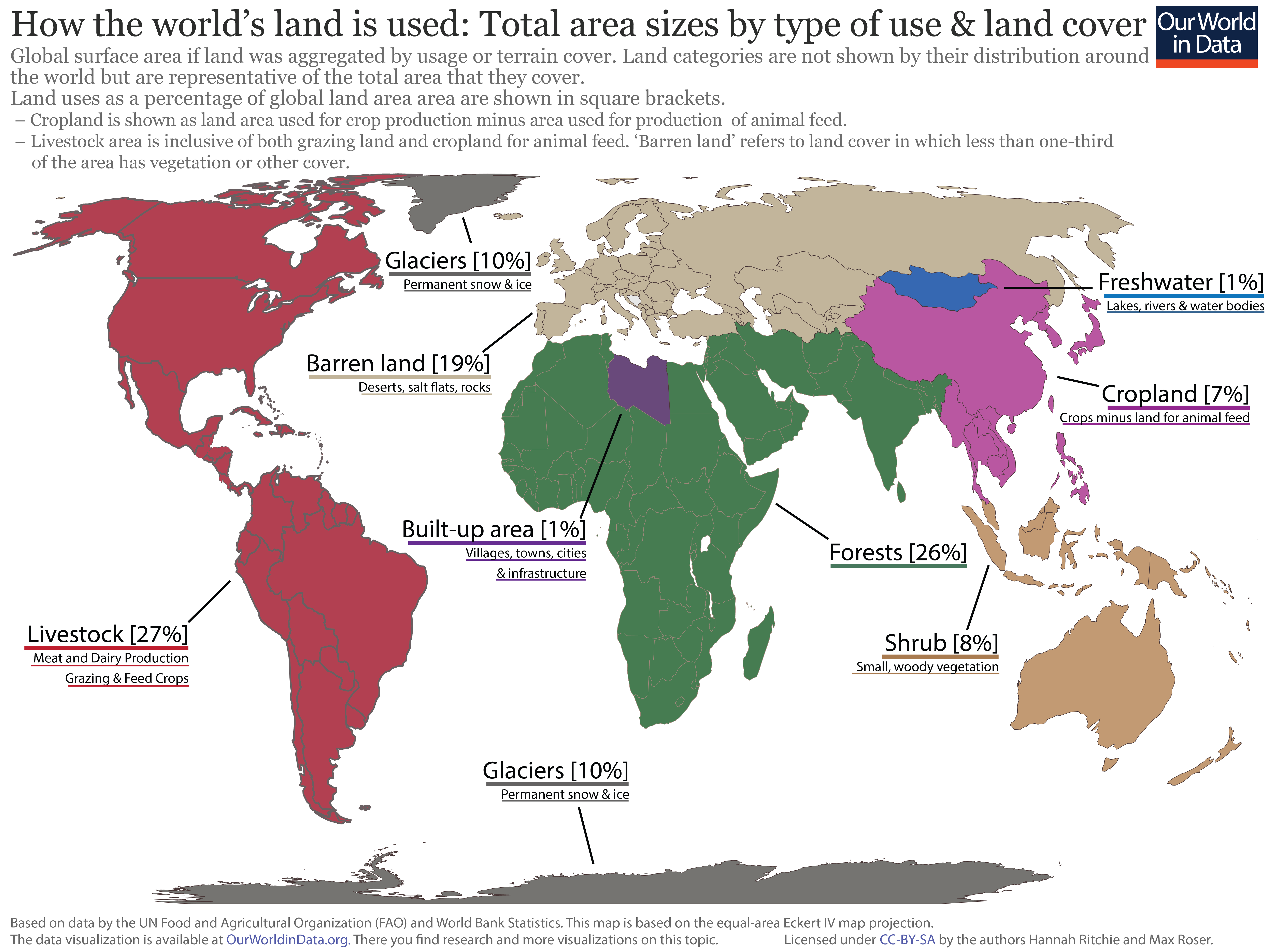
The margins in most farming are razor thin. Our neighbors who grow conventionally spend tons on inputs like fertilizer, for a shockingly small amount of money [in return per acre]. A year of extreme weather – more and more common – throws the whole thing out the window.
People say they want organic, but then they balk at the price without realizing how much labor goes into it when you're not just spraying to control weeds (or, more shockingly, to stop growth on your food crop at just the right time).
All of that said, a lot of the negativity directed toward anyone who has the dream of growing their own food is often coming from a conventional mindset. There are alternative approaches. A few great books are "Permaculture" by Mollison, "One Straw Revolution" by Fukuoka, "Restoration Agriculture" by Shephard.
As I mentioned elsewhere in the thread, it doesn't have to be all-or-nothing – you can start with some perennial herbs on your balcony. Larger scale, I'm an advocate for things like agroforestry practices, becoming more and more interested in agrivoltaics. You can go a very long way with a few dwarf fruit and nut trees, an understory of berries, and a few raised beds managed with no-dig methods.
If nothing else, you learn first-hand the challenges (and joys) of growing food, become more connected to the world that sustains us, and maybe gain a better appreciation for the people who work really hard for very thin margins to keep us all fed.