Humans are driving one million species to extinction - United Nations-backed report finds that agriculture is one of the biggest threats to Earth’s ecosystems
We should reforest most of that land. It was previously mostly forested anyway, and doing so, together with a rapid phase-out of fossil fuels, would enable us to store enough carbon to halt global warming, restore biodiversity, and repair the water cycle to prevent droughts.
What do you mean by empty? Have you ever flown in an airplane? I just mean there's lots of undeveloped land. Perhaps I'm a bit biased by my daily surroundings the state of Georgia is almost 2/3rds forested. Almost all of which was previously clear cut agricultural land, but I've flown all over and it's pretty empty in a lot of areas.
To steel man a bit here, grazing isn't necessarily a win for biodiversity and then there is all of the land that used to produce supplemental feed. Its a set of problems worth considering, even as I disagree with the myopia of the link riddled comment above.
Why is endless growth desirable? Why not quality over quantity, allowing for higher quality food supply instead of mass production of with unhealthy trade-offs?
Because the world population is growing, whether we want it to or not, and I'd prefer we feed everyone than not. So we're gonna need to keep food output growing.
A global shift towards healthy and more plant-based diets, halving food loss and waste, and improving farming practices and technologies are required to feed 10 billion people sustainably by 2050, a new study finds.
Developed countries have dwindling population (well, at least exclusing immigration). And I think it's safe to assume when other countries catch up similar thing will happen, at the very least to the point of levelling up. Hell even India, the biggest country by number of people, is already at 2.0
We don't need to feed more, we just need to bring the education and standard of living if the world up. And maybe figure out how to make the people in developed countries to have sustainable birth rate...
You could boil all of this down to the fact that our current best effort at feeding 9 billion people has a lot of unfortunate externalities. If your proposal is to revert back to high land and labor input methods, then maybe it would make a difference insofar as a few billion people would probably starve. For my part, I'd prefer we try innovating our way through it.
No. Just reduce your meat consumption to about 1kg per month or less. You can still enjoy a really good steak from times to times and you reduce your load on the ecosystem massively.
That's quite the presumption about MY consumption. Moreover the word "just" is doing a lot of work here.
I'm responding primarily to the overall land use picture here. Agriculture even as efficiently as we're doing it now takes a lot of space, even removing most meat from the equation.
A global shift towards healthy and more plant-based diets, halving food loss and waste, and improving farming practices and technologies are required to feed 10 billion people sustainably by 2050, a new study finds.
> If your proposal is to revert back to high land and labor input methods, then maybe it would make a difference insofar as a few billion people would probably starve.
Not necessarily. The crop lands we already have would be sufficient to feed the whole population.
Sustainable and regenerative agriculture is entirely possible. You may want to explore practices such as natural, syntropic, permaculture, and agroforestry farming, to name just a few. While it may require more knowledge and labor, advancements in technology and automation could potentially mean only a slight increase in the workforce, from around 2% to maybe upto 4%.
The benefits would be enormous. And with 40-70% of jobs being bullshit jobs I'm not even afraid we would fill those positions. It's just a matter of regulation and preferences.
> For my part, I'd prefer we try innovating our way through it.
Plant-based diets are an innovation. Restorative agriculture would require new machinery, agroforestry, smaller fields instead of vast monocultures, the incorporation of companion/nitrogen-fixing plants and compost instead of artificial fertilizers, among other changes. Many things would need to change.
> I'm responding primarily to the overall land use picture here. Agriculture even as efficiently as we're doing it now takes a lot of space, even removing most meat from the equation.
Animal ag. brings just 18% of calories and 36% of proteins, while destroying and polluting so much. We should dedicate the land to forests (carbon sequestration) and to the restoration of biodiversity.
My whole point and I discussed this up thread is that things like restorative agriculture and agroforestry require a fuck-ton more human labor.
> The benefits would be enormous. And with 40-70% of jobs being bullshit jobs I'm not even afraid we would fill those positions. It's just a matter of regulation and preferences.
This is total nonsense. When most people worked on farms, food comprised more than 30% of peoples' budgets. The idea that we could have a modern society with 40-70% of people shifting to agricultural labor is on its face ridiculous. You're making a utopian argument here and hand waving away the real problems involved in sending so many people back to agriculture.
> Plant-based diets are an innovation
Nowhere am I arguing against plant-based diets. You're arguing against a straw man. I'm also not anywhere here or at any point saying that the status quo of human calorie composition is ideal. I said that as it stands, our best effort to date to feed 8+ billion people has AT PRESENT negative externalities. I agree that problems are worth addressing, and you seem to be dead set on having an argument with me about something I'm not saying.
> the idea that we could have a modern society with 40-70% of people shifting to agricultural labor is on its face ridiculous
I never said we'd need 40-70% of people in the agriculture. I've talked about the possibility of the increase upto aproximately 4% , with a pool of 40-70% people to choose from. Is it clearer now?
> you seem to be dead set on having an argument with me about something I'm not saying
Ditto :)
> If your proposal is to revert back to high land and labor input methods, then maybe it would make a difference insofar as a few billion people would probably starve. For my part, I'd prefer we try innovating our way through it.
This has triggered my response. I can't agree with that at all.
There's no need to revert to high land and labor input methods. I'll simplify a lot. We could grow more veggies and fruit, plant more nut orchards to replace milk, grow more legumes to replace meat, on smaller fields separated with rows of productive and nitrogen fixing trees (agroforesty) and reforest more lands to let biodiversity rebound and work with it, not against it ... nothing that is particulary hard and nothing of that means that billions would have to die. It would need new (smaller) electric machines and more workers, but maybe 1-2 times more, not 20 times more.
> I never said we'd need 40-70% of people in the agriculture.
> with a pool of 40-70% people to choose from
> There's no need to revert to high land and labor input methods.
> We could
> It would need new (smaller) electric machines and more workers, but maybe 1-2 times more,
This is all very squishy and utopian. I just don't see a practical proposal here. You're talking about completely reworking agriculture with no viable path to providing sufficient calories at a cost that developing nations can bare. We can see the recent debacle in Sri Lanka as a cautionary tale of what can happen if you try to force such a change. On a more personal note I've seen a lot of people try to spin up hobby farms using "restorative" practices and they're producing relatively little food, using unpaid interns, still having to charge 4x grocery store price for worse food, and havign to rely on government handouts to even do that.
Sustainable and regenerative agriculture is entirely possible. You may want to explore practices such as natural, syntropic, permaculture, and agroforestry farming, to name just a few. While it may require more knowledge and labor, advancements in technology and automation could potentially mean only a slight increase in the workforce, from around 2% to maybe upto 4%.
> We can see the recent debacle in Sri Lanka as a cautionary tale of what can happen if you try to force such a change
Without a transition period, education, or support, it was poised to end up badly.
> hobby farms using "restorative" practices and they're producing relatively little food
Again, take a look into syntropic agriculture (Ernst Gotsch) and natural (or 'do-nothing') farming (Masanobu Fukuoka). Their yields are comparable to or better than those of their traditional counterparts, all while repairing the soil and without using any external inputs (thus saving significant costs).


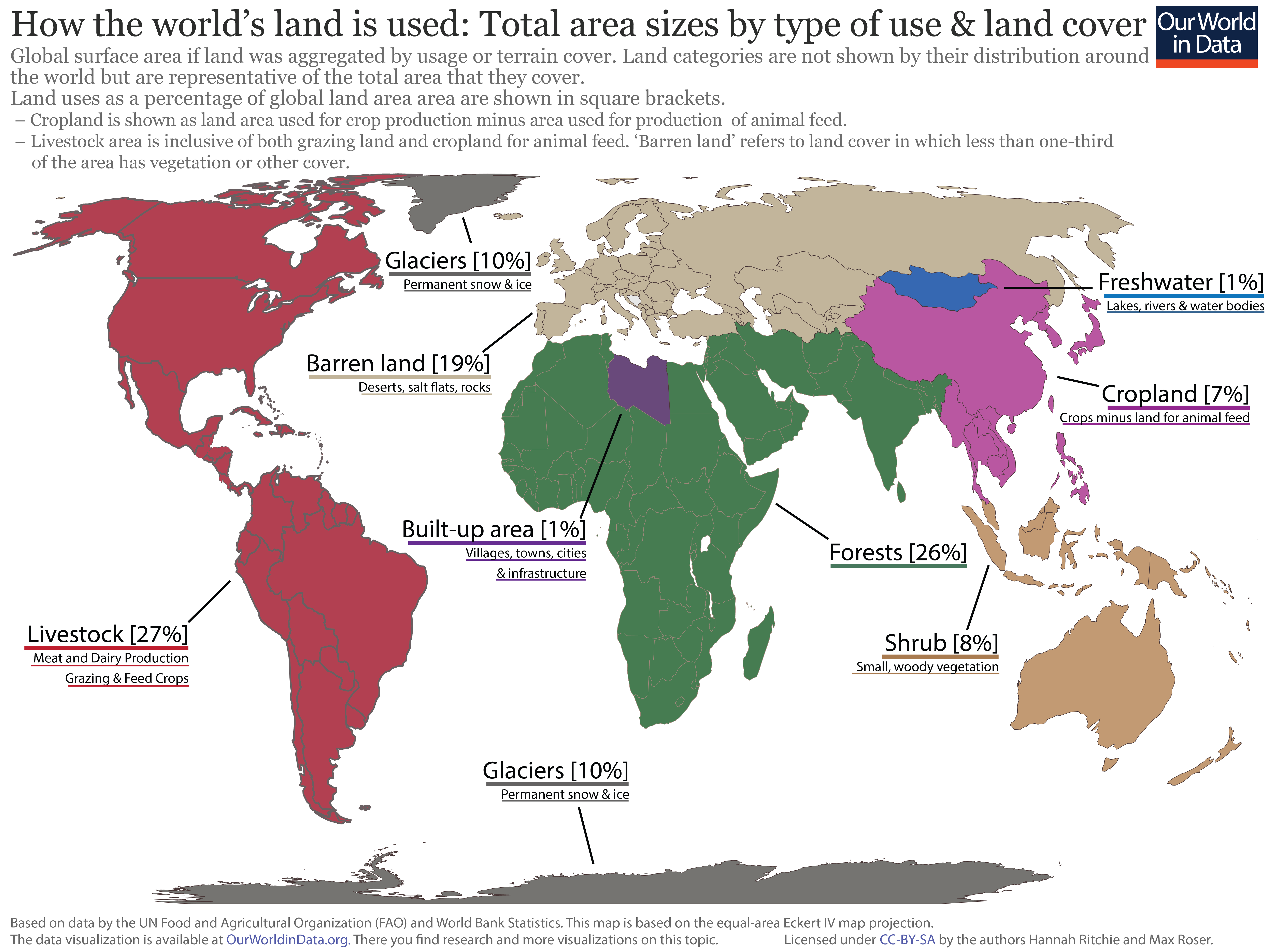
Agriculture production as a major driver of the Earth system exceeding planetary boundaries
https://www.researchgate.net/publication/320356605_Agricultu...
Our global food system is the primary driver of biodiversity loss
https://www.unep.org/news-and-stories/press-release/our-glob...
Biodiversity conservation: The key is reducing meat consumption
https://pubmed.ncbi.nlm.nih.gov/26231772/
Humans are driving one million species to extinction - United Nations-backed report finds that agriculture is one of the biggest threats to Earth’s ecosystems
https://www.nature.com/articles/d41586-019-01448-4